
Make Texture a preferred source on Google to support us
Add Texture to GoogleFor a long time, the idea of stepping into an official store to buy a pre-owned watch was considered an oxymoron in the watchmaking world. The pre-owned market was the exclusive domain of shady dealers, specialized platforms, or savvy collectors capable of spotting an authentic piece beneath a faded bezel. But in 2026, the landscape has changed radically. What was still just a bold experiment in late 2022 has become the industry’s most remarkable growth driver. The official certification program for pre-owned watches launched by the Geneva-based manufacturer—the famous RCPO—is no longer merely a formality: it is redefining the rules of desire and value.
The figures point to a profound transformation. In the first six months of 2026, sales of Rolex-certified watches surged by 101% compared to the previous year. With revenue now reaching $385 million in a single half-year, the “official” secondary market is emerging from its niche to become an economic pillar. This explosion cannot be explained solely by the desire to wear a Rolex on one’s wrist, but rather by a psychological shift among buyers. Trust, once a rare commodity in the pre-owned market, has become a luxury in and of itself.
The Emergence of a New Type of Collector
In the hushed showrooms of authorized dealers, such as those of the 1916 Company, a scene once unthinkable is now playing out: customers who, until recently, swore they would never buy a pre-owned watch, are leaving with models produced ten or twenty years ago. The assurance provided by the manufacturer’s seal has broken down the last barriers. John Shmerler, head of this major watch retail company, notes that acceptance of the RCPO program is growing at a breakneck pace. For many, the international warranty and the certainty that every internal component has been inspected and approved in Geneva are worth far more than the smell of a brand-new watch.
This momentum is particularly evident at traveling events that crisscross the United States, from Manhattan Beach to Baltimore or Philadelphia. There, one encounters reassured newcomers and veterans in search of pieces that are no longer available in the catalog. For that is the real crux of the matter: the program doesn’t just offer watches; it provides exclusive access to the brand’s history. Demand centers on models that are no longer in production, bridging the gap between the manufacturer’s glorious past and the demands of modern comfort.
The Hunt for Discontinued Models
The brand’s current catalog may well be one of the most coveted in the world, but it cannot satisfy the fantasy of the “birth year watch” or the quest for a bygone aesthetic. Buyers are flocking to professional models that have been discontinued. A 1987 Submariner, for example, becomes a prized find for anyone looking to mark a personal anniversary. In this treasure hunt, the certification program serves as the ultimate arbiter.
Even more fascinating is the craze for pieces that have passed through the Geneva Restoration Workshop. These historic models, some dating back several decades, return to the market with their technical integrity restored. At recent presentations, exceptional pieces have captured everyone’s attention: a 1992 yellow gold Day-Date 36 featuring a red enamel “sector” dial set with diamonds, offered at nearly $129,000, and a 1942 chronograph with a deep black dial. Also on display was a 1998 Daytona, equipped with the legendary Zenith movement, whose diamond-set dial and emerald hour markers carried a price tag of $350,000. These watches are no longer mere instruments for measuring time; they have become artifacts whose authenticity is now “blessed” by the source itself.
The Price of Peace of Mind: Understanding the RCPO Premium
However, this peace of mind comes at a cost—and it is far from negligible. Purchasing a watch through the certified channel involves paying a substantial premium compared to the traditional pre-owned market, which is not supervised by the brand. This price difference, which covers service fees, a two-year warranty, and formal authentication, varies by retailer. It generally ranges from 12% to nearly 32%, depending on the retailer and region. While the most seasoned collectors, accustomed to navigating the pitfalls of the gray market, sometimes shy away from these high prices, new customers view them as an investment in security.

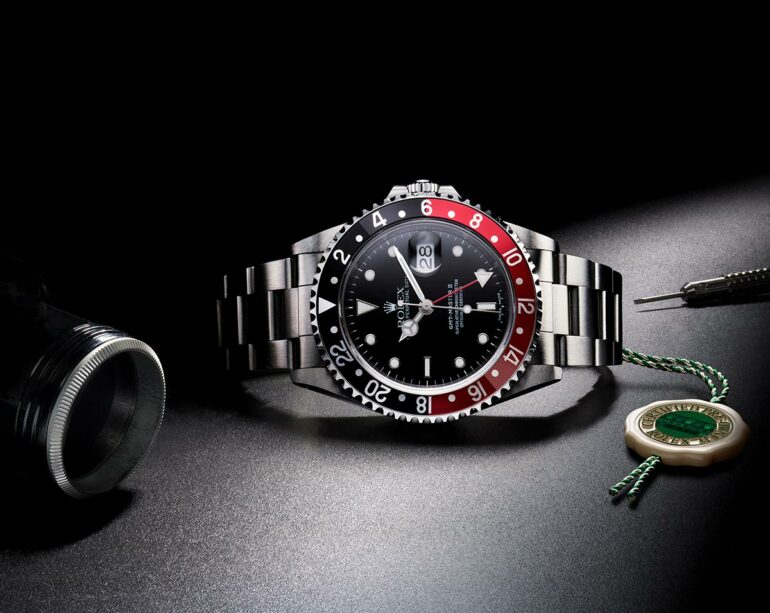
This phenomenon is amplified by the brand’s exceptional ability to retain its value. Approximately 75.8% of models sell for more than their original retail price—an all-time record in the industry. The market also reacts strongly to announcements of model discontinuations. This is what experts call the “Pepsi effect”: since the GMT-Master II model with the blue-and-red bezel was discontinued earlier this year, sales of this model on the secondary market have surged by 60%. The certified program thus becomes the only way to acquire these iconic watches with absolute certainty of authenticity.
A generational shift and a maturing market
While the brand’s dominance remains unchallenged, the internal dynamics of the pre-owned market are showing signs of maturity. Analysts at the Chrono24 platform have observed a decline in Rolex’s relative share of global transactions. After peaking during the pandemic—accounting for up to 44% of all transactions—the brand has returned to more stable levels, hovering around 30%. This rebalancing benefits other brands such as Omega and Patek Philippe, but above all, it reveals a shift in behavior among those under 30.
This younger generation of collectors, which had fueled the speculative frenzy of recent years, now appears to be broadening its horizons. Less focused on the flashy “sport” models that fueled the media hype, these buyers are turning to more formal classics, such as the Datejust, or to the French elegance of Cartier. The market isn’t collapsing—it’s settling down. Prices have stabilized at a level about 55% higher than in 2019, a sign that the bubble has given way to a solid foundation.
In short, the success of the certified pre-owned program marks the end of the era of improvisation in the watch industry. By institutionalizing the pre-owned market, Rolex has not only tapped into a new source of revenue; it has transformed the secondary market into a natural and prestigious extension of its sales network. The message sent to the world is clear: a luxury watch never dies; it simply changes wrists, under the watchful eye of those who created it. Unbridled speculation gives way to a more serene form of collecting, where a model’s rarity is no longer marred by doubts about its origin.