
Make Texture a preferred source on Google to support us
Add Texture to GoogleThe announcement was made by his son, Adam Max, two days after his death. Peter Max, born Peter Max Finkelstein, passed away on September 14, 2026, at a hospital in Manhattan, New York. At the age of 88, the man who was the visual architect of American counterculture leaves behind a body of work in which fluorescent colors and cosmic lines have come to saturate the collective imagination. His passing closes the chapter on an aesthetic that—from the Summer of Love to presidential campaigns—transformed psychedelia into a global consumer product.
The Odyssey of a Child in Exile
Nothing predestined the child born in Berlin on October 19, 1937, to become America’s chromatic herald. Born into a Jewish family, Peter Max fled Nazi Germany with his parents, Salla and Jakob Finkelstein, in 1938. This departure marked the beginning of a geographical odyssey that would shape his visual world. The family first settled in Shanghai, China, where they lived for a decade. In 1948, they moved to Haifa, Israel, before stopping in Paris and finally settling in Brooklyn in 1953. This unique migratory journey culminated in his academic training at the Art Students League of New York, the technical foundation upon which he would build his graphic empire.
The Aesthetics of Ubiquity: From Flower Power to the Boeing 777
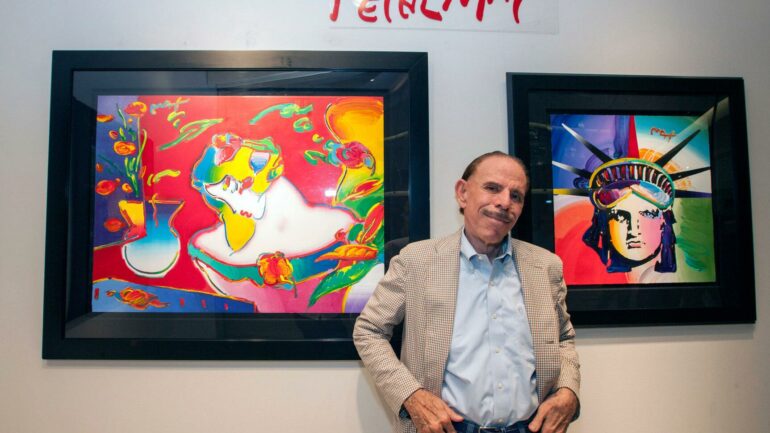
Peter Max’s style is a crossroads. It combines the raw energy of Pop Art, the sinuous lines of Art Nouveau, the optical illusions of Op Art, and, of course, the effervescence of psychedelia. His tools are instantly recognizable: “Day-Glo” (fluorescent) hues, rainbows, stars, and dreamlike silhouettes. In 1967, his appearance on The Ed Sullivan Show left a lasting impression: he drew live on the show, using both hands simultaneously to create perfectly symmetrical images. Two years later, he graced the cover of *Life* magazine, cementing his status as a visual symbol of the Flower Power movement and the cultural revolution of the 1960s.
His strength lies in his ability to bring art into the streets and onto unexpected surfaces. Peter Max does not limit himself to gallery walls. He takes over public and commercial spaces with rare enthusiasm. In 1974, he created murals for more than 200 U.S. border crossings. Later, he painted a Boeing 777 for Continental Airlines in 2000 and designed a monumental mural on the hull of the cruise ship Norwegian Breakaway in 2013. His work appears on stamps, posters, clocks, and even on the cover of the Manhattan Yellow Pages. This ubiquity was confirmed by a 2000 Washington Post report: at the time, he was the second-best-selling item on eBay, just behind Beanie Babies.
The Artist of the Powerful and Major Events
Alongside his popular success, Peter Max became an institutional figure. Between 1981 and 1986, he created a series of portraits for the restoration of the Statue of Liberty. In 1993, he marked Bill Clinton’s rise to power with his installation “100 Clintons.” He was named the official artist for major global events: the 1994 World Cup, the 1999 Woodstock Festival, several Super Bowls, the World Series, the Indianapolis 500, and the Grammy Awards. He also collaborated with the U.S. team at the 2006 Winter Olympics.
Peter Max’s studio has also become a must-visit destination for celebrities. He has immortalized the faces of Paul McCartney, Taylor Swift, Barack Obama, Princess Diana, and Shaquille O’Neal in his vibrantly colored portraits. Each work he produced strengthened the link between his name and the world’s cultural and political elite, making him a modern-day court portraitist.
The Shadows of a Turbulent Final Chapter
Behind the brilliance of primary colors, the artist’s career was marked by periods of legal and personal turmoil. In 1997, he pleaded guilty to tax evasion for concealing $1.1 million in income between 1986 and 1992. His sentence consisted of a period of day release supplemented by community service working with children. More recently, between 2015 and 2019, his name appeared in media reports, notably an investigation by The New York Times, detailing legal battles between his children, Adam and Libra. Allegations emerged claiming that assistants were creating works sold under his name while he was suffering from advanced dementia. Alzheimer’s disease, diagnosed several years earlier, had gradually kept the artist from his paintbrushes. This dark period was marked by the suicide of his second wife, Mary Balkin Max, in 2019.
The Art Market and the Max Legacy
At the time of his death, the artist’s market value remained stable, though segmented due to the nature of his massive output. Estimates from September 2026 place prints and works on paper between $500 and $800 (approximately €450 to €720). In contrast, for original paintings with certified authenticity, prices range from $10,000 to $20,000 (approximately €8,900 to €17,800). These figures reflect the artist’s intention to make his work accessible, while still maintaining collectible value for his unique pieces.
To further explore his world and browse the archives of his work, the official website petermax.com remains the go-to resource. The family has not officially disclosed the specific cause of death, although his fragile health due to his neurodegenerative condition was public knowledge.