
Make Texture a preferred source on Google to support us
Add Texture to GoogleAvenida Paulista swelters beneath a metallic sky. Amid the constant stream of vehicles and the skyscrapers that squeeze the São Paulo skyline, a splash of color stretches out above the void. The Museu de Arte de São Paulo (MASP) does not touch the ground. It levitates, suspended from four colossal concrete pillars painted a striking red. Beneath this imposing structure, a 74-meter-long esplanade opens up to the city. The asphalt there belongs to no institution. Skateboarders make their boards clatter, street vendors set up their temporary stalls, and couples seek shelter from a fierce downpour. This raw plaza—a space viscerally wrested from real-estate greed and returned to the street—embodies the DNA of a radical vision. Achillina Bo, who became Lina by adoption, never simply designed buildings. She sculpted scenes of human life.
Brazil did not give birth to this guiding figure of its urban landscape. It absorbed her, assimilated her, and transformed her. Her story begins far from the tropics, amid the rigors of a Roman education and the rubble of World War II. After earning her degree in architecture in 1939, Lina Bo began her career in Milan, collaborating notably with Gio Ponti. She documented the destruction, witnessed bourgeois facades torn apart by bombs, and photographed the daily life of an Italy in ruins. This early intimacy with collapse would forever immunize her against architecture conceived as an untouchable monument. For her, a wall must first and foremost serve as a foundation for existence.
The Break from Exile
The turning point came in 1946. Fleeing the suffocating atmosphere of a traumatized Europe, she set sail for South America with her husband, the art critic and gallery owner Pietro Maria Bardi. Their arrival in Rio de Janeiro was a seismic shock. Facing Guanabara Bay, the blinding light and lush vegetation swept away the young woman’s European certainties. Brazil at the time was in the throes of a modernist upheaval, driven by the lyrical curves of Oscar Niemeyer and the doctrine of Lúcio Costa. Yet Lina Bo Bardi would quickly distance herself from this Rio school, which she sometimes deemed too pretentious, too disconnected from the sweat and flesh of the Brazilian people.
The couple settled in São Paulo, the frenetic industrial metropolis of the south. It was here, on the heights of the Morumbi neighborhood—then covered in tea plantations and Atlantic Forest—that she drew her first line. Completed in 1951, the Casa de Vidro (House of Glass) became the Bardis’ refuge and a personal manifesto. A transparent box, resting on slender steel stilts painted blue, seems to float above the slope. But contrary to the hygienist dogmas of the European Modern Movement, the architect did not seek to dominate the environment. She allowed it to invade the space. Seventy years later, the Mata Atlântica has literally swallowed up the structure; vines brush against the windows, and the boundary between the living room and the canopy has vanished.
Demystifying the Canvas
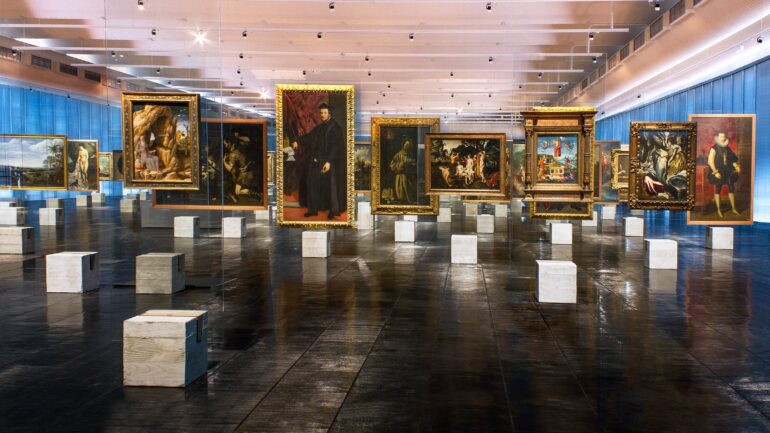
São Paulo’s cultural elite soon commissioned Pietro Maria Bardi to design a major museum. It was Lina who would conceive its setting. Construction of the MASP spanned more than a decade, from 1957 to 1968. To preserve the view of downtown from the avenue, she envisioned this dizzying prestressed concrete bridge. But the masterstroke lies not only in the feat of engineer José Carlos Figueiredo Ferraz. It bursts forth on the museum’s second floor, in the grand gallery.
There, Lina Bo Bardi dooms traditional museum design. She refuses to hang the works on the walls. Instead, she invents the “cavaletes de cristal”—easels consisting of a raw concrete base into which a sheet of tempered glass is embedded. The paintings by Goya, Rembrandt, and Renoir thus float in the middle of the room, free of imposing labels. Visitors wander among the masterpieces as if through a forest, compelled to engage their gaze directly with the painting, without the overwhelming mediation of the institution. The backs of the canvases are visible, revealing the wood, old labels, and the material reality of the object. This aesthetic gesture is eminently political: it demystifies European art to bring it within reach.
The Epiphany of Raw Earth
While São Paulo offered her a monumental scale, it was Salvador de Bahia that revealed to her the very substance of the country. In the late 1950s, she moved to the Afro-Brazilian Northeast to direct the Museum of Modern Art of Bahia. She set her sights on the Solar do Unhão, a former colonial complex on the shores of All Saints Bay, which she restored with a deliberate roughness. Gone was the smooth concrete; in its place were exposed wooden beams and lime.

It was through her immersion in Bahian culture that she shed her last academic habits. She roamed the markets, studying everyday objects made by farmers and artisans: oil lamps cobbled together from burnt-out light bulbs, benches hewn with a machete, clay pottery, and ex-votos carved from scrap wood. Lina Bo Bardi realized that true Brazilian modernity was not to be found in the imitation of Le Corbusier, but in this capacity for survival and invention with meager resources. She organized exhibitions that placed these vernacular objects on the same level as contemporary art. For her, design does not have to be luxurious; it must be vital.
The Citadel of Joy
The culmination of this philosophy took shape in the 1980s with her absolute masterpiece, a place that defies classification: the SESC Pompéia. When she was commissioned to renovate a former metal barrel factory in a working-class neighborhood of São Paulo, the developers expected her to tear it down completely to build a brand-new recreational center. The architect categorically refused.
While visiting the abandoned factory on the weekend, she noticed that local residents had begun to use the space. Children were playing soccer under the sheds, families were grilling meat there—the space was already alive. Her intervention would consist of enhancing this spontaneous use. She preserves the brick walls and the steel framework, removing unnecessary partitions. To accommodate the sports facilities that the factory cannot house, she erects two towers of exposed concrete, connected by aerial walkways that zigzag across the urban skyline. The windows are not glazed but closed off by sliding red wooden latticework, reminiscent of both Japanese architecture and indigenous huts.
Inside the renovated factory, she designed an artificial stream that winds across the concrete floor, inviting children to dip their feet in during the height of summer. She conceived a theater without a raised stage, where the audience surrounds the actors on hardwood benches. The SESC Pompéia becomes a distillation of urbanity, a factory transformed into a factory of joy. The aesthetic is stark and uncompromising, yet the result exudes an immediate human warmth.
Lina Bo Bardi’s legacy cannot be measured by the number of square meters she built. She built relatively little compared to other giants of her generation. Her legacy is of a different nature. Today, on a Tuesday afternoon at SESC Pompéia, elderly people are playing chess near the library, teenagers are stretching before a futsal match in the concrete towers, while the aroma of coffee wafts from the community cafeteria. The raw walls bear the marks of hands and the echoes of voices. The architecture has receded to make way for the flow of daily life, exactly as it was intended.