
Make Texture a preferred source on Google to support us
Add Texture to GoogleIn the traditional hierarchy of building materials, cellulose has no place. The history of architecture has been written in stone, marble, steel, and poured concrete—hard, inert materials meant to defy gravity and the passage of time. Paper, on the other hand, belongs to the realm of the ephemeral. It crumples, tears, absorbs water, and burns. It is the medium for preparatory sketches, never the final work. Yet, by repurposing simple recycled cardboard tubes, Japanese architect Shigeru Ban has overturned this age-old certainty. Where the construction industry seeks invulnerability through mass, he counters with a tectonic system based on lightness. His columns are not hewn from quarries but extruded from old paper.
This approach is not merely a designer’s whim in search of disruptive materials. Shigeru Ban’s use of cardboard tubes follows an unyielding logic where engineering meets the economy of means. Once coated with polyurethane and treated with flame retardants, these cylinders acquire unexpected structural properties. They withstand compression, resist the elements, and provide natural thermal insulation. When placed end-to-end and joined by wooden or metal joints, they form complex frameworks, domes, and vaults. The architect has transformed this industrial commonplace into a visual signature, establishing a unique aesthetic vocabulary in which the repetition of the tubes creates a gentle, almost textile-like rhythm that contrasts sharply with the coldness of contemporary buildings.
Dignity in the Face of Crisis
The turning point for this “paper architecture” did not come from a prestigious international competition, but from the mud of refugee camps. In the mid-1990s, the world witnessed the mass exodus triggered by the genocide in Rwanda. The United Nations High Commissioner for Refugees (UNHCR) provided plastic tarps and aluminum stakes. A tragic problem arose: aluminum has market value. The refugees sold the stakes to survive and cut down surrounding trees to support their shelters, accelerating disastrous deforestation. Faced with this logistical and ecological impasse, Shigeru Ban proposed a radical alternative: structures made of cardboard tubes. The material is inexpensive, can be manufactured on site with rudimentary machinery, and, most importantly, has no resale value on the black market.
The following year, in 1995, the Kobe earthquake devastated Japan. Survivors huddled in tents buffeted by the bitter winter wind. Shigeru Ban deployed his “Paper Log Houses”—emergency shelters that could be assembled in a matter of hours on foundations made of beer crates filled with sand. The walls consisted of cardboard tubes arranged vertically. The challenge here goes beyond simply providing physical shelter. It is about restoring a sense of dignity. The thick paper walls filter the light, insulate against the cold, and provide soft acoustics that contrast sharply with the clatter of the tin-roofed shelters. The architect demonstrates that urgency does not justify spatial mediocrity, and that beauty and mental comfort are not luxuries reserved for times of peace.
From Temporary Shelter to Monumentality
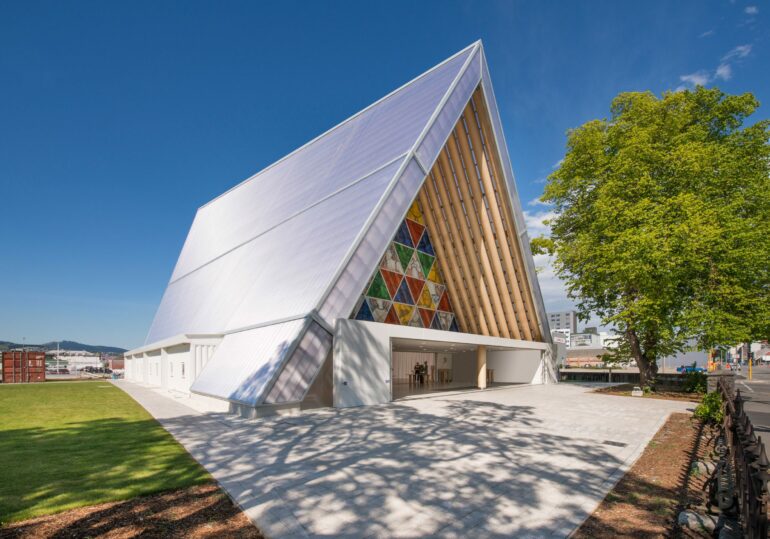
While cardboard became the material of choice in times of crisis, it quickly transcended its temporary nature to take root in public and institutional spaces. The most striking example stands in New Zealand. In 2011, the city of Christchurch was devastated by an earthquake that destroyed, among other things, its 19th-century Anglican cathedral. The community needed an immediate gathering place, long before the billions required for reconstruction in stone could be raised. Shigeru Ban then designed the cardboard cathedral.
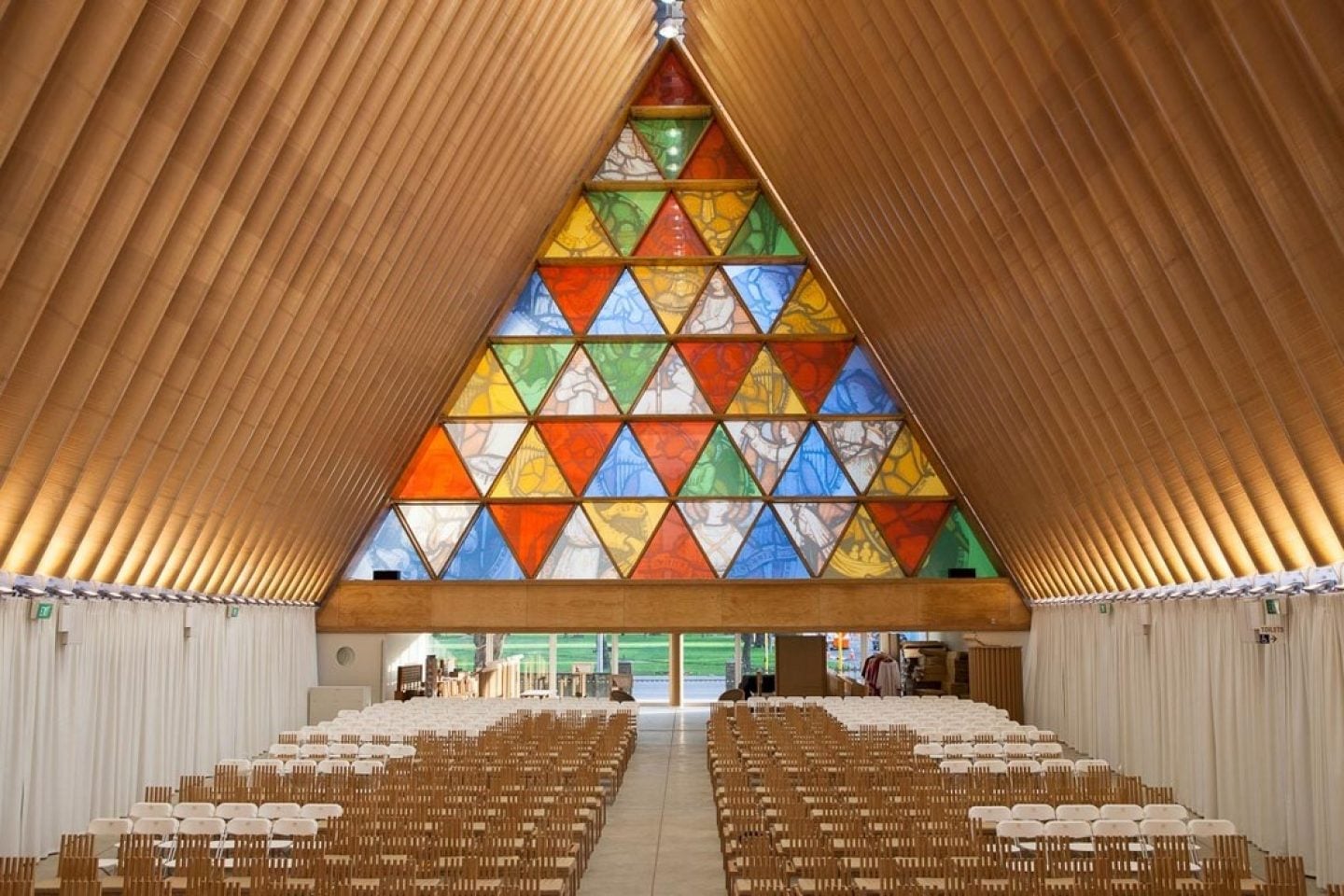
Inaugurated in 2013, this A-shaped structure rises more than twenty meters high. Ninety-six solid cardboard tubes, reinforced by laminated wood beams, make up the nave. The façade is adorned with a triangular stained-glass window made of shards of colored glass, flooding the interior with polychromatic light that reflects off the warm surface of the cardboard. Designed to last at least fifty years, this cathedral blurs the line between the temporary and the permanent. It has become a symbol of an entire city’s resilience, proving that a building made of paper can carry the symbolic and spiritual weight of a stone monument.
The Philosophy of Permanence
Shigeru Ban’s work, which was honored with the Pritzker Prize in 2014, raises a fundamental question about the very essence of architecture: what makes a building permanent? The Japanese architect’s answer is a defiant rebuke to real estate developers. In his view, permanence does not depend on the strength of the foundations. A reinforced-concrete skyscraper built solely for financial speculation will be demolished and replaced as soon as it ceases to be profitable. It is, by its very nature, ephemeral. Conversely, a paper church, if cherished by the community that uses it, will be maintained, protected, and preserved. It is human affection—not the density of the material—that anchors architecture in time.

This reversal of values challenges the ego of a profession often obsessed with posterity and the mark it leaves on the landscape. By accepting that his work can be dismantled, recycled, and returned to the earth without leaving a toxic scar, Ban offers a structural humility. His buildings do not seek to conquer nature, but to coexist with it temporarily.
The Art of Invisible Engineering
Behind the apparent simplicity of the cardboard tube lies absolute technical rigor. To gain approval for the use of this novel material from often-skeptical regulatory authorities, Shigeru Ban’s team had to conduct years of tests on strength, torsion, and load-bearing capacity. They had to invent new jointing systems and figure out how to connect wood, steel cable, and cardboard without weakening the structure as a whole. This obsession with structural detail is also evident in his more traditional projects, such as the Centre Pompidou-Metz, where the spectacular woven wooden roof draws direct inspiration from the structural logic of a woven Chinese hat.
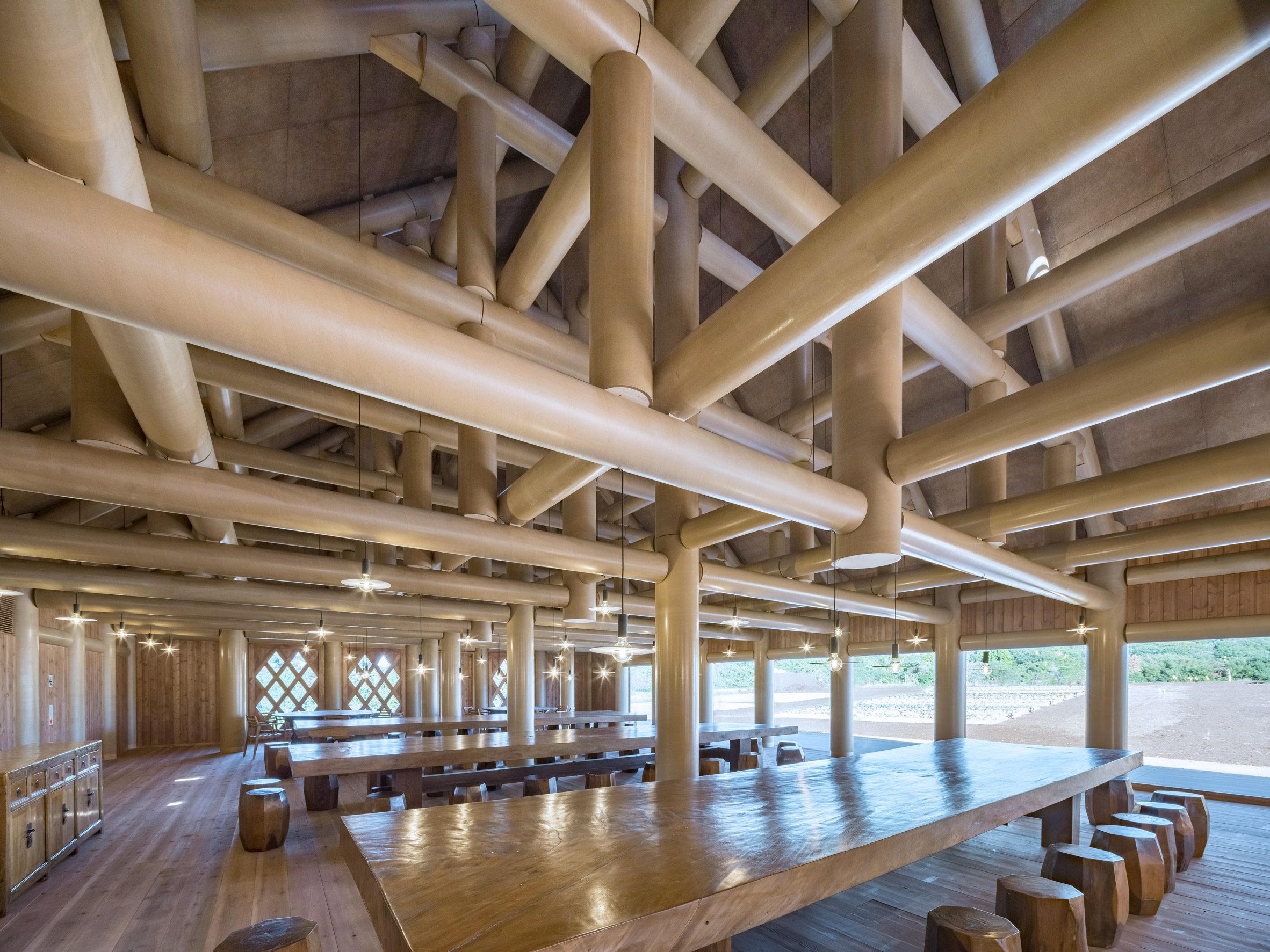
The aesthetic that emerges from this engineering is minimalist, almost ascetic. There are no suspended ceilings, no decorative cladding to hide the building’s skeleton. The structure is the decor. The exposed cardboard tubes showcase their tan color and slightly rough texture. Shadows cling to them differently than on a smooth surface, creating soft and organic interior atmospheres.
Long before environmental responsibility became an indispensable marketing pitch in the brochures of global architecture firms, Shigeru Ban was already building locally using recycled materials. His radicalism has never lain in rhetoric, but in proving his point through practice. By transforming industrial waste into load-bearing columns, he has restored the builder’s craft to its primary function: to provide intelligent shelter for people, making the most of what the immediate environment has to offer.