
Make Texture a preferred source on Google to support us
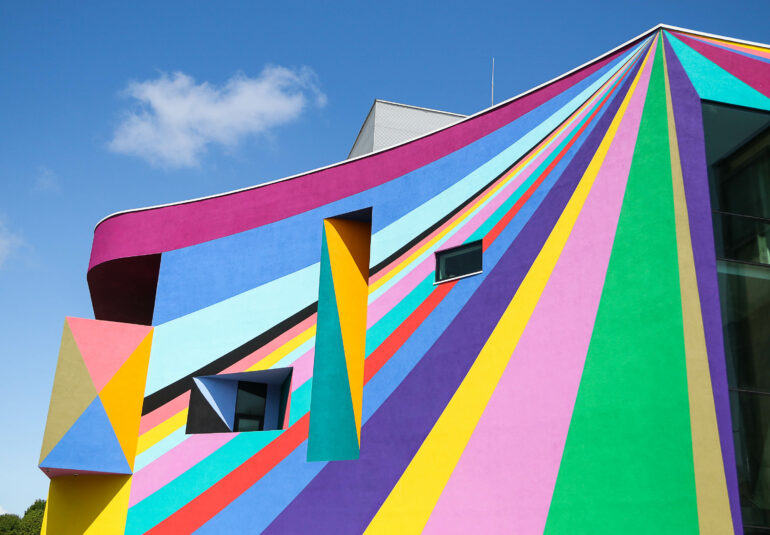
Add Texture to GoogleIn Middlesbrough, a city shaped by its industrial heritage in northeastern England, the art scene of 2026 takes on a unique character—both austere and radical. The Turner Prize Finalists exhibition, organized at the Middlesbrough Institute of Modern Art (MIMA) in partnership with Tate Britain and Teesside University, strays from the beaten path to immerse visitors in a confrontational atmosphere. Far from lighthearted celebrations, this 2026 edition stands out for its formal rigor and unapologetic darkness. Apocalyptic anxiety, mourning, the precariousness of the working class, and a condemnation of extractive policies form the foundation of this selection, which, despite its apparent harshness, stands out as one of the most powerful in recent years.
Workers’ Memory and Fragmented Identities by Simeon Barclay
Simeon Barclay’s installation at the MIMA builds upon the research he began with his performance *The Ruin*. The artist, whose nomination is based on this project—previously presented at the ICA in London and the New Art Exchange in Nottingham—explores here the complex intersections between masculinity, Black identity, and the memory of the working classes in northern England. His exhibition space combines sculptures in aluminum, bronze, and acrylic with sound and text-based environments.
The materiality of his work directly evokes the industrial world, but Barclay subverts it to question the construction of the self in an environment marked by the disappearance of traditional manual labor. His works do more than simply document a social condition; they create a psychological space where collective memory and individual trajectories collide. The use of bronze and aluminum lends the installation a physical heaviness, while the textual elements provide a narrative dimension that anchors her message in a specific geographical and historical reality.
Kira Freije’s “Metal Army” and “Fog”
The tour continues on a floor specifically dedicated to the works of Kira Freije, a layout necessitated by the technical constraints of her installation. Selected for her solo exhibition *Unspeak the Chorus*, the artist presents a theatrical sculptural installation composed of thirty-three life-size humanoid figures. These metallic silhouettes, with cast faces reminiscent of frozen masks, evoke a world situated at the intersection of cyborg and steampunk aesthetics.
The experience is above all physical: the space is saturated by a built-in misting system, creating ambient humidity that envelops the metal structures. This staging transforms the museum gallery into a place of waiting or passage, populated by silent beings whose presence is both protective and unsettling. Freije’s work focuses on this human vulnerability captured in metal—a tension between the material’s solidity and the fragility of the figures’ postures. The constant humidity alters the perception of light and space, compelling the viewer to wander slowly through this inert yet tension-filled crowd.
Marguerite Humeau and the World After Humans
Taking a more biological and speculative approach, Marguerite Humeau explores the frontiers of evolution and extinction. Selected for her project *Torches*, originally presented in Denmark and Finland, she presents biomorphic sculptural compositions at MIMA. Her work is based on a complex alchemy of natural and synthetic materials: beeswax, ancestral yeast, termite mound fungus extract, wasp venom, walnut, and bronze.
These sculptures seem to belong to a future in which humanity has given way to other forms of life or hybrid structures. The materials chosen by Humeau are not merely aesthetic vehicles; they carry within them a temporal and biological significance, such as this ancient yeast or wasp venom, which evoke cycles of life and death beyond the human scale. His forms, at once organic and strange, question our place in the ecosystem and the persistence of life after catastrophe. The precision of the execution contrasts with the wild and unpredictable nature of the substances used, creating a work that seems to be in constant metamorphosis.
Tanoa Sasraku and the Critique of Extractivism
Tanoa Sasraku presents what is arguably the most direct intervention in the exhibition. Her installation, titled *Morale Patch / Watchlist*, immediately engages the sense of smell. The floor of her space is covered with rubber, whose pungent odor hits visitors as soon as they enter. Industrial paperweights are arranged on this floor, each embedded with crude oil.
The political dimension of the work is explicit. Sasraku denounces fossil fuel extractivism and the geopolitical predation that stems from it. By using actual crude oil, she highlights the material reality of energy and its environmental cost. The formal simplicity of the installation—the dark floor, the repurposed office objects—reinforces the power of the message. It is no longer a matter of representing the disaster, but of making it physically present through the smell and sight of this black substance that has shaped modern history while threatening its future. This work builds on her recent projects at the ICA in London, confirming her ability to link global issues with radical artistic experimentation.
Middlesbrough, the scene of an anticipated verdict
The choice of MIMA as the host of the 2026 Turner Prize is no coincidence. The themes addressed by the four finalists—deindustrialization, resource extraction, the evolution of species, and working-class memory—resonate powerfully in this region of the Tees Valley. The exhibition, which is free with reservations through March 29, 2027, places Middlesbrough at the center of the international art scene for several months.
The total prize money amounts to 55,000 pounds sterling (approximately 65,500 euros). The winner will receive 25,000 pounds, while each of the three other finalists will be awarded 10,000 pounds. This financial support underscores the importance of this prize, which continues—despite criticism and changing times—to shape the contours of contemporary British art. The winner will be announced on December 10, 2026, during an official ceremony held at the museum itself, thus bringing to a close this edition, which has been marked by raw sincerity and renewed artistic power.