
Make Texture a preferred source on Google to support us
Add Texture to GoogleAn everyday watch doesn’t need to be the star of a catalog. Above all, it must withstand subway doors, shirt cuffs, unexpected trips, and dinners where you’d rather forget you’re even wearing a watch. This is precisely the niche targeted by the Continental, Héron’s third permanent collection: a compact mechanical timepiece designed to transition seamlessly from urban use to a more mobile lifestyle without losing its character.
With its 37 mm diameter, it might at first glance be classified as a dress watch. But that would be to overlook what lies behind its slim silhouette. The Continental embraces a more pragmatic, almost contradictory approach: the understated elegance of a city watch, combined with the durability of a timepiece meant to be worn without excessive care.
Discretion as a Design Choice
At a time when generous proportions remain the norm in sports watchmaking, Héron has opted for a more restrained design. The Continental’s case measures 11 mm thick in total, including the crystal, and only 8.5 mm to the bezel. This size ensures a presence on the wrist that never tries to dominate. The watch slips easily under a sleeve and retains a certain visual cleanliness, even with its metal bracelet.
The design incorporates the tonneau shape previously explored by the brand’s Mirabel GMT. Its lines flow seamlessly between the bracelet links, with no abrupt break between the case and the lugs. However, the Continental forgoes the most decorative details in favor of a more functional design. The crown, in particular, features a understated shape, with a fluted side designed for a secure grip.
This understated design does not equate to fragility. The case is made of hardened stainless steel. The brushed surfaces reach 1,200 HV on the Vickers scale, while the polished areas register 800 HV. In practice, this process significantly increases scratch resistance compared to untreated stainless steel, with a level reported to be more than double. A concrete selling point for a watch destined to find its way onto coffee tables, into luggage, and onto desks rather than remaining in a jewelry box.
Water resistance of 100 meters—or 10 bar—confirms this deliberate balance between slimness and ruggedness. Where many slim watches are limited to 30 or 50 meters of water resistance, Héron equips the Continental with a screw-down crown and a more practical water resistance rating. It does not present itself as a diver’s watch—a role filled in the lineup by the Marinor—but it defies the usual constraints of a dress watch.
A Dial Designed for Low Light
The key difference from the Mirabel GMT lies in the dial. Héron has opted for a “sandwich” construction, a solution inherited from the world of tool watches. The principle is simple in concept but more elaborate in execution: the hour markers are neither painted nor applied to a single surface. They appear through cutouts in an upper plate.
Beneath this lies a luminescent layer, which in turn rests on a solid base. This layered architecture ensures that each hour marker is composed of luminescent material across its entire visible surface. This enhances nighttime readability without turning the dial into a technical showcase. It is a method notably associated with Panerai and more recently adopted by Formex, but here it takes on a more urban flair thanks to the slim case and the color scheme.
This choice of dial best illustrates the Continental’s positioning. The watch doesn’t try to pose as an extreme professional instrument. Instead, it borrows elements from the design language of tool watches that genuinely enhance usability: legible markers and a construction that remains effective as light fades.
Three Color Palettes, Three Personalities
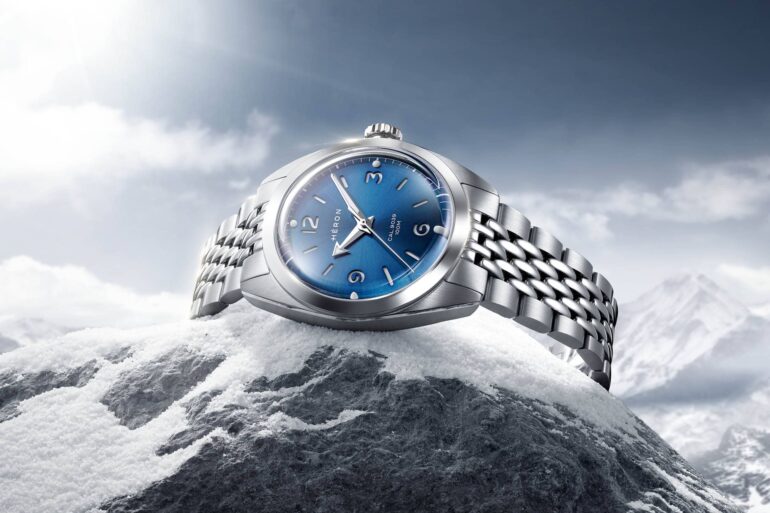
The collection features three models, each of which significantly alters the perception of the same design. The 5001-A features a black sunburst dial; the 5002-A, a blue sunburst dial; and the 5003-A, a cream-colored lacquered dial. The black and cream versions feature orange luminescent accents at the four cardinal points, while the blue version opts for white markers.
The black model is the most straightforward. Its contrast and orange accents reinforce its sporty character without resorting to the aggressive design language often associated with contemporary sports watches. The blue model appears more open and less austere, enhanced by the shifting effect of its sunburst dial. It is the one that best highlights the Continental’s travel-oriented nature—not through a GMT complication or a dedicated function, but through its ease in transitioning from one setting to another.
Finally, the cream version shifts the watch toward a neo-retro aesthetic. Its sandwich dial features brown luminescence reminiscent of the so-called “old radium” hues. The result does not seek to mimic an antique piece: the hardened case, water resistance, and automatic movement immediately ground the watch in the present. Rather, this version plays on the contrast between a nostalgic color and a contemporary design.
The Bracelet as an Everyday Feature
The seven-row steel bracelet, with a rice-grain pattern, deserves special attention. Often, this design offers appreciable flexibility but can seem overly decorative on a utilitarian-inspired watch. Here, it serves as a bridge between the model’s two design goals. Its links follow the curves of the wrist and visually lighten the case, while avoiding the austerity of a bulkier three-link bracelet.

The folding clasp makes it easy to put on and take off, while the quick-change system allows the wearer to switch out the bracelet without tools. Héron does not specify alternative bracelet options in the available information, but this feature clearly positions the Continental as a flexible timepiece. An everyday watch should adapt to the wearer, not impose a uniform on them.
This focus on practicality sets the Continental apart from timepieces that rely solely on a single feat, such as extreme diving depth or record-breaking battery life. Here, every element addresses a familiar situation: a reasonable size, a surface that’s more resistant to scratches, water resistance that doesn’t restrict daily life, and readability taken seriously.
A Japanese movement, proudly showcased
On the back, a transparent caseback reveals the Miyota 9039 automatic caliber. Its rotor is decorated with a snowflake motif, a detail visible through the sapphire crystal caseback. This third-party movement operates at 28,800 vibrations per hour (4 Hz) and offers a 42-hour power reserve. Its stated accuracy ranges from -10 to +30 seconds per day.
The choice of the Miyota 9039 is consistent with the watch’s proportions. This caliber is renowned for its slim profile despite its automatic winding mechanism, a feature that keeps the Continental’s thickness at 11 mm. Héron therefore opts for a well-known movement, suited to the model’s purpose, rather than a spectacular mechanical movement that would have added weight to the case or driven up its price.
The display is limited to hours, minutes, and seconds. This simplicity is not a shortcoming: it makes the dial more legible and avoids contradicting the watch’s original concept—that of an object that accompanies the wearer without demanding attention.
A Clear Pricing Equation
Priced at 470 British pounds—approximately $630—the Héron Continental falls into a price range where the overall coherence of the watch matters more than a litany of features. It features hardened steel, 100-meter water resistance, a luminescent sandwich dial, a quick-change bracelet, and an automatic movement—without trying to compensate for the lack of complications with grandiose claims.
The Continental is not intended to replace a dive watch or imitate a formal timepiece. It strikes the right balance between these two worlds: slim enough not to detract from a dressy outfit, yet well-equipped enough to stay on your wrist when plans take an unexpected turn. The three models—5001-A, 5002-A, and 5003-A—can be explored on the Héron website.