
Make Texture a preferred source on Google to support us
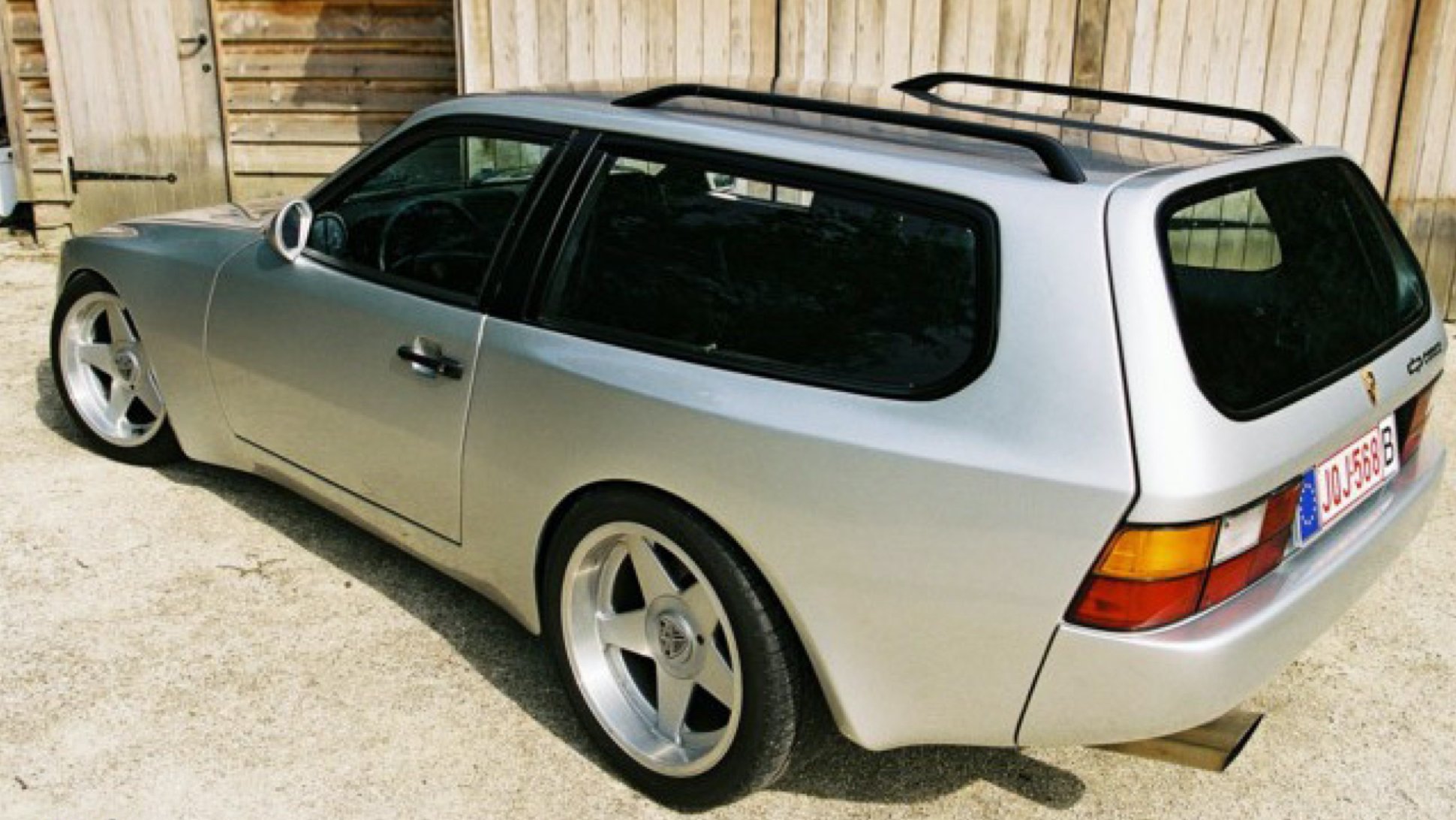
Add Texture to GoogleIn the mid-1980s, Andreas Freund drove a Porsche 924 converted into a station wagon every day. It was a rare find, coming from the workshops of Günter Artz, a body shop owner and car dealer in Hanover. The car eventually disappeared, its parts scattered at an auction in Paris. For decades, Freund searched for another one. Without success. So he ended up doing what people in the trade do when the market doesn’t give them what they want: he built it himself, on a different chassis, forty years later. It’s called the GT-K44, it’s green, and it was unveiled to the public on Saturday, September 19, at the Nürburgring.
A Sketch Given as a Birthday Gift
The project didn’t stem from market research but from a gift. In early 2022, independent automotive designer Michael Söhngen, a longtime friend of Freund’s, gave him a drawing for his birthday: a Porsche 944 reimagined as a shooting brake, painted green. The sketch hit the mark. It brought the long-lost 924 back to life and gave Freund, founder and CEO of CarPoint GmbH, a reason to take action.
He’s no amateur. Based in Karlsruhe, in Baden-Württemberg, his company specializes in restoring Porsches and remanufacturing parts for these models. In other words, the expertise needed to cut out a roof and reshape a rear end was already in the workshop. All that was missing was the inspiration—and the sketch provided it.
The chosen name reads like a condensed technical specification sheet. “GT” stands for Gran Turismo, “K” for Kombi—the German term for a station wagon—and “44” is a nod to the 944, which serves as the base model. No poetic references, no marketing gimmicks: just an engineer’s nomenclature.
The Artz Legacy
To understand the GT-K44, we must go back to its predecessor. In the early 1980s, Günter Artz designed and built a station wagon based on the 924 Turbo. The idea of a Porsche with a vertical tailgate, capable of carrying more than just two suitcases, was considered a novelty at the time. Production remained limited: estimates generally put the number at around twenty units—a figure passed down through the memories of enthusiasts and specialized archives, but one that no audited production records confirm. The uncertainty is part of the legend.
Freund does not replicate Artz’s 924. Instead, he adapts the concept to the 944, its direct descendant, which shares the so-called transaxle architecture: front-mounted engine, transmission mounted on the rear axle, and rear-wheel drive. A logical choice, and not just because of the similarity in their silhouettes. The unveiling at the Nürburgring, in fact, took place as part of a gathering dedicated specifically to Porsche transaxle models, organized during the ADAC 1,000 km race weekend. The newcomer was unveiled to the audience best qualified to judge it.
Steel, Not Plastic
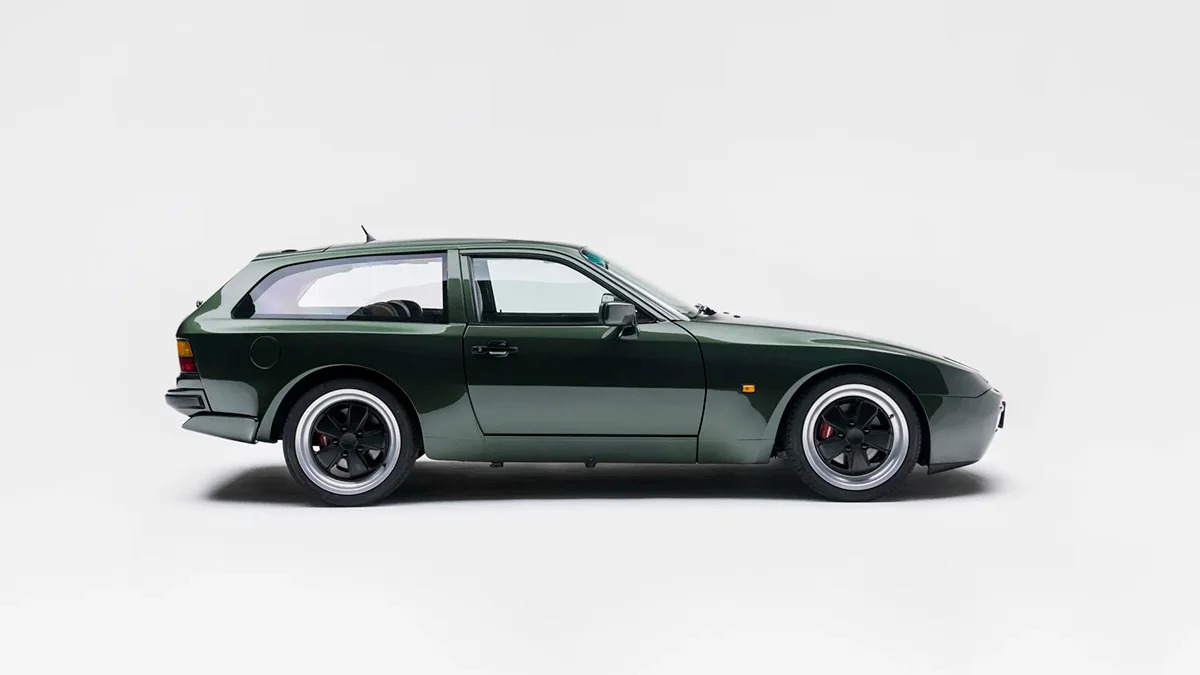
The first key decision concerns the material. While many custom conversions simply add fiberglass components, CarPoint works with hand-formed steel sheet metal. It’s a longer and more demanding process, but the result blends seamlessly with the original body.
The most radical change is at the rear. The large, domed glass hatch—a distinctive feature of the stock 944—disappears entirely. In its place, the roof extends horizontally all the way to the rear. To accommodate this new roofline, the B-pillars and rear fenders have been modified. Custom-designed rear side windows elongate the profile and give the car the sleek station wagon look suggested by Söhngen’s sketch.
The tailgate, meanwhile, takes on a new design. It extends down to the level of the bumper and rises about 40 centimeters into the roof, allowing for vertical loading. This is where the car lives up to its “Kombi” name: the opening is no longer a sloped hatch but a true trunk door. The original folding rear bench seat has been retained, preserving the 944’s versatility. The taillights have been redesigned to fit the new contour.
A detail that’s less photogenic but crucial for a future owner: all modifications are covered by TÜV certification in Germany. The GT-K44 isn’t a showpiece—it’s built to be driven.
Chassis No. 1, an S2 in oak green
The prototype is based on a 1991 944 S2 coupe, the version that marked the end of the 944’s production run. Under the hood, nothing has changed: the naturally aspirated 3.0-liter inline-four delivers its standard 211 ch, paired with a five-speed manual transmission. Freund wasn’t after performance. He was looking for the car he had lost—but with a more powerful engine.
The exterior color, Oak Green Metallic, faithfully replicates the color of the anniversary design. Inside, the upholstery combines black leather and velvet with the “Pascha” checkered pattern. This design first appeared at Porsche in 1977 on the 928, another of the brand’s transaxle models. The choice is by no means trivial: it anchors the interior in the same era and technical lineage as the body.
This first example is now listed for sale on Elferspot, the platform specializing in Porsches. The price is not listed; it is provided upon request.
Ten cars, and the customer brings their own
Beyond the prototype, CarPoint is offering this conversion to customers in a strictly limited series of ten cars. It’s important to understand the concept: this isn’t about buying a GT-K44 off a catalog. The customer provides their own Porsche 944, and the workshop transforms it. For those who don’t own one, CarPoint can help find a donor vehicle.
The initial range of options is broad. All versions of the 944 are accepted: the standard 2.5-liter, 163 ch model; the S; the S2; and even the Turbo and Turbo S, whose power outputs range from 220 to 250 ch. Manual or automatic transmission—it doesn’t matter. Each GT-K44 will therefore carry the mechanical character of the car that served as its base, which means the ten units could be very different from one another.
The price for the conversion, set in September 2026, starts at 100,000 euros before tax—which, as a rough estimate, is around 114,000 dollars at that month’s exchange rate. This amount should be considered a minimum. It covers bodywork, paint, and interior finishes, excluding taxes, but does not include the purchase of the 944. The final bill will depend on the car provided and the customization options selected, for which the workshop has not released any details. Therefore, the total cost will vary depending on whether the car is a standard 944 or a Turbo S.
A Personal Project Turned into a Small Production Run
What sets the GT-K44 apart from the many restomods on the road today is its origin. It seeks neither to modernize the 944 with electronics nor to supercharge its engine. It fills a void. Freund wanted to recreate the station wagon he drove every day forty years earlier. Having never been able to buy another one, he brought the idea to life using his workshop resources and a friend’s pencil sketch.
It remains to be seen which 944 owners will be willing to entrust their cars to the saw in Karlsruhe to turn them into one of the ten. The first results should become apparent in the coming months, as orders are finalized. For now, the only existing GT-K44 awaits its buyer, in oak green, price upon request.