
Make Texture a preferred source on Google to support us
Add Texture to GoogleThe clash of cultures is only superficial. Between the fervor of the stands and the hushed silence of the sewing ateliers, an unprecedented interplay is now redefining the strategies of the major fashion houses. The US Open recently confirmed this trend, transforming tennis courts into auxiliary runways, while Formula 1 and global soccer attract audiences that the fashion industry openly covets. This shift toward the sports arena is far from a mere public relations ploy. It is a quest for a firm foothold.
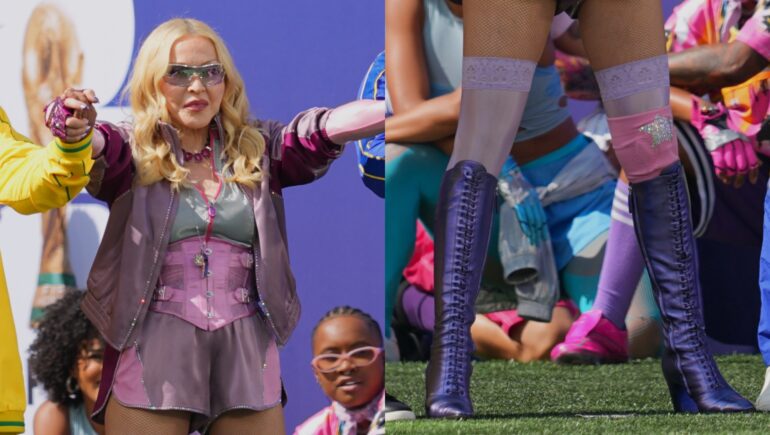
The example of Yves Saint Laurent perfectly illustrates this mechanism of proving oneself through events. For the 2026 World Cup final, the brand is already making its move through a iconic figure of pop culture: Madonna. Dressed by Anthony Vaccarello in a Teddy jacket emblazoned with “Madonna 10” for the halftime show, the singer will not merely be wearing a garment. She will be reviving a bold legacy—a direct echo of a cultural seismic shift that was foundational to the brand. In 1998, on the field at the Stade de France and just minutes before kickoff of the historic France-Brazil match, the fashion house sent 300 models down the runway wearing archival pieces under the gaze of cameras from around the world. The viral rediscovery of these images today underscores an obvious truth: an archive draws its strength from its visceral connection to an indisputable event. History no longer serves as a backdrop; it functions as a major financial and cultural asset.
The End of the Mirage of Perfection
This obsession with documentary evidence and reality responds to an existential crisis of the image. For decades, the luxury industry pursued an aesthetic of the unattainable, erasing every flaw and smoothing every texture to deliver cold, unreal campaigns. Generative algorithms have shattered this monopoly. Visual perfection has become a commodity, infinitely reproducible, without effort or cost. As a result, the veneer is cracking.
Data compiled by VisualGPS, Getty Images’ analytics observatory, maps this psychological shift with great precision. The public’s perspective has changed. An image devoid of even the slightest imperfection now triggers an immediate sense of suspicion. Consumers scrutinize the source, searching for errors or the machine’s hand. Conversely, photographs that embrace a certain rawness—whether through the absence of filters or the presence of imperfections—resonate with audiences. Getty Images’ global creative director, Rebecca Swift, analyzes this phenomenon in the pages of *The Observer*, highlighting a fascinating paradox: the general public is happy to play around with artificial intelligence in their private lives, but categorically refuses to grant this leeway to high-profile commercial entities. Demanding authenticity is becoming the new norm.
For an industry whose margins and prestige rest on the idea of a long-term process, laborious manual execution, and tangible scarcity, the use of synthetic visuals amounts to a form of internal sabotage. Replacing a photograph of an existing object with a simulation means breaking the fundamental pact of trust. If form is not embodied by matter, it is reduced to a mere dead pixel, incapable of supporting the narrative of craftsmanship.
Memory in the Face of Imitation
Faced with the deluge of content generated out of thin air, simply unearthing the past is no longer enough. It must be proven. Brands’ internal photographic collections serve as a foundation, but they often suffer from a one-sided perspective—that of a controlled, official narrative. This is where external archives take over. Vast documentary catalogs paint a far more complex and organic portrait of clothing.
A dress captured on the fly at a festival, a crumpled coat draped over an actress’s shoulders as she leaves a studio, a silhouette spotted in the background of a television archive… These stolen moments wrest the item from its status as a commodity and inscribe it into cultural history. The external archive acts as a certificate of social authenticity. It documents wear and tear, movement, and context. A machine can easily apply film grain, virtually wash out colors, or generate motion blur to mimic the past. But it fails to produce traceability. The value of archival photography lies precisely in its nature as irrefutable proof of a creation’s existence at a specific moment in time.

The Aesthetics of Nostalgia Under Close Scrutiny
The magnetic appeal of past decades—particularly the 1980s and 1990s—dictates a large part of today’s creative direction. Fashion houses’ responses to this demand vary, ranging from strict reissues to stylistic homages. Last April, Giorgio Armani formalized this heritage-focused approach by launching “Armani Archivio,” the house’s very first line of reissues, tailored to satisfy a clientele eager for the cuts and materials of that golden era. For its part, Chanel has drawn on the imagery of ’90s video games to drive its spring campaign, injecting a dose of retro pop culture into its classic aesthetic.
However, the tightrope these brands are walking is extremely thin. Younger generations, born with a screen in their hands, possess a particularly keen sense for detecting cynicism. Reducing nostalgia to a lazy artistic direction—a simple sepia filter applied to a new collection—leads to failure. Staging that is too heavy-handed or disconnected from the brand’s historical truth is immediately penalized.
The numbers support this demand for substance. The VisualGPS study reveals that 73% of respondents perceive a direct increase in a brand’s value when it uses authentic vintage images. This overwhelming percentage does not reflect a fetish for all things old. Rather, it indicates a weariness with the fake, the synthetic, and the prefabricated. What the public values is the depth of time—the certainty that the brand has stood the test of time, that it has clothed real people and participated in the cultural conversations of the past to legitimize its place today.
Contemporary luxury finds itself at a decisive crossroads. Having the means to create grandiose campaigns is no longer a differentiating factor in an era when software can generate lavish backdrops in a matter of seconds. The absolute competitive advantage—the only one that cannot be bought or programmed—is verifiable heritage. By placing the archive back at the center of the stage—far from being a mere passive ornament—the great houses assert that their history is their strongest safeguard. In a world saturated with perfect illusions, truth—even when imperfect—becomes the ultimate luxury.