
Make Texture a preferred source on Google to support us
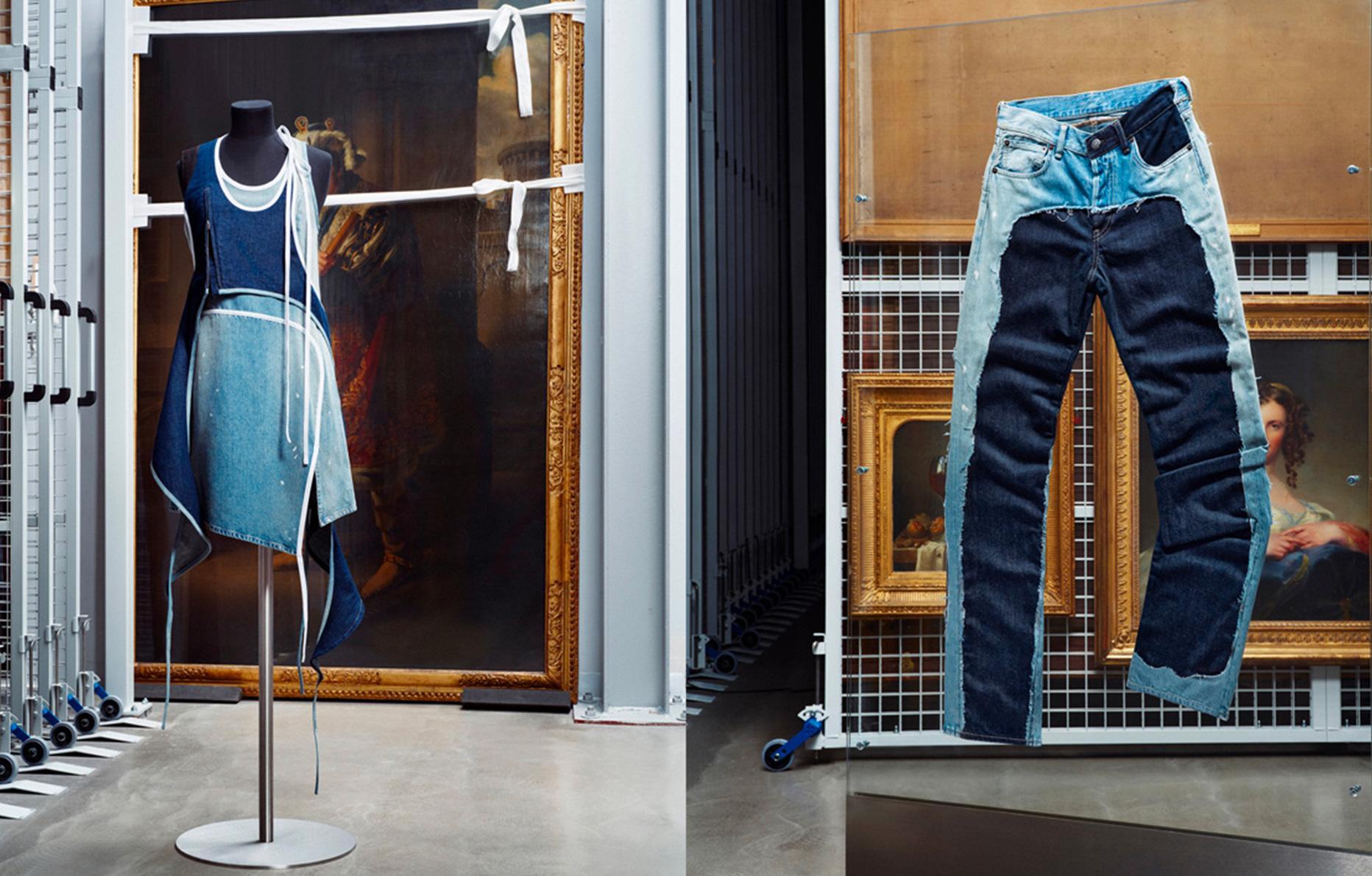
Add Texture to GoogleAt the V&A East Storehouse in London, Hussein Chalayan’s garments are already part of the permanent collection. They also serve as a backdrop for new pieces: it was at this museum that the campaign for his collaboration with Acne Studios was photographed. The choice of location lends an interesting tension to the collaboration. How can one revisit a body of work that has become part of cultural heritage without reducing it to a mere tribute? The answer lies in twelve pieces, plenty of denim, and a conviction shared by Chalayan and Jonny Johansson: a fashion concept can continue to evolve long after its debut runway show.
The Archive Put to the Test Through Clothing
Perhaps the most interesting aspect here is not the return of a name, but the way in which his research finds new purpose. The capsule collection draws from three collections from the early 2000s: “Ventriloquy,” presented in 2001; “Medea,” in 2002; and “Manifest Destiny,” in 2003. These references mark a specific period in the British-Cypriot designer’s career. Above all, they provide material to revisit, featuring the fabrics and silhouettes that define Acne Studios’ aesthetic.
Denim, jersey, and leather thus bring to life ideas rooted in a deliberately conceptual approach to fashion. The shift is key. The goal is not to put old creations back on the runway, but to examine what endures a change in medium, context, and perspective. The collaboration plays out precisely in this distance between the preserved garment and the one we might wear today.
The historic pieces and the capsule collection appear together in the campaign. This juxtaposition allows the project to be interpreted as more than just a collection steeped in references: the garments that provided the inspiration are there, alongside their contemporary interpretations. The museum becomes the place where one can observe what endures and what transforms.
Denim as a Point of Discussion
The section dedicated to jeans gives the dialogue its most concrete expression. Two silhouettes from Acne Studios, named “1996” and “2009,” are crafted from patchwork denim. A shirt incorporates this same assembly principle. The choice of styles already established in the brand’s repertoire avoids starting from scratch: Chalayan’s design language meets forms that have their own history.
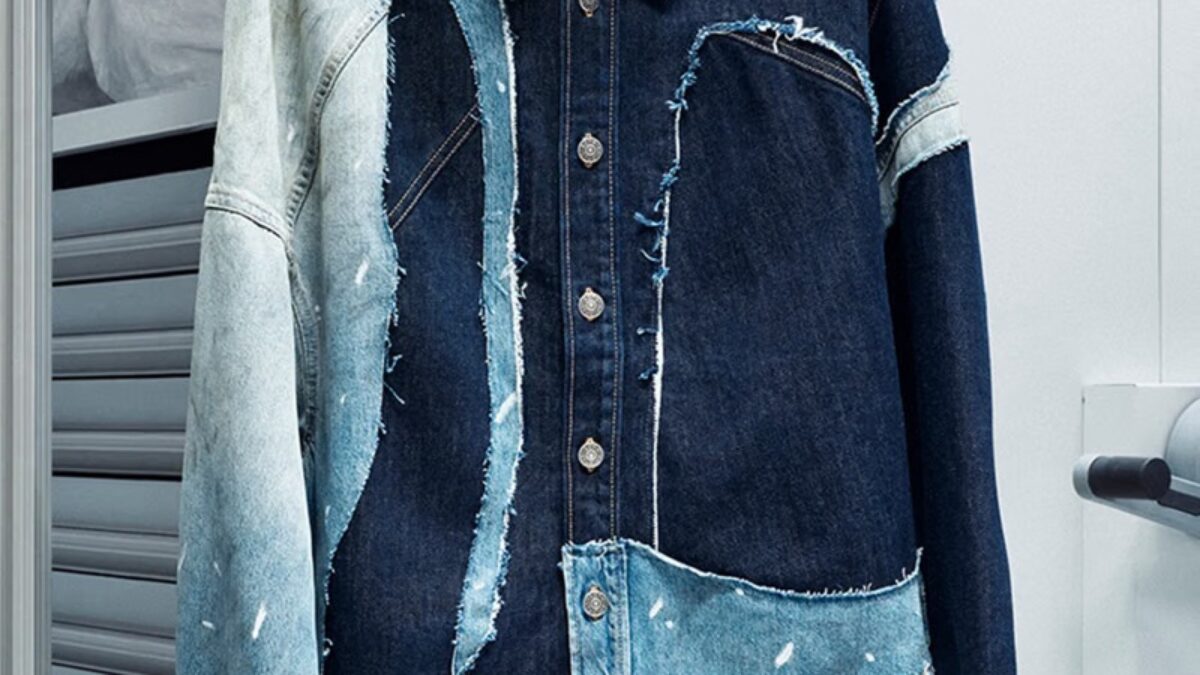
Added to these reinterpretations is a new “twisted” pair of jeans featuring a trompe-l’œil python print. Here, the denim suggests a different material through the mere effect of its surface. Without claiming to reduce Chalayan’s entire approach to this illusion, we encounter a question central to his work: Is a garment exactly what it appears to be? Here, the experimentation remains rooted in a familiar object, rather than in a spectacular display.
An asymmetrical denim vest and dress, meanwhile, employ a layered construction borrowed from “Manifest Destiny.” This layering technique is also evident in the jersey T-shirts and vests. This application of a single technique across multiple materials is one of the most recognizable threads running through the capsule collection. What is drawn from the archive relates less to replicating a specific look than to a method of constructing the garment.
The “Camero” bag extends this concept: its new version assembles pieces of leather in shades reminiscent of denim. The color shares a kinship with jeans, while the material changes. Finally, a slogan T-shirt explicitly signals the collaboration. In this twelve-piece collection, the shared signature thus manifests itself in varying degrees, from the displayed message to the construction details.
Johansson, an admirer and collaborator
Jonny Johansson makes no secret of the personal motivation behind the invitation. The co-founder and creative director of Acne Studios expresses his admiration for Chalayan and for the influence of his work on fashion. His intention is to restore Chalayan’s visibility, while giving him the freedom he needs to work. The project is built on this trust, as well as on a deliberate closeness reflected in the prominence given to the creative process.
This initial asymmetry—between the one who extends the invitation and the one he admires—could have led to a respectful but unproductive celebration. Chalayan’s account, on the contrary, describes an exchange that led him to reconsider his own archives. He particularly emphasizes the pleasure he took in developing denim with Johansson. He also highlights the contribution of a team from another generation, capable of approaching his work from a different perspective.
The designer says he discovered, through this reexamination, the enduring nature of certain intuitions. This insight reveals the true scope of the project. The value of the archive lies not only in what it reveals about an era, but also in what another team is still able to draw from it. The tribute thus gives way to the work of the atelier.

Before the museum, the garden soil
To understand the significance of this reintroduction into circulation, we must go back to an act that predates the collections referenced by Acne Studios. In 1993, for his graduation collection “The Tangent Flows,” Chalayan buried garments in his family’s garden. He dug them up shortly before their presentation. This process introduced an element into their creation that goes beyond the cut alone: the time spent underground.
The London boutique Browns took notice of these pieces and borrowed the collection to display in its window. The following year, Chalayan founded his ready-to-wear brand. This transition from the garden to the store window already highlights a distinctive aspect of his career: radical experimentation can find a commercial audience without its starting point being mundane. The collaboration with Acne Studios raises, in a different form, this question of the intersection between experimentation and the wardrobe.
Throughout his career, Chalayan has fostered a dialogue between fashion, architecture, and industrial design, while also incorporating technology and the performing arts. The runway show has served as a platform for him to raise political and cultural questions. This ambition explains why a revival of his work cannot be reduced to a mere selection of patterns: it also involves design methods that demand to be understood.
Returning Without Reviving His Fashion House
Institutional recognition came early: Chalayan was named “British Designer of the Year” in 1999 and again in 2000, before being appointed a Member of the Order of the British Empire in 2006. His roles as creative director at Puma and Vionnet, as well as his collaborations with Björk and Lady Gaga, have placed his work in very different contexts. Experimentation, therefore, has never meant isolation.
After the pandemic, however, he suspended production at his label and devoted himself to teaching at the University of Applied Sciences Berlin. The capsule collection marks a return to designing clothing with a partner—not an announcement of the revival of his own label. The distinction is crucial: Acne Studios is providing him with a defined framework here—twelve pieces to relaunch a project—without attempting to recreate everything that existed before.
Alongside the clothing, another item will accompany the launch: “Reference: Hussein Chalayan,” a book published by Acne Studios in a limited edition of 1,000 copies. Following the exhibition of the archives and the capsule collection at the London museum, the book will provide a distinct platform for them. It offers a way to continue exploring these references once the campaign images have faded from view.