
Make Texture a preferred source on Google to support us
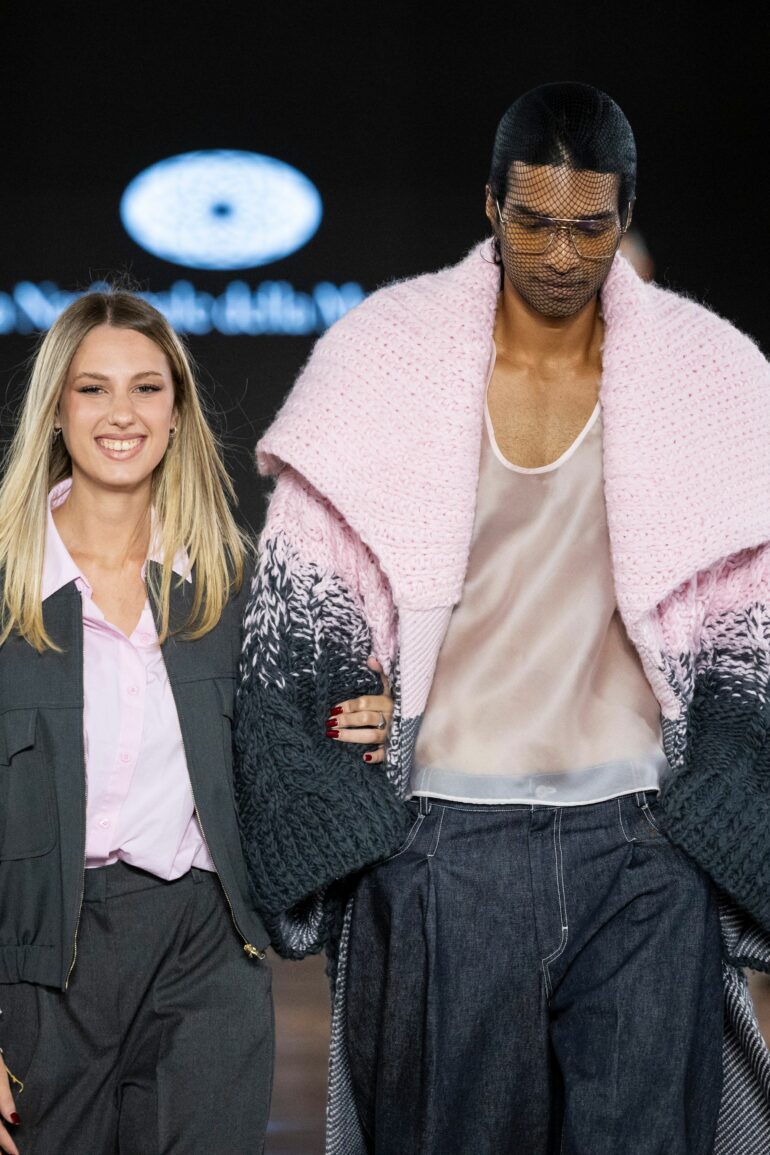
Add Texture to GoogleCan a closure define the direction of an entire silhouette? That is the challenge presented to the candidates for the Ykk Prize, one of the awards at Milano Moda Graduate. The technical detail becomes the starting point for the garment, rather than its final touch. This constraint also offers an illuminating glimpse into the twelfth edition of the event organized by the Camera Nazionale della Moda Italiana: behind the identification of new talent, a certain vision of education takes shape, where innovation must meet craftsmanship. The closing fashion show, held at the Rotonda della Besana in Milan, was the visible part of this process. The learning experience, however, is not limited to the runway.
Learning what holds a collection together
People tend to remember a name—and sometimes a school—from a competition. Milano Moda Graduate also deserves attention for its educational program. For the eighth consecutive year, the Camera Nazionale della Moda Italiana has offered students guidance focused on the development and production of their collections. The choice of topics is revealing: it’s not just about helping students formulate an aesthetic vision, but about working on the practical aspects of bringing it to life.
Workshops and consulting sessions thus address sustainability and production techniques. Their inclusion in the same program encourages students not to separate the creative intent from its practical implications. Conceiving a collection and understanding how it will be manufactured are two distinct exercises, which this program brings together. For students, this integration usefully shifts their perspective: a garment cannot be evaluated solely based on the impact it makes during a runway show.
The program also covers trends, international markets, merchandising, and digital communication. These are all issues that a collection must address once it has been designed. How does it find its place? How does it become accessible to its intended audience? Without offering a universal answer, the content of this program serves as a reminder that design engages in a dialogue with professions whose demands do not always align with its own. Learning to understand these demands is an integral part of the program.
Matilde Bonechi: A Name to Remember—Without Inventing a Story for Her
The prize in the fashion design category goes to Matilde Bonechi, a student at the Istituto Marangoni. She was chosen from among six finalists by a jury chaired by Luca Lisandroni, CEO and member of the executive board of Brunello Cucinelli. This composition lends the judging process a distinct professional dimension: the selection of emerging talent takes place under the watchful eye of a fashion house executive, at the intersection of creative design and the management of a fashion business.
However, it is important to distinguish between what this award signifies and what it does not reveal. The award designates a winner; it is not enough to define her creative vocabulary, her preferred materials, or the references in her collection. There is no justification for attributing an aesthetic signature to her at this stage based solely on this distinction. The fact itself is already significant: among the six finalist proposals in her category, Matilde Bonechi’s won the jury’s vote.
The value of Milano Moda Graduate lies precisely in this transition between two evaluation frameworks. A student represents a school, but her work is also presented to professionals outside that institution. The award raises her profile beyond the educational context. It serves as a benchmark, not a verdict on her entire future career. This nuance allows us to take young designers seriously without turning every award into an exaggerated promise.
Technical Constraints as a Creative Theme
The Ykk Prize follows a different logic. Awarded by Ykk Italia, the event’s main partner, it recognizes a project centered on fastening accessories. The guidelines require participants to design an outfit using these elements. This shift is interesting: what might otherwise be treated as a supply becomes a design issue in its own right.
The constraint does not dictate what the final result should look like. Rather, it defines the problem to which each candidate must provide an answer. What role should the fastener play in the composition of a garment? Should they be made immediately noticeable, or integrated into the silhouette in some other way? These questions arise from the exercise itself, without prejudging the solutions actually presented. They demonstrate how much an apparently narrow topic can influence the design of the entire garment.
Ten finalist projects, created by eleven fashion design students, were in the running. The prize was awarded to Costanza Barbieri and Giulio Censori, both students at IED, the Istituto Europeo di Design. Their joint project also marks a departure from past winners: this time, the award recognizes a collaborative effort. Alongside the individual distinction received by Matilde Bonechi, this award thus makes room for another way of conceiving and presenting a proposal.
Schools, but also multiple ways to stand out
A special mention was also awarded to Corinne Zanini, a student at the IUAV University of Venice. Along with the Istituto Marangoni and the IED, her institution is thus among those represented in the announced awards. The event, dedicated to emerging talent from Italian fashion schools, is therefore not limited to the selection of a single winner.
The Fashion Design Award—which recognizes a technical project—and the Special Mention do not share the same scope or purpose. It would be reductive to lump them together into a single ranking. Rather, their coexistence allows the works to be evaluated according to multiple criteria: one creative proposal may be recognized in a general selection, while another is honored for its response to a theme defined by an industry partner.
This is also what gives meaning to the educational program associated with the event. The runway showcases the results; the workshops address the skills needed to achieve them and to further develop the work. Between these two moments, Milano Moda Graduate reveals a multidimensional educational experience, without reducing the profession to the mere act of drawing.
After Milan, a week in Shenzhen
For Costanza Barbieri and Giulio Censori, the next phase of the award takes on a concrete form. Presented by Hideyuki Kubo, president of YKK Italia, the award includes a week of training at the group’s showroom in Shenzhen. The trip thus extends the assigned theme through an experience with the partner who proposed it.
The detailed schedule for the week has not been specified. Nevertheless, its inclusion in the award is enough to capture attention: after designing an outfit centered on fastening accessories, the two students will be able to continue their training within the group’s environment. Their next step, therefore, is not another trip down the runway, but a week of training in Shenzhen.