
Make Texture a preferred source on Google to support us
Add Texture to GoogleUnder the skies of Curaçao, where limestone has been patiently sculpted over millennia, a unique sensory experience shatters the silence of the depths. In the Kueba di Indjan cave, located near Tera Kòrá, artist Cannupa Hanska Luger has orchestrated an encounter between the primordial earth and contemporary creation. Titled *Kantika di Tera* (Land Song), this site-specific installation, unveiled on Saturday, September 26, 2026, transforms a geological cavity into a monumental and ephemeral musical instrument. By suspending clay whistles from the millennia-old walls, the artist does more than simply occupy the space; he awakens a buried sonic memory, carried by breath and time.
The limestone sanctuary of Kueba di Indjan
The setting chosen for this work is not merely a backdrop, but a full-fledged participant in the composition. The Kueba di Indjan cave is a limestone formation estimated to be nearly five million years old. This mineral labyrinth, adorned with stalactites and stalagmites, is famous for its zenithal light well, which, at certain times of day, projects a pure beam of sunlight all the way to the floor of the cave. Beyond its geological features, the site is imbued with a mystical aura. Local legends often refer to it as Kueba di Brua, or “witches’ cave” in Papiamento, evoking ancient rituals and witchcraft practices attributed to the island’s indigenous peoples. It is in this intersection between geological science and oral folklore that Cannupa Hanska Luger chose to establish her project.
Cannupa Hanska Luger’s decision to focus on this site was no accident. Born in 1979 on the Standing Rock Reservation, this member of the Three Affiliated Tribes of the Fort Berthold Reservation (Mandan, Hidatsa, and Arikara), of Lakota descent, has for years been engaged in a profound exploration of the relationship between the body, the earth, and the object. Based in New Mexico, Luger is exploring a new iteration of his research on the ancestral globular whistle—a universal ceramic technology he had already begun to explore through his VOLUME series.
Clay and Fiber: A Materiality in Transition
The work *Kantika di Tera* is based on a strict material duality: earth and plant fiber. To suspend the instruments at the center of the cavity, just below the luminous opening, Luger used hand-braided cords. These ropes were made from recycled fibers from banana tree trunks, processed by the local organization Farm to Crafts. These natural fibers blend visually with the vines that hang naturally from the vaulted ceiling, blurring the line between human intervention and organic growth.
At the ends of these ropes are the whistles, clay objects shaped using pre-Columbian techniques. Luger’s approach is rooted in a philosophy of absolute respect for the natural cycle: the whistles are made of raw, unfired clay. This technical choice makes the installation inherently ephemeral. Under the influence of the cave’s ambient humidity, the clay will gradually disintegrate, returning to a state of dust or mud and reintegrating into the cave’s geological soil. The sourcing of materials also underscores this connection to the local landscape. While some of the clay used for the community workshops was commercially sourced (as the local clay is sometimes too saturated with salt for immediate modeling), Luger was keen to collect clay from near the cave painting sites on Curaçao. This clay, rich in pigments and history, was purified and incorporated into the final installation, creating a direct bridge between ancient cave art and living sculpture.

A Community and Biotic Symphony
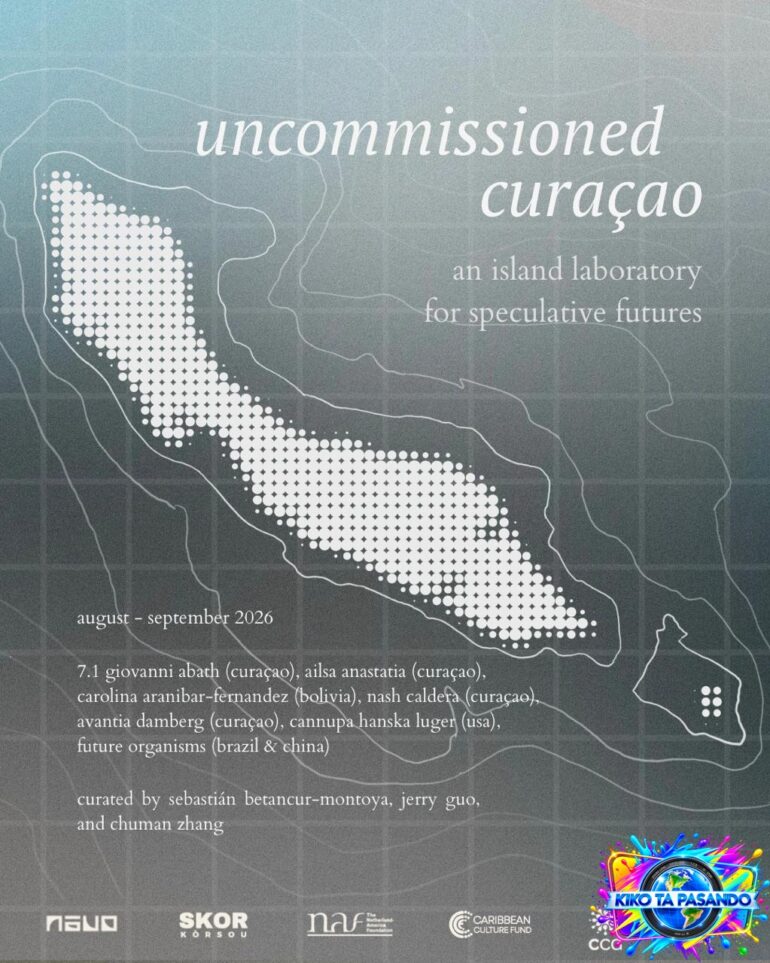
The Kantika di Tera project is part of the second edition of Uncommissioned: Curaçao, an experimental public art initiative led by the local SKOR Kòrsou foundation and the Los Angeles-based Novo Collective platform. Curated by Sebastian Montoya-Betancur, Jerry Guo, and Chuman Zhang, this event is supported by the Mondriaan Fund and the Caribbean Culture Fund. Participation is at the heart of the project: during the week leading up to the opening, Cannupa Hanska Luger led three workshops open to the local community to collectively craft the whistles now suspended in the cave.
The activation of the installation on September 26, 2026, marked a moment of acoustic grace. The artist’s son inaugurated the sound performance, playing an ambient piece composed specifically to engage with the unique acoustics of Kueba di Indjan. The sound, produced by human breath within the clay globes, propagated through the crevices of the limestone, creating a resonance that seemed to emanate from the depths of the earth itself. This moment of communion was punctuated by an unexpected biotic interaction: the flight of a colony of bats, regulars at the site, which crossed the space above the audience during the musical performance. This intrusion of the wild underscored the very nature of the project: a work that does not impose its presence but rather integrates itself into a preexisting ecosystem.
Admission to this event was free and open to the public, though advance reservations were required due to the site’s fragility and the limited capacity dictated by the cave’s layout. By rejecting the material permanence of his objects, Luger leaves behind an experience rather than a relic. Once the whistles have faded into the damp darkness of the cave, all that will remain of *Kantika di Tera* is the memory of a fleeting song, an earthly melody returned to its original silence.