
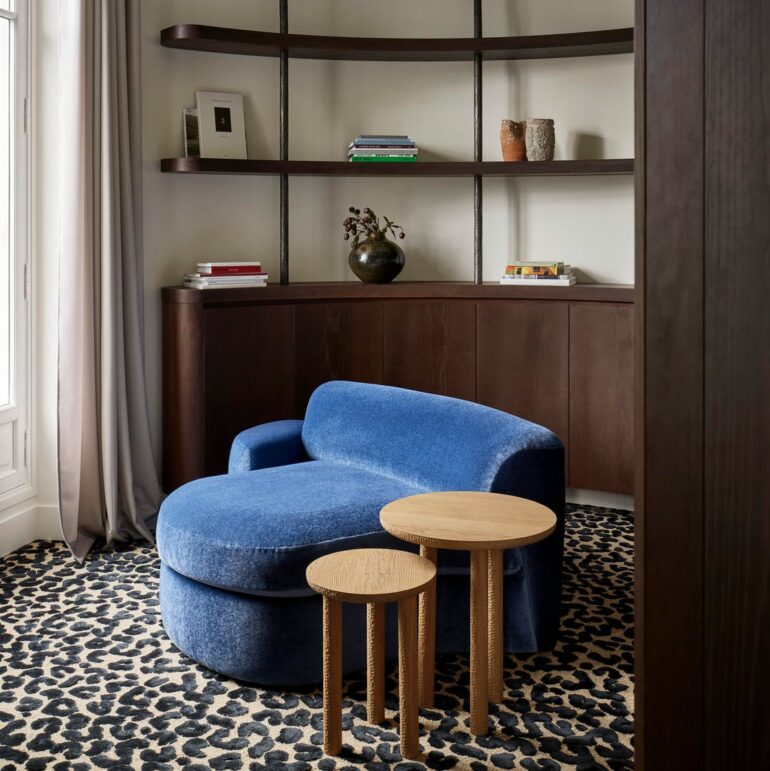
Long before the interior design industry seized upon the concept and stripped it of its substance, a figure from the Germanopratine scene single-handedly embodied the essence of a cultured bohemian lifestyle—somewhat decadent and fiercely independent. At the corner of Rue Jacob and Rue Bonaparte, behind a dark storefront that seemed to defy trends, Madeleine Castaing ran her business. With her bowl cut held in place by an elastic headband—which she wore as a theatrical touch—and her eyes rimmed in black, she was no mere antique dealer. She crafted atmospheres. While the dawning twentieth century swore by the hygienic minimalism of the Bauhaus, the straight lines of Mallet-Stevens, and the coldness of tubular steel, she looked elsewhere. Toward the boudoirs of the nineteenth century, toward the eccentricity of the English Regency, toward a romanticism steeped in melancholy.
Her approach had less to do with interior design than with staging. Stepping into her shop in Saint-Germain-des-Prés was an initiatory experience. The furniture was not arranged according to commercial logic, but rather staged, illuminated by soft opaline lamps, amidst the scent of potpourri. If a visitor displeased her or seemed incapable of understanding the soul of a Napoleon III bergère, she would dismiss their inquiry with a wave of her hand, declaring that the piece was “already sold.” This uncompromising attitude forged her legend. Madeleine Castaing did not sell furniture; she granted the right to bring a fragment of her world into one’s home.
The Invention of a Visual Grammar
The Castaing style is based on combinations that, on paper, border on heresy. She rehabilitated the Biedermeier style—long considered heavy or provincial—and created a dialogue between it, English mahogany, and rattan. This penchant for woven rattan, introduced into high-society salons alongside majestic antiques, epitomizes that famous bohemian nonchalance. We no longer seek museum-quality perfection; we seek life.
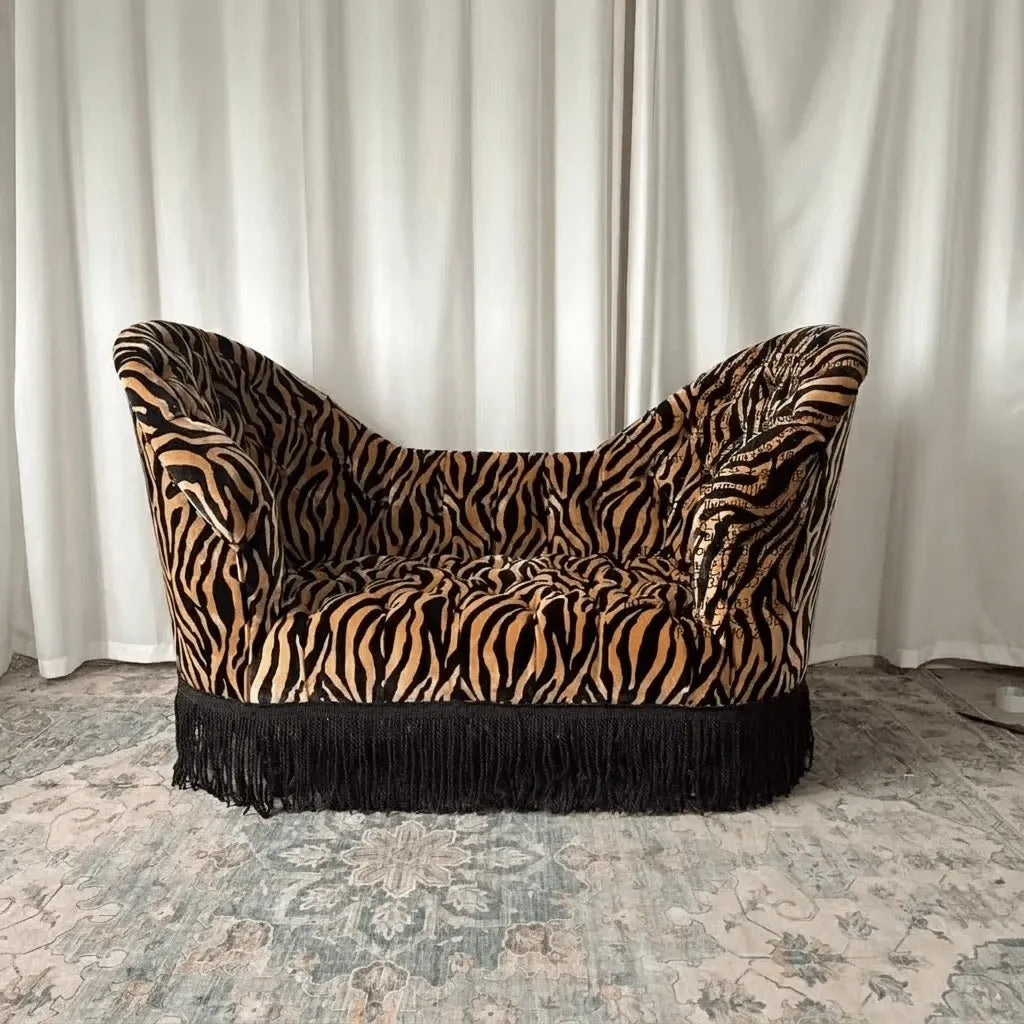
Above all, she creates a color palette. First, there’s Castaing blue. It’s neither a pure turquoise nor a sky blue, but a cool aquamarine hue, slightly tinged with gray, that evokes the stormy skies of neoclassical paintings. This blue became her preferred backdrop. To make it come alive, she used black as a strict accent, often through dark baseboards or lacquered frames. But her masterstroke lies in the introduction of the panther motif. Long before fashion seized upon it to the point of overuse, Madeleine Castaing was rolling out leopard-print carpets in private mansions. The animal print disrupts the austerity of an Empire-style sofa or the restraint of a striped wall hanging. Stripes, in fact, which she incorporated into cotton fabrics, often framing acanthus leaf motifs or floral garlands.
The Asylum in Lèves and the Shadow of Soutine
To understand the origins of this aesthetic vocabulary, one must leave the streets of Paris and travel to Lèves, in the Chartres region. In the 1920s, along with her husband Marcellin Castaing—a wealthy landowner and refined scholar—she acquired a vast estate there. Lèves became her true laboratory for experimentation. Room after room, filled with books, worn-out rugs, and deep armchairs into which one sinks to put the world to rights. The aesthetic of ruin and the charm of wear and tear were cultivated there with obsessive precision.
This place is inextricably linked to their role as patrons. The Castaings were Chaïm Soutine’s staunchest supporters. Fleeing the poverty of Montparnasse, the Expressionist painter found a refuge in Lèves, where he would spend long summers. Marcellin and Madeleine collected his paintings with a fervor bordering on obsession, becoming his primary sources of material and psychological support. The relationship between the interior designer and the artist was stormy and passionate. Soutine painted her. The famous portrait, now housed at the Metropolitan Museum of Art in New York, captures her anxious face and feverish gaze beneath her dark bangs. The presence of Soutine’s tortured canvases—with their blood-red hues and distorted perspectives—hung against floral wallpaper defines the fundamental contrast at the heart of the Castaing spirit: bourgeois gentility fractured by the anguish of modernity.

Villa Santo Sospir, the Shared Masterpiece
Although she rejected the title of interior designer, she would occasionally agree to take on projects for a select few close friends. One of her most fascinating creations remains Villa Santo Sospir, on the Saint-Jean-Cap-Ferrat peninsula, owned by socialite Francine Weisweiller. History has mainly remembered that Jean Cocteau “tattooed” the walls with his mythological frescoes during a stay that dragged on. Yet the setting for these frescoes bears Madeleine Castaing’s signature.
Faced with the blinding light of the Mediterranean and walls already saturated with Cocteau’s drawings, she demonstrated unusual restraint. She opted for bamboo furniture and wrought-iron chairs, and chose rustic fabrics and straw mats. She created a vacation home for an intellectual elite, far removed from the opulence of the French Riviera’s luxury hotels. At Santo Sospir, bohemian chic takes on a Mediterranean flair—spartan yet infinitely refined.
The Legacy of a Rebel
Madeleine Castaing, who passed away in 1992 at the age of 98, lived through the century on the fringes of all conventions. She founded no official school, yet her influence discreetly permeates the work of the greatest contemporary interior designers. Jacques Grange, who was once her disciple, has often recounted how she taught him to see the beauty in an ugly object—or at least in an object that the times deemed as such.
Today, the Castaing aesthetic lives on beyond her legendary boutique, whose closure in the 2000s marked the end of an era for the Saint-Germain-des-Prés neighborhood. Her textile patterns, embossed velvets, and dazzling carpets continue to be woven by Edmond Petit, preserving the materiality of her world. His “Lola Montez” and “Rayure Castaing” printed fabrics still find their way into interiors seeking to escape the standardization of contemporary luxury. But simply reproducing the pattern is not enough to capture the spirit. The soul of his style lay in that instinctive gesture—placing a cushion of bold red on a dark armchair to enliven a room, with the same precision as a painter adds a touch of light to a canvas.