
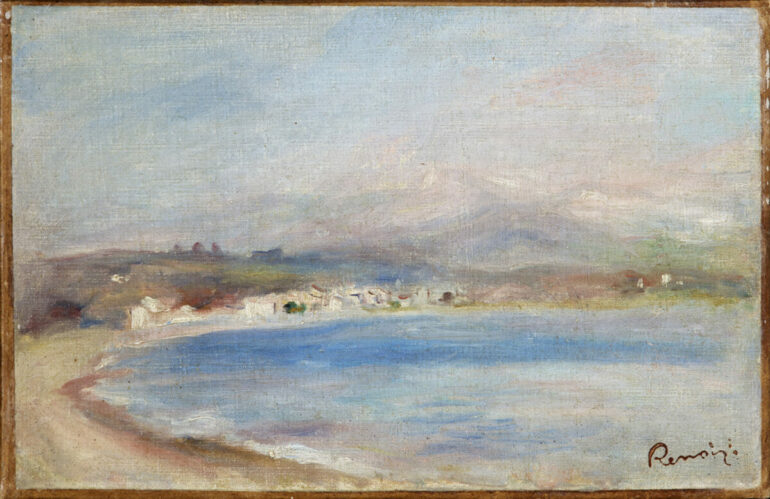
The image has an almost cinematic intensity: two masterpieces hastily abandoned in the grass of a Mediterranean garden, remnants of a frantic escape. On September 8, 2026, the peaceful grounds of the Renoir Museum, perched on the hills above Cagnes-sur-Mer, were the scene of a break-in carried out with chilling precision. Although the rapid response—or perhaps the panic of the intruders—allowed two of the four paintings torn from their frames to be recovered within the property’s garden grounds, the toll remains devastating. The Portrait of Madame Colonna Romano and Young Woman at the Well have vanished. For this institution on the French Riviera, which jealously guarded a collection of twelve works by the Impressionist painter, the loss far exceeds the financial value of the loot—even though that was estimated at several million euros. It is a direct amputation of the local cultural memory.
The End of the Myth of the Romantic Burglar
The era of the lone art thief, armed with nothing more than a pocketknife and a touch of worldly audacity, is definitively over. The heist carried out on the French Riviera reveals the new face of organized crime specializing in art. The break-in occurred from the outside, through the gardens, carried out by a group of individuals whose equipment betrayed paramilitary-style preparation. Tactical gloves, helmets, combat gear, and specialized tools designed to detach the canvases from their frames in a fraction of a second: the assailants left nothing to chance. This meticulous logistical preparation was aimed at a single goal: speed. The operation was designed to be completed before the alarm system could fill the space with noise, before the security guards arrived, and before law enforcement could cordon off the perimeter.
Faced with the shock of the incident, local authorities had to respond urgently. The mayor of Cagnes-sur-Mer, Bryan Masson, immediately announced the launch of multiple concurrent investigations. The case, which goes beyond a mere local news item, has naturally led to the involvement of the French national unit dedicated to the protection of cultural heritage. Investigators now face the classic challenge of this type of case: a race against time to prevent the works from disappearing into the opaque channels of the black market or being used as a bargaining chip by organized crime networks.
A European Geography of Vulnerability
The disappearance of the Renoir paintings is part of a broader trend that has been affecting European institutions with alarming regularity. Organized crime has fully grasped the value of masterpieces as tools for blackmail and transactions. Just a few months before the raid in Cagnes-sur-Mer, in March 2026, the Magnani Rocca Foundation, located not far from Parma, Italy, suffered a similar attack. Three paintings, signed by Renoir, Matisse, and Cézanne, vanished without a trace. The outcome of this Italian case, however, offers a glimmer of hope: in August of the same year, the Italian unit specializing in cultural heritage succeeded in recovering the works following a sting operation that led to the arrest of five individuals directly affiliated with organized crime.
But the threat does not weigh solely on regional foundations or isolated artists’ homes, whose intimate architecture inherently complicates security measures. Institutional strongholds are also faltering. The art world still remembers the shocking attack carried out in broad daylight against the Louvre Museum in October 2025. Disregarding the discretion of nighttime operations, a commando unit deployed a cherry picker to reach the building’s facade and make off with pieces of fine jewelry. The symbolism of this Parisian heist is stark: if one of the most heavily guarded museums in the world can be breached with the brazenness of an open-air construction site, the absolute security of collections is nothing but an illusion.

The Empty Frames Syndrome
The walls of our museums are haunted by ghosts. The theft of works of art fascinates us because it touches upon the untouchable—a fascination that undoubtedly dates back to 1911, when Vincenzo Peruggia calmly walked out of the Louvre with the Mona Lisa under his arm. Leonardo da Vinci’s painting, recovered two years later, paradoxically earned its status as an absolute legend thanks to this disappearance. But not all stories end with a triumphant return.
In the United States, the Isabella Stewart Gardner Museum in Boston still confronts its visitors with the chilling sight of thirteen desperately empty frames, remnants of the 1990 heist that decades of investigations have never been able to solve. Closer to home, the lure of raw profit has led to irreparable losses, where the material value takes precedence over aesthetic value. The disappearance of the massive Big Maple Leaf gold coin in Berlin in 2017, or the methodical ransacking of the priceless jewels of the Grünes Gewölbe in Dresden in 2019, illustrate the cold-heartedness of criminal networks indifferent to the historical significance of their loot.
These successive disappearances, from Saxony to the Riviera, highlight a fundamental asymmetry. By definition, a museum is designed for openness, light, and proximity between the public and the artwork. Organized crime operates according to the opposite paradigm: shadow, violence, and the breaking down of barriers. Protecting these treasures requires transforming ancient palaces, delicate villas, or glass-walled structures into impenetrable vaults. Reflection on the future of cultural institutions today is confronted with this physical urgency: finding the exact balance between sharing beauty and protecting it against a form of crime that, for its part, knows no aesthetic constraints.