
Make Texture a preferred source on Google to support us
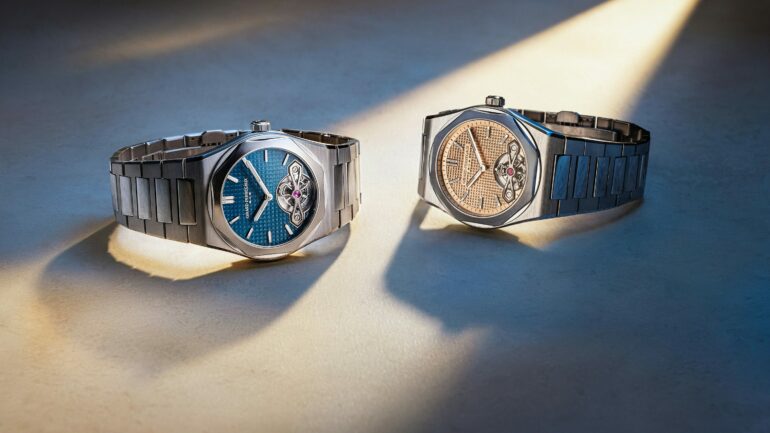
Add Texture to GoogleSome watches stand out for their cases, others for their dials. The Girard-Perregaux Laureato Fifty Tourbillon Micro-Rotor 39 mm takes a more understated approach: its most compelling feature is a movement height of 6.1 mm. A discreet, almost technical figure that nevertheless encapsulates the intent behind this new creation. For housing a tourbillon and a micro-rotor within this thickness amounts to making volume a matter of style as much as mechanics.
The Movement as a Starting Point
The watch’s name immediately reveals its two protagonists: the tourbillon and the micro-rotor. The former places the watch in the realm of high complications; the latter suggests a quest for compactness. Brought together in a movement just 6.1 mm thick, they shift the collector’s focus toward what isn’t necessarily visible at first glance.
This fact does not sum up a watch, but it captures its essence. A tourbillon is, by its very nature, a mechanism that requires space. A micro-rotor, by contrast, reflects a desire to minimize the bulk of the automatic winding mechanism. Between the two, Girard-Perregaux presents a clear equation: preserving the presence of a tourbillon without making thickness a showy feature.
In the world of watchmaking, complications are often used as immediate statements. They stand out, multiply the displays, or impose their mechanics on the watch’s silhouette. The Laureato Fifty Tourbillon Micro-Rotor seems to champion a different approach to technical prestige. Here, the figure of 6.1 mm lends the movement a sense of restraint. The mechanical mechanism is present, but it is integrated into an architecture designed to remain understated.
This approach makes the choice of the micro-rotor particularly fitting. Its presence isn’t merely a technical detail meant to pad a spec sheet; it shapes the entire design. In a watch that combines automatic winding and a tourbillon, the micro-rotor becomes the tool that allows for a different use of space than would be possible with a more visible and intrusive oscillating weight.
A Laureato shaped by the brand’s heritage
Girard-Perregaux presents this Laureato Fifty as a fusion of the heritage elements that define the collection and a new movement. This concept merits closer examination. It does not signify a break with the brand’s design language, but rather an evolution within a territory already familiar to the brand.
The word “Fifty” places this version within a retrospective framework, while the introduction of a new movement prevents it from becoming a mere commemorative exercise. It is not simply a matter of dressing up a complication with the Laureato’s design codes. The announced innovation lies at the very heart of the watch’s movement: a tourbillon caliber with a micro-rotor that measures 6.1 mm in height.
This approach also speaks to the value placed on established collections. A watch collection does not necessarily benefit from being constantly redesigned. On the contrary, it can become the framework for a more nuanced exploration: retaining its signature elements, then altering their interpretation through a different mechanical construction. The dialogue between heritage and innovation thus takes on a less decorative, more structural form.
The Laureato Fifty Tourbillon Micro-Rotor therefore does not present a simplistic contrast between past and present. The two move forward together. The hallmarks associated with the Laureato serve as reference points; the new movement introduces a new level of technical sophistication. These are two temporal dimensions that overlap within a single object: that of a collection whose identity remains recognizable, and that of research focused on the integration of complex watchmaking components.
Thirty-nine millimeters: a measurement that sets a new tone
The 39-millimeter diameter plays a decisive role in how this timepiece is perceived. It sets the Laureato Fifty Tourbillon Micro-Rotor apart from designs that seek to turn the complication into a display of sheer size. Here, the tourbillon is not paired with a case whose dimensions would overshadow the rest of the watch. The choice of 39 mm establishes a different relationship between the wrist, the collection’s design, and the movement it houses.
This size gives the project a clear direction. It encourages the viewer to see the watch as a whole, rather than focusing on a single spectacular detail. The diameter, the presence of the tourbillon, the use of a micro-rotor, and the movement’s slim profile are not merely a collection of features. Together, they embody a single idea: to incorporate high-end mechanics into a design that remains understated.
The word “compact” would undoubtedly suit this ambition, but it would not do it justice. A watch can never be reduced to its dimensions alone. Above all, the 39 mm size has a cultural implication: it rejects the notion that the value of a complication should be reflected in a more imposing presence. The Laureato Fifty offers an interesting counterpoint to this temptation. Its technical sophistication is evident, but the size immediately tempers any overly showy interpretation.
This restraint gives the tourbillon a different role. It remains one of the most loaded terms in the watchmaking vocabulary, but here it is framed by a quest for proportion. The tourbillon does not overshadow either the Laureato collection or the logic of the micro-rotor. It fits into a composition where each element seems to call out to the next.

Slimness is not just a matter of profile
It would be tempting to discuss a movement 6.1 mm high as a mere exercise in measurement. But that would be to miss what this dimension suggests. Mechanical thinness always influences the way a watch is conceived: it imposes compromises, requires precise organization of components, and forces a prioritization of functions.
In this case, the stated height focuses this design thinking on two mechanisms whose combination is not immediately obvious. The tourbillon requires its own space; the micro-rotor is chosen for its ability to fit without occupying the volume usually reserved for an oscillating weight. The figure of 6.1 mm thus becomes the tangible result of a deliberate design choice.
It would, however, be reductive to reduce this slimness to a mere numbers game. Girard-Perregaux offers more than just a dimension to remember. The brand integrates this movement into the Laureato Fifty, with its heritage elements presented as integral to the model. The technology does not stand apart from the design: it enhances a silhouette that already has its own defining features.
This is where this watch’s appeal lies. Enthusiasts of complications may focus on the tourbillon and the micro-rotor; those who first appreciate the coherence of a collection will see the continuity with the Laureato’s design language. The watch doesn’t require a choice between these two perspectives. It harmonizes them within a 39 mm case and around a 6.1 mm movement.
A complication kept in check
The Laureato Fifty Tourbillon Micro-Rotor embodies a low-key approach to the complication. Its name is long, its components are ambitious, but its focus remains clear: a Laureato, a tourbillon, a micro-rotor, 39 mm in diameter, and a movement 6.1 mm thick. This almost austere precision suits it well.
Perhaps the most telling choice lies in this lack of distraction. Girard-Perregaux does not pile on functions in the available description. The brand highlights the dialogue between its aesthetic heritage and a new caliber. That alone is enough to define the watch’s character: a timepiece where sophistication does not seek to multiply, but to find its rightful place.
Ultimately, the Laureato Fifty Tourbillon Micro-Rotor reads as a watch defined by its proportions. The 39-mm case complements the 6.1-mm movement. The micro-rotor complements the tourbillon. And the elements inherited from the Laureato meet a new design. It is in this balance—rather than in the accumulation of effects—that its appeal lies.