
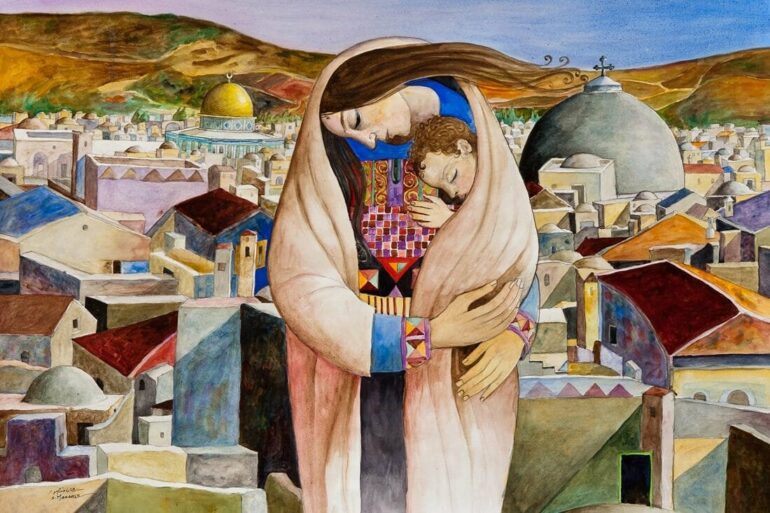
When the First Intifada broke out in 1987, Sliman Mansour made a decision that would transform not only his personal practice but the entire aesthetic of a nation. In his studio, it was no longer just a matter of painting the uprising, but of experiencing it through the very medium itself. By joining the movement to boycott Israeli products, Mansour and his peers in the New Visions collective found themselves deprived of their usual tools: tubes of oil paint and acrylics disappeared from their easels. What could have been a technical impasse became an artistic epiphany. Instead of giving up, Mansour turns to what lies beneath his feet. He begins to knead the earth, mixing it with glue, hay, and natural pigments such as henna or coffee. This shift to mud is not a retreat; it is a declaration of sovereignty. By using the very soil to represent the territory, he merges the subject and the medium, creating works whose cracked, organic texture seems to breathe the history of Palestine.
Mud as a Political Manifesto
Sliman Mansour’s work with earth is not merely a folkloric curiosity. It is a visceral response to a suffocating situation. Through this technique, he explores the fragility and resilience of existence. Once dried, the mud cracks, creating a network of wrinkles that evokes both the passage of time on the faces of farmers and the scars of a fragmented landscape. In these compositions, color no longer comes from a factory, but from the local geology. The deep brown of the soil, the ochre yellow of the clay, and the reddish hues of henna make up a palette that requires no external mediation. For Mansour, painting with the earth from his village of Birzeit means physically anchoring Palestinian identity in a material reality that no one can take away.
This experimental approach, shared with other artists such as Nabil Anani and Tayseer Barakat, marks a break with traditional political posters. Until then, Palestinian art had been largely dominated by propaganda imagery that was necessary but sometimes one-dimensional. With Mansour, the political becomes metaphysical. The work is no longer content merely to convey a message; it is the message by its very nature. This period of intense creativity proves that constraint can be the most powerful driver of formal innovation, transforming logistical scarcity into a revolution in visual thought.
Wandering and the Weight of the World
If there is one face that haunts the collective imagination, it is that of the old man bent under the weight of an immense, eye-shaped stone, at the center of which stands Jerusalem. Originally painted in 1973, the work *Jamal al-Mahamil* (*The Pack Camel*, or *The Bearer of Sorrows*) has become the most widely reproduced image in Palestinian art history. This elderly man, whose bulging muscles and weary gaze express an almost mythological perseverance, embodies the burden of exile and a visceral attachment to the land. The original painting met a tragic fate: given as a gift to Muammar Gaddafi, it is believed to have been destroyed during the U.S. bombing of Libya in 1986, although other sources suggest it disappeared during the fall of the regime in 2011.
Faced with the loss of this iconic work, Sliman Mansour set out to paint it again in 2014—not to replicate the past, but to keep the memory of this endurance alive. This figure of the porter is not merely an allegory of suffering; it symbolizes the dignity of one who refuses to let go of his burden, no matter how heavy it may be. In this image, Jerusalem is not just a city—it is a responsibility that each generation carries on its back. The impact of this work is such that it can be found both in the living rooms of families in the diaspora and on the walls of refugee camps, attesting to Mansour’s role as the architect of a shared visual consciousness.
Building an Infrastructure for the Imagination
Mansour’s commitment never stopped at the door of his studio. Aware that art cannot flourish without structures, he devoted a large part of his life to building cultural institutions. As early as the mid-1970s, he helped found the Palestinian Artists’ League, a crucial organization for protecting and promoting artists under occupation. Later, in 1994, he co-founded the Al-Wasiti Art Center in East Jerusalem, a venue that has become a vital hub for exhibitions and theoretical discourse on contemporary art in the region.
His influence also extends to the academic realm. By teaching at Al-Quds University and actively participating in the life of the International Academy of Art Palestine, he has trained generations of young artists to look beyond the obvious. His message has always been clear: art is a form of resistance, but it must first and foremost be art. He encourages his students to master classical techniques before deconstructing them, advocating for an intellectual rigor that rejects oversimplification. For Mansour, culture is a line of defense as important as any geographical border, for it is the last refuge of inner freedom.
The Poetics of the Olive Tree and the Horizon
Beyond the mud and the figures of porters, the landscape remains Sliman Mansour’s great, silent subject. His depictions of the olive tree are never purely decorative. The tree, with its twisted roots and centuries-old longevity, is a mirror of the Palestinian people. In his more recent paintings, the landscape becomes more refined, almost abstract, capturing the light of the Judean hills with an almost nostalgic precision. He paints not only what he sees, but what he fears will disappear. Every hill, every dry-stone wall is an act of territorial assertion in the face of the gradual erasure of the original landscape.
His later works also explore the theme of women in traditional dress, yet far removed from Orientalist clichés. The intricate embroidery and tatreez patterns—which he reproduces with surgical precision—serve as codes of identity and textile archives integrated into the painting. By placing these figures at the heart of dreamlike or fragmented landscapes, he forges a link between the female body—guardian of traditions—and the land, the object of all desire. It is a painting of permanence. Despite the cracks in the mud or the rifts of history, a chromatic serenity persists in Mansour’s work—a faith in the beauty of simple forms that continues to define the aesthetic horizon of an entire region.
In 2019, Sliman Mansour received the UNESCO International Prize for Arab Culture, an honor that underscores the universality of his struggle. Yet the artist remains rooted in his daily life in Ramallah, continuing to observe the transformations of his environment. His career proves that the most powerful art often arises from the most precarious conditions. By transforming dust into poetry and restriction into invention, he has shown that cultural resistance is not merely a reaction to the present, but a patient and aesthetic construction of the future. His work remains a living testament to the human spirit’s ability to transform mud into an unwavering affirmation of life.