
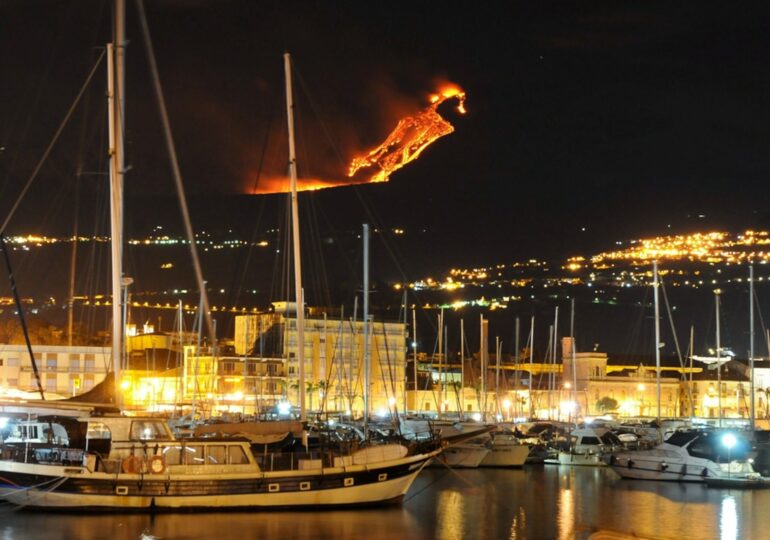
There are invitations that reason dictates we decline, but that instinct is quick to seize upon. Imagine the scene: an ordinary day under the Mallorcan sun, in the company of two friends from California. They’re getting ready to set sail for their annual summer ritual: a week of cruising aboard a forty-meter sailboat. This is nothing like those flashy, motorized “gin palaces” that clutter the Mediterranean harbors; we’re talking here about a true, high-class sailboat, manned by a crew of six. Normally, the circle is closed, the guest list set in stone. But this year, a quirk of geology has thrown the usual order of things into disarray. A few hundred miles away, Mount Etna has erupted, spewing a cloud of ash over Sicily and causing the immediate closure of Catania’s airport. Two Italian guests found themselves stranded, forced to watch the train—or rather, the boat—pass them by. That’s when the question came up, almost casually: “Why don’t you come stay for one night?”
On paper, the timing is disastrous. An important dinner awaits us the following evening at a trendy beach club—a promise made to loved ones we cherish. Yet, before logic could even formulate an objection, the answer shoots out, a little breathlessly: “What should we pack?” The excitement instantly sweeps away the still-painful memories of past crossings. We recall that twelve-hour trip on a Greek ferry where my partner spent the entire time vomiting into a plastic grocery bag. But seasickness seems like a thing of the past, especially when you see the partner in question breaking into a sailor’s dance in the living room—a rather memorable sight, to be sure. The course is set, and the meeting is scheduled for the next morning at 9:00 a.m. sharp on the docks at Port Adriano.
The Sacred Law of Teak and Onboard Etiquette
Arriving early at the dock is a basic courtesy in this world where punctuality is the only punctuation that matters. As we wait to board, a silent prayer rises that Mount Etna will continue its volcanic antics and that the Catania airport will remain hopelessly closed. Once on board, the captain welcomes us with an opening address that resembles a monastic code of conduct. Here, luxury has its rules, and almost all of them revolve around preserving the deck. The first is absolute: no shoes. Forget high heels or leather soles on the immaculate teak. The second rule concerns aesthetics and chemistry: spray-on sunscreen is prohibited, as oil is the sworn enemy of precious wood. Finally, the third rule requires a quick rinse under the stern shower after every swim in the sea, to prevent salt crystals from staining the deck. One might even wonder, with a touch of irony, whether laying down wood-look linoleum wouldn’t make life easier for everyone—but that would be to deny the very essence of recreational boating.
Becoming a model guest requires a certain amount of discipline. You quickly learn to move about with a keen awareness of your own footsteps. Just once, I let my guard down and broke the rule about rinsing off after a swim in the sea. The captain’s gaze, though polite, speaks volumes—enough for me to realize I’ve come close to committing a crime of lèse-majesté. Fortunately, I’m spared the chore of scrubbing the deck. On this forty-meter yacht, everything is a matter of striking a balance between technical rigor and the fluidity of social life. This is where the talent of our hosts, H and her husband M, comes into play. They possess that rare art of invisible organization—the kind that transforms complex logistics into a moment of pure relaxation.
The Art of Invisible Hospitality
Hosting guests aboard a sailboat of this size cannot be improvised. Weeks in advance, the menus were meticulously planned, favorite wines were selected and delivered to the onboard wine cellar, and entertainment was arranged for every moment of the day. It is this surgical precision in preparation that allows the magic to happen, creating the illusion that everything flows naturally, like the wake behind us. We sail along the rugged coastline of Mallorca, carried by a light breeze, before beginning the crossing to Menorca. For me, it’s an immediate rediscovery: having lost my Menorcan virginity just the week before, I savor the thrill of this impromptu return.

As we approach the neighboring island, the light changes, softening into a golden caress. We drop anchor as twilight settles in. The sight is breathtaking: the surrounding cliffs stand out against the horizon as if they’d been sketched in charcoal. Above our heads, the night sky begins to light up, the stars seeming to wink at us in a knowing way. It is at this very moment that the news breaks, confirming that my “dear friend” Mount Etna continues to act up. Catania is still at a standstill. The question comes up again, predictable yet delightful: “Would you like to stay one more night?” Needless to say, our dinner at the beach club has just gone up in volcanic smoke.
Learning to Take a Leap into the Unknown
What was supposed to be just a twenty-four-hour getaway turns into a three-day retreat. It’s a luxury far more precious than teak or fine wine: the luxury of watching time slow down. Conversations stretch out, becoming deeper—and funnier, too. We relearn how to marvel at insignificant details. M, our host, takes it upon himself to perfect my maritime education. He encourages me, with a touch of playful kindness, to jump off the top of the boat, to let myself slide into the depths of the dark water. He even improvises some diving lessons. While Tom Daley probably has nothing to fear from my technique, I find myself becoming somewhat addicted to it. There’s something liberating about the act of plunging into the unknown, of letting myself be swallowed up by the sea only to resurface, washed clean of all tension. I do it again and again, like a child who’s just discovered a new superpower.
This magical interlude takes me back to childhood memories, to that twinge of jealousy I used to feel when listening to certain classmates’ tales of endless, luxurious vacations. My father, with the quiet wisdom that characterized him, would help me put things into perspective. “One day, when you’re lucky enough to experience these moments, they’ll seem truly special. There’s no harm in knowing how to wait,” he’d tell me. His words resonate with particular clarity as the sailboat’s tender finally drops us off at the pier in Mahón. He was right. The wait and the unexpected events gave these three days a unique feel. I savored every second, every glass of wine, every dip in the water. As I set foot on dry land, I feel immense gratitude toward our hosts, toward my father’s wisdom, but also—and above all—toward that Sicilian volcano, whose explosive temperament turned out to be the most beautiful gift of the trip.