
The Geometry of the Desert: Architecture of Adaptation
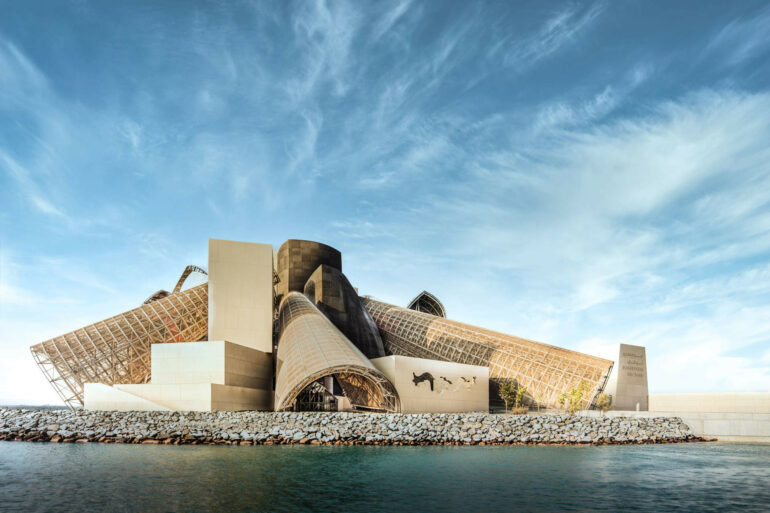
Building a cultural institution in extreme latitudes requires a radical rethinking of materials and climate. For the future museum complex in Abu Dhabi, architect Frank Gehry has moved away from smooth, standardized forms in favor of a structure organically connected to its arid environment. His architectural vision centers on ten monumental sculptural cones that redefine the local skyline. These volumes transcend mere aesthetic function to act as high-precision thermal devices. They ensure constant natural ventilation and cast vast areas of shade, adapting the building’s massive scale to the region’s extreme temperatures. This rugged interplay between the building and the sun marks a break from the neutrality of traditional exhibition spaces, offering visitors a physical experience in which architecture overcomes the challenges of the weather.
The site’s proportions convey a dizzying scale. With a total footprint of nearly 80,000 square meters, the building immediately stands out as the largest project ever undertaken by the Solomon R. Guggenheim Foundation. The layout of the spaces also reveals a fascinating reversal of conventional exhibition design norms. The interior galleries will span 11,600 square meters, while the open-air exhibition spaces will cover 23,000 square meters. This spectacular spatial asymmetry suggests a program in which monumental installations and sculptures will be directly exposed to the harsh light of the Persian Gulf, sheltered by the interlacing of these famous cones. Inside, the architect has envisioned unconventional layouts: asymmetrical perspectives break up the monotony, encouraging visitors to wander while immersing themselves in the surrounding desert landscape.
The Epicenter of a Territorial Strategy
In institutional circles, this project had almost become the stuff of legend—a promise held in suspense that seemed to scan the horizon, waiting for its moment. The Abu Dhabi Department of Culture and Tourism has finally set this vision in stone by scheduling the grand opening for December 11, 2026. This official announcement goes beyond simply setting a completion date. It marks the realization of one of the most scrutinized projects of recent decades, signifying the transition from a long-term political ambition to an operational reality.
The institution will not stand alone on a blank slate. It will cement the Saadiyat Cultural District, an area where the emirate is concentrating its museum resources with exceptional density. The new behemoth will be located in the immediate vicinity of the Louvre Abu Dhabi. This prestigious neighborhood will soon be further enriched by the completion of the Zayed National Museum, the Abu Dhabi Natural History Museum, and the teamLab Phenomena Abu Dhabi visual art space. This ecosystem reflects the local authorities’ clear commitment: to establish the emirate’s status as the undisputed global capital of the arts. By bringing together natural history, national narrative, digital innovation, and contemporary art within a single area, Saadiyat is envisioned as an intellectual hub. The stated goal is to forge a highly connected global community, where diverse audiences can come together through the visual arts.
The Shift in Centers of Gravity
While the exterior design exudes obvious formal power, the content of the collections heralds an equally profound overhaul of the discipline. The chosen time frame focuses exclusively on contemporary and modern art from the 1960s onward. However, the major shift occurs in the realm of artistic geography. The institution is deliberately moving away from the customary supremacy of Western art scenes to firmly shift its intellectual center of gravity toward other regions.

Scrupulous attention will be paid to artistic expressions from West Asia, North Africa, and South Asia, while maintaining connections with works from other continents. This positioning marks a rebalancing of representation in the art world. It offers a premier platform for aesthetics and imaginaries that are all too often viewed through a peripheral lens by major institutions in the Northern Hemisphere. By focusing on these regions, the museum’s leadership ensures that it highlights artistic trajectories that resonate deeply with the cultural reality of its own region, while simultaneously propelling new artists onto the global exhibition circuit.
Moving Away from Historical Linearity
To support this broadening of perspective, the curators made the radical decision to abandon the traditional chronological sequence. The linear historical narrative, deemed inadequate to encompass the complexity of non-Western trajectories, gives way to a thematic exhibition structure. The interior spaces will become zones of intellectual friction where works from different decades and movements will intersect, prioritizing conceptual affinities over strict chronological order.
Exploration of the collections will revolve around major themes of reflection. Abstraction will allow us to analyze how the rejection of figuration has manifested itself and been reinvented according to geographical contexts. Narrative and language will examine the imprint of scriptural tradition on the visual arts. Popular culture will serve as a mirror to the social changes in these regions, while landscape will examine artists’ visceral relationship with their physical environment. This cross-disciplinary approach aims to forge unexpected connections between artists whom institutional history has not traditionally brought into dialogue with one another.
On December 11, 2026, the opening of these doors will mark more than just the completion of a titanic undertaking. By displaying its collections in the shadow of its immense thermal chimneys, the institution is effectively shifting the center of gravity of contemporary art toward the Persian Gulf, imposing a new framework for geographical and aesthetic analysis on the global market.