
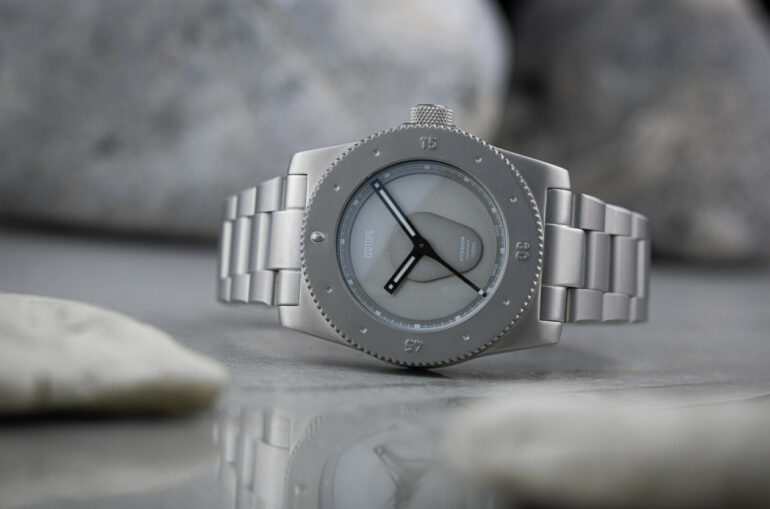
Some dive watches overemphasize adventure, piling on marine colors, engraved waves, and literal nods to the underwater world. The Isotope Hydrium Grey Reef Shark takes the opposite approach. Its shark doesn’t appear anywhere on the dial. It doesn’t tell its story through imagery. It expresses itself through a more subdued presence: a gray mass, matte surfaces, a compact design, and that sense of tension characteristic of silent predators.
The shark as a temperament, not as decoration
The name “Grey Reef Shark” signals a specific inspiration: the grey reef shark. Yet Isotope does not transform its Hydrium into a themed watch in the most literal sense of the term. No printed animal, no figurative motif, no tropical colors meant to evoke the ocean floor. The reference lies in the atmosphere: cold, dense, almost mineral.
This edition embodies a brutalist vision of the tool watch. “Brutalist,” in this context, does not imply an excess of material or cheap aggression. Rather, it lies in the economy of design and the choice of an unvarnished visual language. The Hydrium retains the design elements that have established its silhouette within the collection, but strips away anything that might distract from the essentials. The watch thus gains in coherence: gray becomes the color of an object designed for function, not for ornamentation.
This approach is fitting for a watch rated water-resistant to 300 meters, or 30 bar. The Hydrium Grey Reef Shark can therefore accompany its owner on a dive, even in the context of an encounter with sharks. But it doesn’t need this scenario to justify its existence. Its appeal lies precisely in its ability to embody the idea of immersion without turning it into a costume.
A case treated as a single block
The 316L stainless steel case measures 40 mm in diameter and is 12.9 mm thick. These proportions place this Hydrium in the compact rather than the showy category, even though its surface finish gives it a very assertive presence. Isotope has opted for a full microbead finish, a treatment that darkens the steel and absorbs light where a more conventional polish or satin finish would seek to reflect it.
The result has a distinctly industrial feel. The metal seems less precious than functional, as if it had been designed to withstand rather than to seduce. This formal restraint also gives the watch a more contemporary look: gray is not a neutral color, but a way of revealing volume through the contrast between planes and shadows.
The unidirectional rotating bezel, designed for calculating dive times, effectively encapsulates this approach. Crafted from a single piece of metal, it avoids the decorative effect of an added insert. Its five-minute markers alternate between raised Arabic numerals and recessed dots. The design is simple, legible, and almost architectural. It accentuates the monolithic character of the watch without weighing down the design.
In a category where dive watches often follow the same conventions, the Hydrium opts for a less predictable aesthetic. It does not seek to evoke nostalgia for vintage equipment. Instead, it embraces the concept of a contemporary instrument, designed around materials, textures, and elements reduced to their essential function.
A gray dial that eschews embellishment
The cool gray dial continues this process of simplification. The logo at 12 o’clock has been simplified compared to previous Hydrium versions: only the name “Isotope” remains, in white, without the symbol that previously accompanied it. This detail alone is enough to alter the overall balance. The upper part of the dial feels more open, and the composition fully embraces its monochromatic aesthetic.
The hour, minute, and second hands—all black—enhance the contrast while remaining within the same visual palette. No splash of color disrupts this interplay between gray, black, and white. It is a demanding choice: without a bright color to guide the eye, the watch must rely on its textural depth and proportions.
At the center, the raised Lacrima motif maintains the graphic identity of the Hydrium line. Surrounding it, a raised outer ring features the hour and minute markings. The depth created by these different levels prevents the dial from appearing flat or austere. The eye moves between the center, the outer scale, and the hands, following a layout that is easy to read without being conventional.
This simplicity is therefore not a lack of design. On the contrary, it is based on a very precise attention to how each element occupies the space. By eliminating superfluous effects, Isotope highlights what defines the Hydrium’s personality: its central motif, its outer chapter ring, and its instantly recognizable silhouette.

The Strap Collectors Have Been Waiting For
Above all, this edition introduces a long-awaited development in the Hydrium family: its first steel bracelet. Until now, the collection did not offer this option, even though fans of the brand had been clamoring for it. The arrival of the bracelet is therefore not merely a change in accessory; it expands the ways in which the model can be worn.
Constructed with three rows of links, the bracelet echoes the case’s beaded finish to maintain the watch’s visual unity. A diving clasp with micro-adjustment allows for a custom fit, while quick-release pins make it easy to switch between configurations. The Hydrium Grey Reef Shark comes with this bracelet and a gray FKM rubber strap.
The choice between the two affects more than just comfort. On a rubber strap, the watch emphasizes its nautical and technical character. On a steel bracelet, it takes on a more urban, almost austere look, with a seamless matte finish between the case and the links. The new bracelet remains compatible with all Hydrium models produced to date. Owners of an earlier version can therefore purchase it separately, without having to replace their watch.
Priced at 268 pounds, it also reflects a commitment to evolving the collection as a cohesive whole rather than reserving a new material for a single model. It’s a detail that matters in a line where collector loyalty appears to have influenced development decisions.
A Movement Visible Behind the Austere Exterior
The watch’s front face emphasizes simplicity; its back reveals a more watchmaker-oriented nuance. Through the transparent case back, the Swiss Landeron 24 self-winding caliber is visible. It beats at 28,800 vibrations per hour—or 4 Hz—and offers a 40-hour power reserve. Its functions are limited to hours, minutes, and seconds, in keeping with the project’s overall simplicity.
The movement features several types of finishes: brushing, Côtes de Genève, and circular graining. This variety contrasts with the deliberate minimalism of the dial and case. While the exterior maintains a restrained appearance, the case back offers a glimpse into the movement’s intricate mechanics. The outer edge of the caseback also bears the individual number of the watch within the series.
The Isotope Hydrium Grey Reef Shark is limited to 200 pieces and priced at 1,300 British pounds. Orders open on September 10, 2026, through Isotope. With its unique bracelet, micro-bead-blasted case, and a dial that avoids overly obvious diving motifs, this Hydrium does not seek to imitate the depths—instead, it captures their rare light and gravity.