
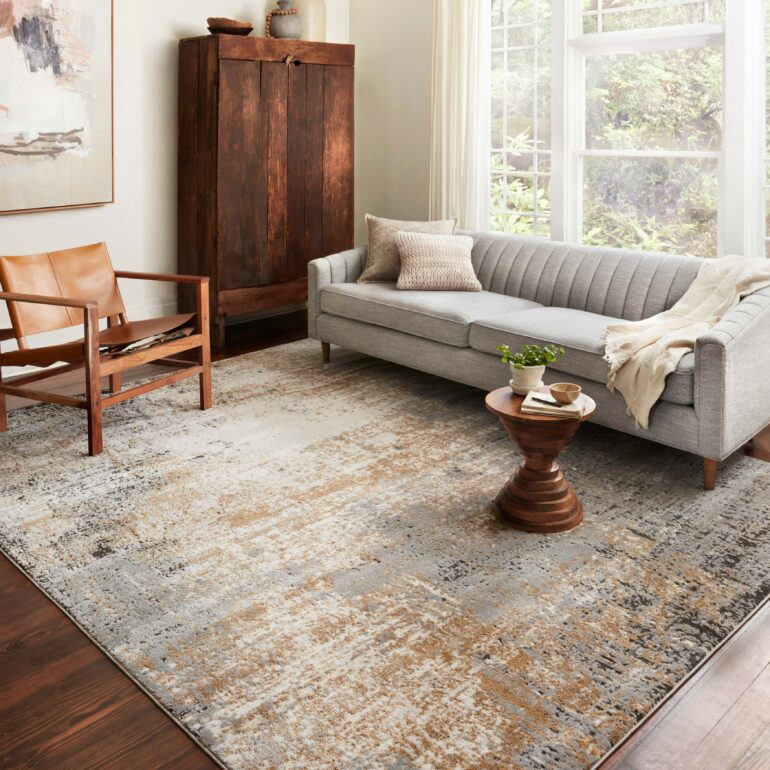
The architecture of lofts and large open living rooms demands a discipline that is often underestimated: anchoring. In these spaces, where the boundaries between living areas blur, the rug is no longer just a decorative accessory but a structural tool for “zoning.” Looking ahead to 2026, the aesthetic is shifting radically away from industrial rigor and binary black-and-white contrasts. We are seeing the emergence of a movement dubbed “Emotive Modernism,” which favors organic tones—terracotta, olive green, chocolate brown, or teal—and textures capable of softening hard concrete or wood floors. To inhabit the space without appearing to float, standard dimensions are evolving: the 8×10-foot (240×300 cm) size becomes the minimum requirement, while 10×14-foot (300×420 cm) rooms are becoming the norm to accommodate an entire seating area.
Texture as a Foundation: Jute and Natural Fibers
The return to raw materials is reflected in a pursuit of tactile depth rather than intricate patterns. The Makeda rug, crafted from a blend of jute and cotton hand-knotted by Lulu and Georgia, exemplifies this trend toward tactile minimalism. Priced between $600 and $1,000, it offers a neutral yet textured foundation. In a similar vein, the Emily’s House London rug features a flat weave for an understated presence.
The architectural structure of the floor can also be achieved through more pronounced textures. The Savanna model from Nordic Knots (approximately €1,160 for an 8×10 size) combines dark jute with cream-colored wool accents, creating a contrasting ribbed effect that adds rhythm to the room. For high-traffic areas, short-pile rugs remain the preferred choice, such as the Adele DL-302 Platinum from Atlanta Designer Rugs, whose thickness—limited to one centimeter—ensures enhanced durability.
The Essence of Comfort: Wool and Plush Textures
Thermal and acoustic comfort is the top priority in large, open spaces. New Zealand wool, renowned for its natural dust-filtering properties, remains the material of choice. The Grand collection from Nordic Knots, particularly in the Walnut and Chestnut shades, draws inspiration from the Scandinavian hospitality style with its high, dense pile (priced between €840 and €969 depending on the finish). This pursuit of softness is also evident in the reimagined Berber style. Pieces from Beni Rugs, such as the Surcoma Blush Peach model, use traditional Moroccan wool washed using ancestral methods, featuring peach and burnt orange tones that are a far cry from the classic black-and-white Beni Ourain rugs.
For those who prefer a more graphic aesthetic without sacrificing the elegance of wool, flat-woven rugs like the Cross or Plaid models from Nordic Knots offer a modern alternative. Their low profile is particularly well-suited for use under furniture with casters or in loft-style dining rooms. For an extra touch of sophistication, the blend of wool and Tencel—a silky fiber derived from wood pulp—adds a satin sheen to the designs from the collaboration between Jeremiah Brent and Crate & Barrel, particularly in the Chestnut Red shade.
Curved Geometries and Bold Colors
The year 2026 marks the end of the dominance of the strict rectangle. Sinuous shapes and organic edges are taking center stage to break up the linearity of industrial architecture. Collections featuring fluid silhouettes and varying pile heights create a topographical landscape on the floor. This formal freedom is accompanied by a return to bold colors, such as chartreuse. The Nelio model, designed by Sarah Sherman Samuel for Lulu and Georgia (approximately €895), uses a grid of polka dots on an acid-green background to energize the space.
The “Scandi Berber” style also blends these influences, combining Nordic geometric patterns with the rich texture of shaggy rugs. For more modest budgets, these designs are sometimes available in synthetic microfiber, offering a softness comparable to natural fibers.

The Reinvention of Vintage: Restoration and Patina
Authenticity remains a safe haven, championed by brands like Revival Rugs. The process involves sourcing Turkish or Persian rugs ranging from 30 to 100 years old, restoring them, and—for certain models like the Dythos or the Hart—overdyeing them in contemporary shades of terracotta or olive green. These one-of-a-kind pieces, priced between €310 and €1,790, retain the delicacy of vintage wool while blending seamlessly into today’s color palettes.
At the same time, collections like Colette (Revival) or the lines from Loloi Rugs focus on the “faded” effect. These rugs evoke the aesthetic of the 1970s with faded traditional medallions and warm neutral tones, offering a weathered look right out of the box. They often use polyester printing techniques or fine shorn wool for easy maintenance.
Technical Specifications and Maintenance Realities
The major innovation in recent years has been machine-washable rugs, a segment dominated by Ruggable. Their two-piece systems (decorative cover and non-slip rug pad), such as the Sudaria or Odette models, allow for at-home cleaning of sizes up to 8×10. However, using large rugs in lofts poses technical challenges: a 240×300 cm rug requires a washing machine with a capacity of more than 10 kg. Industry professionals emphasize that forcing a rug into a drum that is too narrow can damage the machine.
For natural fibers, the rules are different. Wool, thanks to the hollow structure of its fibers, hides dust for several years without appearing dirty, but requires vacuuming without an aggressive rotating brush to avoid breaking the fibers. In contrast, jute and sisal are extremely sensitive to moisture; any liquid spills must be treated with dry brushing only, or the weave will be permanently marked. As for the lifespan of washable synthetic rugs in high-traffic areas, maintenance specialists estimate it to be between four and six years, compared to several decades for hotel-quality hand-knotted wool.