
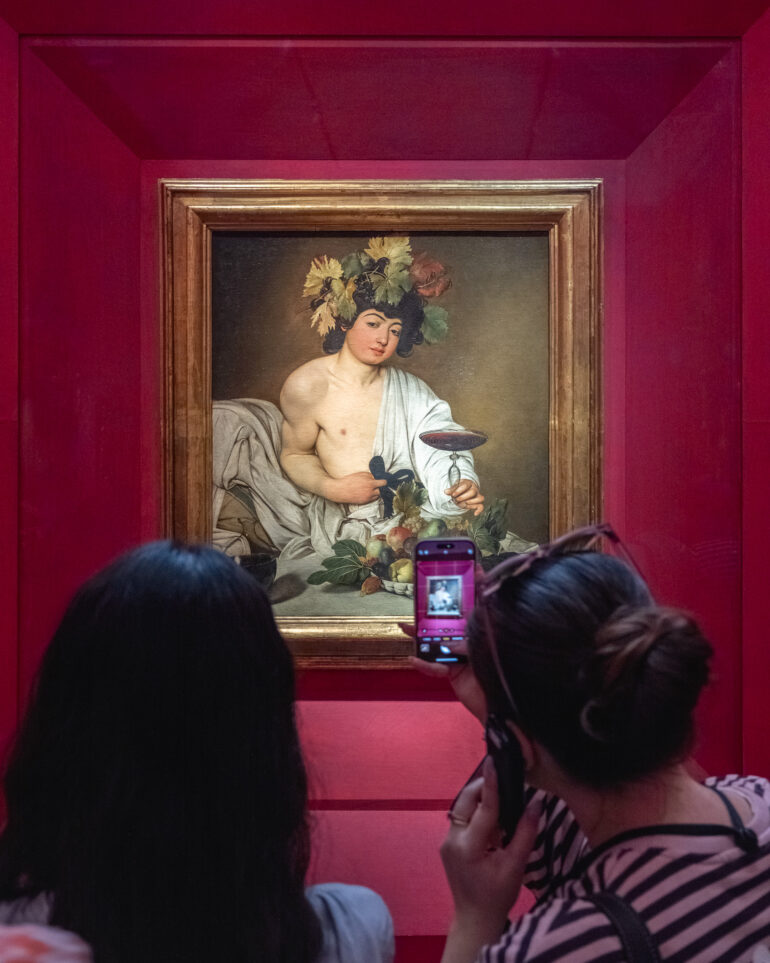
The skies over Florence took a sudden turn on Thursday, September 17, 2026. In the afternoon, a “rain bomb” (*bomba d’acqua*), as Italian meteorologists call it, struck the Medici city with rare ferocity. Within the space of an hour, rainfall readings reached critical levels: 44.6 mm at the Botanical Garden and up to 45.5 mm within the Boboli Gardens. This sudden downpour put the city’s historic structures to the test, seeping even into the first-floor galleries of the Uffizi, where Caravaggio’s masterpiece, *Bacchus*, had to be immediately secured.
A leak beneath the skylight in the Sala del Seicento
The incident came to a head in the 17th-Century Hall (*Sala del Seicento*). It was here, beneath a skylight, that a water leak was detected as the storm battered the historic center. The water, caused by a leak in the skylight, flowed directly onto the protective display case housing *Bacchus* (circa 1598). This 95 × 85 cm oil on canvas, one of the most closely scrutinized works in the collection, was located precisely in the path of the leak.
Museum staff observed water running down the outer wall of the climate-controlled display case. Thanks to this high-tech protective system, the liquid never came into contact with the paint layer. The conservation teams immediately proceeded with the preventive removal of the painting (cataloged under number 1890, no. 5312) to isolate it from any residual moisture. As a safety precaution, the gallery was closed to the public to allow for a thorough technical inspection and complete drying of the surfaces.
Bacchus: Spared from Rumors and Floodwaters
Beyond the weather-related incident, confusion briefly stirred up some news outlets. English-language publications initially reported that *The Medusa*, another major work by Caravaggio held by the institution, was the target of the water infiltration. Official sources quickly corrected these claims: only the *Bacchus* was affected by this emergency evacuation. No damage was reported, neither to this work nor to the six other 17th-century paintings on display in the same room, which remained out of reach of the floodwaters.

The management of the Uffizi Galleries did not disclose the specific structural causes of this roof failure, nor did it confirm any theories regarding possible maintenance issues with the drainage system or the roof structure. Emphasis was placed on the effectiveness of the emergency protocols: the very next day, on the morning of Friday, September 18, the room was able to reopen its doors, and the *Bacchus* was returned to its place in its glass display case.
Widespread Impact at the Pitti Palace
While the Uffizi Gallery was able to resume normal operations in less than twenty-four hours, the storm left more lasting damage on the other bank of the Arno. The Pitti Palace, also managed by the Uffizi Galleries, suffered similar water infiltration. These incidents forced management to restrict access to certain exhibition areas. As a result, the Palatine Gallery and the Gallery of Modern Art experienced temporary room closures, illustrating the vulnerability of Renaissance palaces to these increasingly frequent extreme weather events.
To date, the institution has not disclosed the cost of the drying operations and any necessary roof repairs, nor has it revealed the insurance value involved in these procedures for relocating the artworks. The situation has now stabilized, allowing visitors once again to admire the masterpieces of the Seicento.