
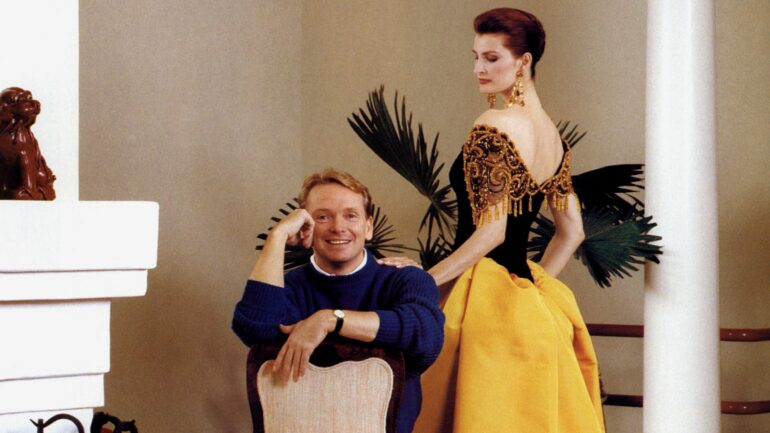
When you step through the door of the Beverly Hills villa where Bob Mackie lived in the late 1980s, the silence and the light create an immediate contrast with the deafening glitz of the stage. For the man the press has dubbed the “Sultan of Sequins” or the “Rajah of Rhinestones,” his home is not an extension of his craft, but its exact opposite. In September 1989, when he opened the doors of his home to Architectural Digest magazine, the designer actually found it amusing to think of his visitors’ potential disappointment. They expected chrome, black, and the glimmer of the thousands of sequins he embroidered for Cher or Diana Ross. Instead, they discovered a sanctuary of serenity where natural light served as the sole ostentatious luxury.
Architecture as a Haven of Privacy
Purchased in the 1980s, this Beverly Hills property was not chosen for its social prestige, but for its intrinsic architectural qualities. Designed by an architect who lived there himself, the house emphasizes structure and natural light. Vast floor-to-ceiling windows punctuate the space, blurring the boundary with the outdoors while preserving complete privacy. For Bob Mackie, this choice is one of discretion. The designer, whose hands have shaped the silhouettes of Tina Turner, Dolly Parton, and Elton John, refuses to let his living environment become a stage set. “ I’ve never liked a lifestyle that mirrors the clothes I design—it doesn’t appeal to me,” he confided during the guided tour. This quest for privacy guides every design decision, making the home a retreat far from the red carpets and spotlights of television studios.
An Aesthetic of Retreat
The interior design, orchestrated in collaboration with his friend, interior designer Robert Kelly, reflects a radical minimalism for the time. Mackie doesn’t clutter his space with superfluous furniture. When he moved in, he admitted to buying almost no furniture, preferring the simplicity of what was already there, with the exception of a library sofa that he had reupholstered. This room, the library, stands out for its unique finish: a weathered blue paint, applied with a sponge, which gives the walls a washed-out, soothing texture. Far from the clutter often associated with fashion personalities, the rooms feel airy and open.
Even more striking is the near-total absence of professional mementos. In this temple of restraint, the ten Emmy Awards, the Tony Award, and the Oscar nominations do not take pride of place on the mantels. The trophies are out of sight, replaced by a few posters and discreet photographs. The only nod to his shared history with the world’s biggest stars is a ceramic shoe, a gift from Cher, which is among the few personal items on display. The rest is devoted to his work, and his work remains at the Bob Mackie studio.
From Beverly Hills to the Heights of Laurel Hills
The real estate journey of Robert Gordon Mackie, born in 1939, reflects this constant quest for Californian tranquility. After his years in Beverly Hills, the designer sold that property to purchase, in July 2005, a ranch-style home in the Laurel Hills area, within the Hollywood Hills West. For $1,695,000 (approximately 1.52 million euros at the current exchange rate), he moved into a 1962 home spanning approximately 320 square meters. With its five bedrooms and four and a half bathrooms, this home retains the functional and horizontal spirit of mid-century California architecture. Mackie lived there for more than a decade before selling it in 2016, the year the property was listed on the market for a price ranging between $2,175,000 and $2,180,000.
The man who passed away on September 14, 2026, in Palm Springs at the age of 87 maintained this duality between public extravagance and private restraint until the very end. While his creations continue to define a certain vision of Hollywood glamour, his successive residences serve as a reminder that, for the designer, true luxury lay not in the glint of rhinestones, but in the quality of a shadow cast upon a faded blue wall.