
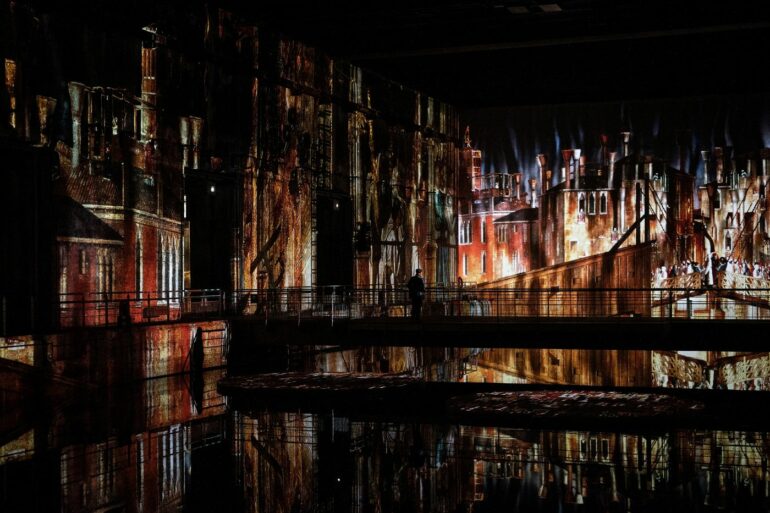
A new exhibition in Venice brings together artists and science to raise awareness about climate change and ocean degradation, using immersive installations and innovative data in a venue steeped in history.
A venue steeped in history for a contemporary crisis
The site wasn’t chosen at random, in fact. In this former church turned exhibition space, the sacredness of the place almost amplifies the ritualistic dimension of certain works. The One Ocean Foundation describes its project as a transdisciplinary initiative, combining podcasts, lectures, artist residencies, traveling exhibitions, and digital archives. The idea is to truly emphasize biodiversity, marine conservation, and the health of the planet. It’s also worth noting that the project has been nominated for the Earthshot Prize, which lends it considerable credibility, as does its recognition by the United Nations Decade of the Oceans.
The initial observation is now well documented: the changes affecting the ocean are no longer just a scientific abstraction—they’re a concrete reality. They impact the climate, migration, coastal ecosystems… Basically, everything that makes Earth habitable. In Venice, a city that lives constantly with the vulnerability of its water, this interpretation takes on its full meaning. It’s quite fascinating, isn’t it?
Seven artists, seven ways to listen to life
This project brings together seven artists and collectives from around the world: Marshmallow Laser Feast, Yoko Shimizu, Antoine Bertin, Almagul Menlibayeva with Suad Gara, Andrea Crespi, Elnara Nasirli, and Orkhan Mammadov. The Biennale describes their work as an exploration of connections, migration, and communication between living beings and their environment. The chosen mediums range from simple immersive installations to moving images, sound, and even artificial intelligence.
Marshmallow Laser Feast presents *Seeing Echoes in the Mind of the Whale*, a work based on bioacoustics and the voices of cetaceans. Antoine Bertin, meanwhile, works on *Fish String Theory*, drawing inspiration from the soundscapes of the Venetian lagoon and incorporating the mysterious sound produced by a Mediterranean stonefish. Honestly, his project—launched during a residency organized by the One Ocean Foundation in collaboration with ZEITGEIST19—took on a whole new dimension thanks to in-depth research conducted at Auckland University of Technology.
The main message is, first and foremost, to listen before showing. In Yoko Shimizu’s work, bioluminescence and plankton become fragile indicators of the planet’s balance. Elnara Nasirli, with *Whispering Forest*, translates the electrical activity of an olive tree into sounds using human touch, demonstrating that perception can also become an ecological practice in its own right.
Myths, Data, and Collapses
The darkest part of the exhibition concerns the Caspian Sea. Almagul Menlibayeva and Suad Gara present *Water Older Than the Sun (Caspian)*, featuring original music by Reinhold Heil, accompanied by the short documentary *Requiem for the Caspian* produced by ZEITGEIST19. All of this addresses the ecological degradation of a region where water is inextricably linked to memory and geopolitics.
Andrea Crespi, for his part, evokes the myth of the Nereid Thetis in a holographic display, blending ancient history with statistical data. Orkhan Mammadov uses artificial intelligence to reveal networks of mycelium, both above and below ground. You see, technology isn’t presented here as a miracle solution, but rather as a tool. Useful, perhaps, but it can also be misleading if we don’t keep in mind the physical reality it seeks to reveal.
A Warning Rather Than a Comfort
In its presentation, the Foundation emphasizes the idea of a planetary archive: the ocean preserves the memory of deep time, but also, of course, current imbalances. This is what gives *As Above, So Below* a significance that extends far beyond the exhibition season itself. The event is scheduled to run through June 8, 2026, with extended hours on that day to coincide with World Oceans Day.
Venice loves to lose itself in its illusions, but it also knows the price it must pay for that. I find that the exhibition’s strength lies precisely in this constant search for truth. It doesn’t promise to re-enchant the sea. On the contrary, it challenges us and poses the question: how can we understand it, if not by listening to what we stand to lose?