
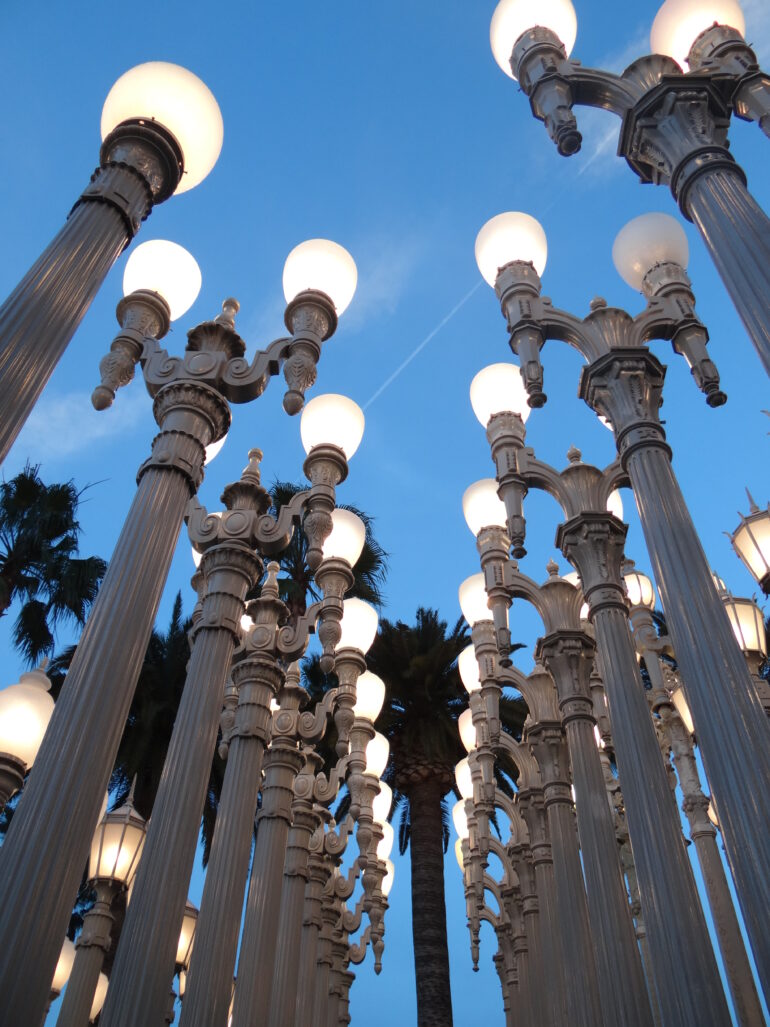
LACMA presents two iconic works: *Metropolis II*, which amplifies the frenzy of urban life, and *Rain Room*, which suspends rain in a sensory space. This dual exhibition masterfully illustrates art’s ability to simulate and reveal the very essence of our modern environment.
Two machines that explore the city
At the heart of LACMA, two installations embody a major contemporary concern: immersing the visitor in a system that does not merely invite observation, but “measures, challenges, and moves” them. Metropolis II, a monumental work by Chris Burden, transforms the modern city into a nervous mechanism composed of steel beams, 18 tracks, and HO-scale trains. The institution notes that miniature cars race through it at a proportional speed of 240 miles per hour, with this saturated engineering network capable of handling approximately 100,000 vehicles per hour (lacma.org).
Speed as a synonym for vertigo
The work does not celebrate the exhilaration of traffic; rather, it highlights its exhaustion. According to the museum, Chris Burden sought to make the public experience the stress inherent in a hyperactive, noisy, and suffocating megalopolis. This interpretation aligns perfectly with the artist’s aesthetic, drawn to installations where engineering becomes a true critical language. Here, the city stands less as an architectural promise than as an oppressive mechanism, a cathedral of endless flow with no apparent exit (lacma.org).
What makes Metropolis II so fascinating is that the scaled-down version, far from soothing the eye, concentrates all the urban frenzy. It does not dispel it; it condenses it and pushes it to its peak (lacma.org).
Rain suspended in sensory space
With Rain Room, the studio Random International shifts its aesthetic register, without abandoning the concept of an immersive installation. LACMA describes it as a continuous downpour that miraculously stops as soon as a human presence is detected. Visitors thus take control of the elements, treating themselves to a poetic pause within a highly responsive environment. Conceived in 2012, this installation invites the viewer to master the rain, while paradoxically confronting them with its persistent omnipresence (lacma.org).
The collective explains that the work utilizes water, a complex network of sensors and valves, as well as custom-built software. This technological choreography offers an amplified mirror of our ecosystem, where the human footprint freezes nature in place. This striking contrast between protection and vulnerability also explains the work’s timeless appeal, acclaimed from London to Shanghai, via New York and Los Angeles (random-international.com).
The institution, a new laboratory for experimentation
The significance of this approach goes beyond mere spectacle to question the very framework of the exhibition. By including Rain Room in its Art + Technology program (via The Hyundai Project), LACMA reaffirms a visionary strategy: transforming the museum into a space for lived experiences, moving beyond the strict preservation of objects. While this installation left a lasting impression at the BCAM between November 2015 and January 2017, Metropolis II remains today one of the centerpieces of the institution’s online programming (lacma.org).
Ultimately, these two works explore a shared reality through diametrically opposed prisms. One accelerates our world to the point of mechanical exhaustion; the other suspends it, drop by drop. Between Chris Burden’s steel dystopia and Random International’s obedient poetry, LACMA delivers a lesson as discreet as it is powerful: contemporary art and design are no longer content to be a mere representation of the world. They simulate it to lay bare, raw and exposed, its very nerves (lacma.org).