
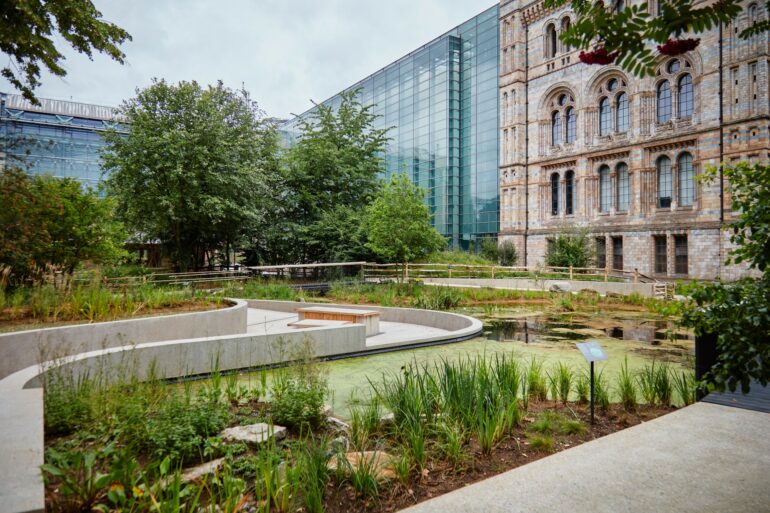
In London, the transformation of museum green spaces into true cultural hubs exemplifies a cutting-edge trend: combining biodiversity, inclusion, and exceptional design to reinvent the open-air artistic experience.
From Backyard to Heart of the Cultural Experience
Long relegated to the status of mere ornamentation, the green spaces of London’s museums are now establishing themselves as cultural destinations in their own right, rivaling the appeal of indoor galleries. A perfect illustration of this dynamic, the garden at Tate Britain—awarded a gold medal at the 2026 Chelsea Flower Show—offers a striking demonstration of contemporary landscape design, far removed from any horticultural pastiche. Designed by landscape architect Tom Stuart-Smith, this project even serves as a manifesto for the highly anticipated renovation of the Millbank Garden, scheduled for next spring.
From a secluded retreat to a public space
Opened in 1897, Tate Britain long concealed its garden behind monumental, austere architecture. Majestic staircases and an imposing portico loomed over two modest lawns, almost smothered by the building’s imposing presence. This relic of a bygone era called for reinvention. At a time when cultural institutions are rethinking their appeal to reconnect with their audiences, the landscaped garden takes on a highly strategic dimension.
The approach is bold: to make the exterior a natural extension of the galleries. The project weaves a subtle dialogue with British art, while avoiding the pitfall of museum insularity. It draws inspiration in particular from Victor Pasmore’s painting *The Green Earth*, created between 1979 and 1980, and features a plant selection that is unexpected for a national institution. Magnolias, sago palms, false pepper trees, pomegranate trees, and fig trees compose a palette with almost Mediterranean accents, aptly highlighting the changing London climate.
Botanics in the Service of Resilience
Far from mere exotic affectation, this botanical selection addresses eminently contemporary imperatives: resilience in the face of climate upheaval and the preservation of biodiversity. The Royal Horticultural Society notes that this space was designed with water-efficient species, evoking the forests of East Asia. The layout incorporates a stone path guiding visitors to a circular agora dedicated to relaxation, conversation, or pure contemplation.
In this design, every detail of the layout is weighed with the same rigor as the architectural volumes. This garden transcends passive observation to become a true place of social interaction. This philosophy echoes the requirements of the 2026 Chelsea Flower Show, whose 113th edition highlighted accessibility, material reuse, and climate adaptation. Proof, if any were needed, that landscape design constitutes a civic narrative as powerful as an art curation.
London, a pioneer of open-air culture
Tate Britain is part of a major metropolitan movement. In 2024, the Natural History Museum unveiled the spectacular renovation of its South Kensington gardens, the result of five years of work and a £25 million investment. With over five million visitors in its first year, the site has successfully transformed its lawns into true extensions of its collection, adding a unique educational dimension.

Other gems of the capital are following suit. The Barbican recently hosted a striking installation by Delcy Morelos, transforming its sculpture courtyard into a monumental burial mound. Over at Kew Gardens, a vast outdoor exhibition dedicated to Henry Moore extends this exploration of the symbiosis between art and nature. One thing is clear: culture gains strength when it breaks free from its historic walls to flourish in the open air.
The art of reconnecting with the living
While the union of sculpture and landscape runs through the history of art—from Barbara Hepworth, who enhanced her works through the movement of the sun, to Claude Monet, who regarded his Eden in Giverny as his ultimate masterpiece— the concept takes on a special resonance today. It is about responding to the climate emergency, the decline of biodiversity, and that visceral need to reconnect with the living world.
These projects require colossal investments, often supported by philanthropy, but they uphold an essential principle: free access. In a metropolis where the enjoyment of a private garden is often a privilege, the real challenge is to share beauty without reducing it to a mere matter of ownership.
Ultimately, these virtuous ecosystems offer an elegant response to the sometimes intimidating rigidity of traditional institutions. A masterfully designed garden softens the experience, invites visitors to linger, slows the pace of the visit, and multiplies the reasons to step through a museum’s doors. While the landscape does not cure all the frailties of historic buildings, it proves that a cultural institution can—and must—breathe differently.