
The Virtual Builder's Stone Anchor
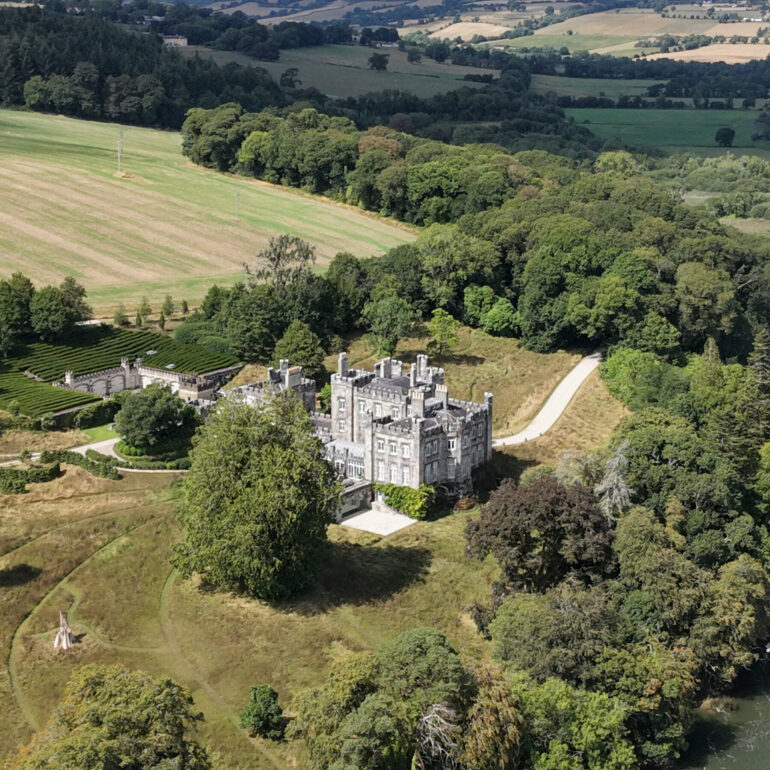
In a move that seems to contradict the very essence of his intangible empire, Mark Zuckerberg has just cemented his attachment to the physical world by acquiring Strancally Castle. This choice, far from trivial, places the founder of the digital social era at the heart of rugged Ireland, within a residence whose foundations have stood for two centuries. There is a kind of raw poetry in this gesture: the man who has spent two decades dematerializing our social interactions now seeks refuge behind stone walls whose thickness defies time and algorithms. This estate is more than just a prestigious real-estate transaction; it signifies a desire to be part of a historical continuity that silicon can never offer.
The two-hundred-year-old building casts its massive silhouette against a landscape where silence is broken only by the elements. By choosing this residence, Mark Zuckerberg is making a radical departure from the sleek, transparent aesthetic of Silicon Valley to embrace the weight, opacity, and permanence of granite. Strancally Castle is not a structure born of a futuristic vision, but a remnant of an era when power was measured by the ability to withstand the assaults of the outside world. For the CEO, it’s a return to the tangible, to raw material—a way to possess a piece of eternity that depends on neither software updates nor a network connection.
The Memory of Shadows and the Weight of the Past
The most striking aspect of this acquisition undoubtedly lies in the castle’s immediate surroundings. The property is located right next to a site marked by a particularly dark and macabre medieval past. This juxtaposition between the new owner’s contemporary luxury and the grim echoes of local history creates a charged, almost anachronistic atmosphere. Mark Zuckerberg isn’t just settling into a postcard-perfect setting; he is putting down roots on land where the memory of past centuries is tinged with tales of medieval cruelty and violence. This coexistence with the spectres of Irish history adds a solemn, even austere, dimension to his move.
This proximity to places with a sinister past highlights a striking contrast with the technological optimism the billionaire usually embodies. While the metaverse promises a world free of friction and pain, the ground beneath his new home serves as a reminder of the relentless reality of the human condition throughout the ages. The stories of that medieval era—marked by a harshness whose traces still remain on the site—anchor Strancally Castle in a geographic and historical reality that defies any attempt at digital smoothing. It is a luxury that does not seek to please, but to assert a presence—a personal fortress built atop the sediments of a turbulent past.
The Irish Turn and the Quest for Permanence
The choice of Ireland as the chosen location for this new estate is no accident either. By acquiring Strancally Castle, Mark Zuckerberg is aligning himself with a geography of strategic isolation. The island, with its capricious climate and rugged topography, offers natural protection that few other places can guarantee. Here, the two-hundred-year-old building becomes a bulwark. The billionaire seems to be trading constant visibility for the discretion of fortresses of yesteryear. This move raises questions about the vision that technology leaders have for our future: a growing need to reconnect with structures that have already proven their ability to weather the storms of history.
The building itself, with its two-century-old architecture, represents the antithesis of planned obsolescence. In a world where everything becomes obsolete within a few months, owning a monument that has witnessed the passing of generations brings a nearly mystical sense of stability. Mark Zuckerberg isn’t just changing his surroundings; he’s changing his relationship with time. By taking up residence within the walls of Strancally Castle, he agrees to become the guardian of a legacy that transcends him. The estate imposes its own rules and its own rhythm, forcing its inhabitant to adapt to the stone rather than the other way around. It is a lesson in humility before the material world—a luxury to be savored in its enduring nature and sturdiness.
A New Form of Technological Lordship
Zuckerberg’s arrival in this region of Ireland redefines the contours of success in the digital age. The goal is no longer merely to own servers or patents, but to dominate lands steeped in history. The image of the castle—especially when surrounded by sites with a bloody medieval history—evokes a return to a modern feudalism in which the new lords of data seek to legitimize their power through the possession of historic estates. Strancally Castle thus becomes the standard-bearer of a power that, having conquered minds through screens, now seeks to leave an indelible mark on the physical landscape.
This installation is sure to fascinate as much as it provokes thought. Seeing one of the most influential men on the planet nestle within a two-century-old building, in the midst of a land steeped in dark legends, offers a striking image of our times. It is the meeting of hyper-modernity and archaism, of an uncertain future and an immutable past. Ultimately, Mark Zuckerberg’s acquisition of this Irish castle may well be his clearest statement on his worldview: a space where, despite all virtual progress, nothing can ever replace the security and prestige of a stone citadel firmly anchored in soil rich with stories—however terrifying they may be.
The Strancally estate, with its two centuries of history, is thus poised to begin a new chapter—perhaps the strangest in its narrative. Within its walls, the murmur of invisible servers might soon mingle with the echoes of the surrounding medieval tragedies, sealing the unlikely union between the Palo Alto tycoon and the ghosts of ancient Ireland.