
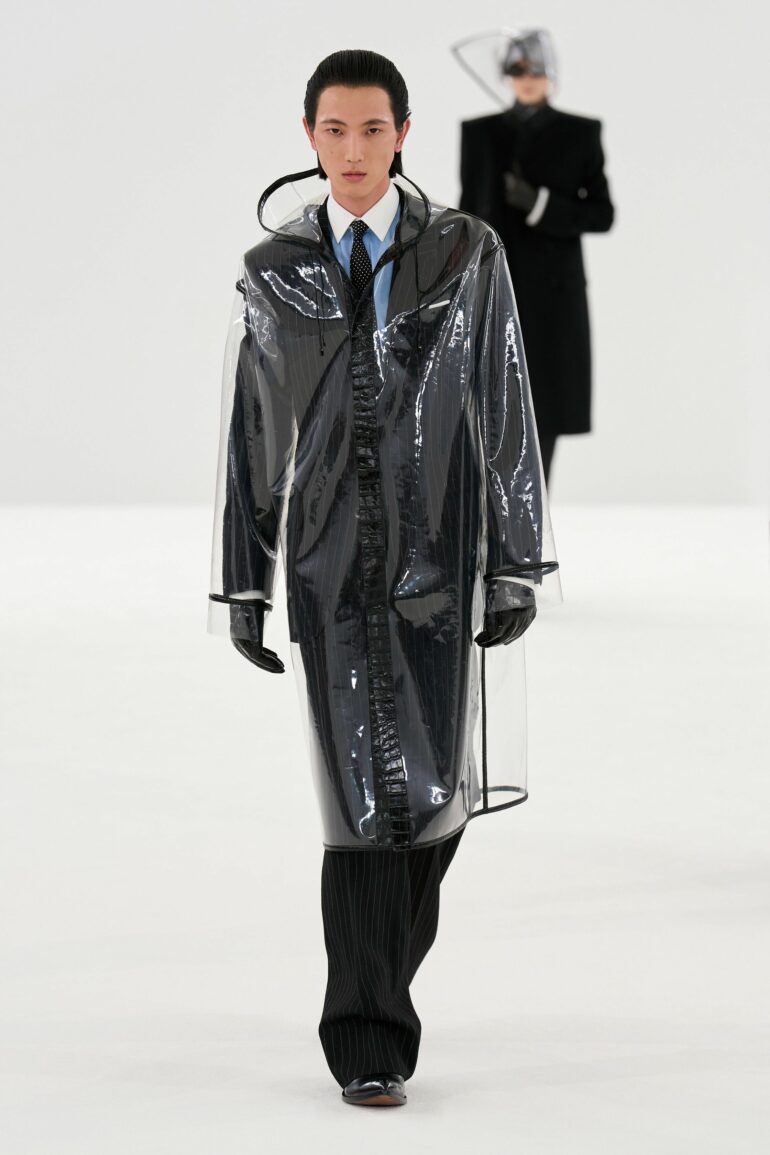
A blinding light, a space devoid of any points of reference, and a frontal composition that borders on an interrogation. To showcase Tom Ford’s Fall/Winter 2026 collection, photographer Stuart Winecoff set up his shot against a white backdrop with a deliberately clinical, almost medical aesthetic. No shifting shadows, no distracting backdrops—no visual escape is permitted. In this sterile environment, the figure has no choice but to exist on its own terms, with absolute urgency and clarity. The campaign aims for immediate impact, reducing the garment to its primary function while heightening its psychological weight.
In front of the camera, an ensemble cast—conceived as a gallery of assertive characters—confronts this harsh light. The sculptural features of Kristen McMenamy, the sharp elegance of Liu Wen, and the stature of Mila Van Eeten intersect with the magnetic presences of Paolo Grebic, Aluel Makuach, Scott Barnhill, Benjamin Orlando, Ardi H, Malick Bodian, and Alfredo Ramirez. Their poses—still and commanding—transform this photo shoot into a display of quiet strength. The attitude of these ten faces conveys a single, fixed idea: here, restraint is the most direct path to a form of danger.
The architecture of the suit as a shield
The stylistic statement leaves no room for doubt or comfort. The cut, with its extreme precision, transcends the simple notion of clothing to take on the role of a contemporary breastplate. For the men, the look is structured around double-breasted suits whose imposing cut immediately commands respect. Women, for their part, claim their space through the volume of particularly wide-leg pants. In both cases, the fabric draws a strict boundary between the individual and the outside world.
The patterns themselves contribute to this strategy of distance. Stripes, far from being flexible, are treated with implacable rigidity, acting almost like the bars of a graphic cage. Contrasting this rigidity is the wild instinct of animal prints, which punctuate the collection and serve as a reminder that animality is never far beneath the veneer of control. This tension is the beating heart of the design. The skin, at times starkly exposed, is revealed not out of vulnerability, but as a challenge to the observer. Enclosed in thick leather gloves and hidden behind dark glasses, the models’ identities fade somewhat to give way to a cold, highly calculated allure.
The Paradox of Materials: From Organic to Synthetic
An examination of textures reveals a similar complexity, built on the clash of opposites. The precision of the lines finds an unexpected echo in the use of materials that challenge the notion of protection. Jackets and trench coats—the cornerstones of the classic protective wardrobe—are here crafted from completely transparent plastic. This choice of an industrial, translucent material blurs the lines: while the barrier physically isolates, it visually exposes the garment’s anatomy and underlying layers. It is a paradoxical form of protection, inviting the eye while forbidding touch.

Against this synthetic armor, more sensual elements burst onto the scene. The density and warmth of a mustard-colored wool dress break the prevailing chill, injecting a dose of saturated color and organic material into this austere landscape. Further down, light bounces off the surface of leggings entirely covered in sequins. These nocturnal sparkles, combined with the precision of tailored cuts, create a visual tension that prevents the silhouette from becoming uniform. The contrast between the matte finish of the wool, the sheen of the plastic, and the sparkle of the sequins underscores the ambivalence of a wardrobe that refuses to choose between austerity and extravagance.
The Ackermann Method: Theatricality and Transgression
This surgical approach to clothing follows directly in the wake of the Fall 2026 pre-collection, which had already laid the groundwork for this silhouette that is both sensual and austere. The impetus provided by Haider Ackermann crystallizes a very clear direction for the house. The eminently theatrical spirit that has defined the label since its inception is not abandoned; rather, it is channeled, stripped of all excessive embellishments, to focus on the precision of the attitude.
Under this direction, the aesthetic equation rests on an extremely precarious balance between the discipline imposed by the structure of the garments and the transgression suggested by the way they are worn. It is in this interstice, between rule and rupture, that desire lurks. By opting for a staging devoid of any narrative artifice, the campaign isolates this power dynamic. The impassive faces, the absence of smiles, the frontal angle of the shot: every detail contributes to eliminating any trace of naivety. This boldness, far from being accidental, is measured down to the millimeter, confirming that attraction, within this visual grammar, always demands a certain degree of risk.