
Deconstructing the Gaze: When Kuala Lumpur Reimagines Southeast Asia’s Identity
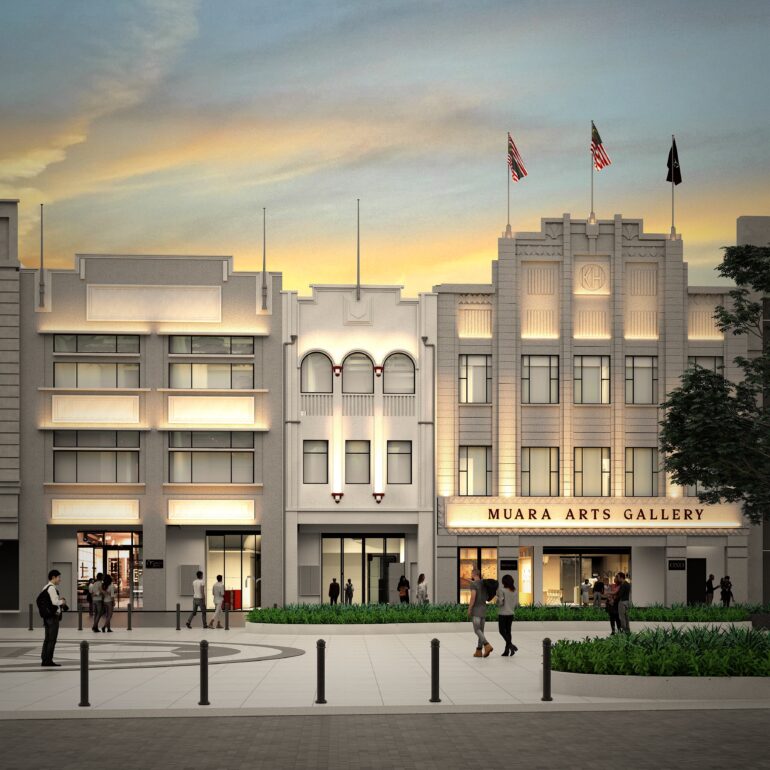
A metropolis’s urban fabric often dictates how culture is perceived there. In Kuala Lumpur, the Medan Pasar neighborhood is set to welcome a particularly unique architectural and intellectual addition. On November 1, 2026, Muara Arts will open its doors in the heart of the Malaysian capital. The institution did not opt for the usual sterile white cube or a flashy architectural statement. The project is rooted in a complex of six adjoining townhouses—direct legacies of the Art Deco period—that have undergone extensive renovation. This choice of location is by no means incidental. It immediately creates a visual and conceptual tension: housing the region’s most contemporary and elusive creative expression behind historic facades with strict geometric lines. It is a way of physically anchoring the creative process in the city’s rich history in order to better explore its cultural future.
This new hub, structured as a nonprofit organization and supported by the Creador Foundation, is emerging within an Asian institutional landscape that is rapidly expanding. Yet, despite the proliferation of museums and galleries, the very definition of regional art still seems to slip through the fingers of theorists. The narrative suffers from a form of chronic instability. It is precisely this gap that the new artistic director, Lydia Yee, intends to address. Her arrival signals a desire to break with the past. The former director of London’s Whitechapel Gallery is shifting her focus to a region where issues of representation are particularly acute. The stated goal is a radical departure from any form of aesthetic complacency. The aim is no longer to present a decorative, sanitized, or complacent vision of Southeast Asia, but rather to provide a space for critical reflection.
The End of Homogeneous Narratives
For a long time, the creative works of Malaysia and its neighboring countries were interpreted through the lens of a fantasized identity, unified by external criteria. The ambition of this new venue is to shatter this illusion of homogeneity. The institution aims to demonstrate how this shared identity is empirically constructed, how it grapples with its own contradictions, and how it reconstitutes itself in an almost organic manner. The physical space of the six Art Deco houses thus becomes a repository for partial, fragmented histories, where works can finally be approached on their own terms, without having to conform to a preestablished curatorial narrative.
To bring this approach to life, the opening project takes the form of an alphabetical guide. Titled *A–Z of Southeast Asian Art: A Critical Dictionary*, the inaugural exhibition brings together the work of more than forty visual artists. On paper, alphabetical order might seem like the height of academic rigidity—a desperate attempt to classify the unclassifiable. In reality, the curatorial framework uses the alphabet as a tool of subversion. Each letter does not serve to close a debate, but rather acts as a gateway to an idea, a specific term, or a tension inherent to the region.
The Dictionary Method as a Curatorial Tool
This intellectual approach did not emerge out of thin air. It has its origins in the long-term project initiated in 2017 by the Singaporean visual artist Ho Tzu Nyen, whose work can be explored here. With his seminal work, *The Critical Dictionary of Southeast Asia*, the artist laid the groundwork for a sprawling and ever-evolving research platform. His initial premise was to question the relevance of a geographic region whose contours cannot easily be confined within traditional political borders. The curatorial team has adopted this intellectual framework as its own. What was originally a single artwork—a digital generator of connections—is transformed here into a fully-fledged exhibition methodology.
The physical exhibition route designed for the opening unfolds across a variety of media. Painting and sculpture are presented alongside textile art, immersive installations, video, and works on paper. This formal diversity reflects the heterogeneity of the themes explored. Visitors are invited to navigate intuitively between concepts of a radically opposed nature. The word “archipelago,” with all that it implies in terms of geographic dispersion and cultural diversity, clashes with the notion of “animism,” reviving the layers of spiritual beliefs that permeate these territories. Further on, the earthy, hardworking figure of the “buffalo” is placed in perspective alongside a term as politically charged as “corruption.”
A Deliberate Regional Scope
These lexical parallels create deliberate semantic short circuits. They force the eye and the mind to establish novel connections between realities that coexist within the same geographic territory without always communicating with one another. The exhibition refuses to take sides or offer a definitive overview. Instead, it leaves the questions raised by the juxtaposition of the works wide open.
The stakes go far beyond simply inaugurating yet another cultural venue on the map of Malaysia. The aim is to provide a structural framework for artistic narratives that sometimes struggle to find a suitable platform, free from the expectations of an art market that craves easily identifiable symbols. The approach resembles a real-time mapping of a complex intellectual landscape. By refusing to set definitions in stone, the institution embraces an unstable interpretation, acknowledging that modern and contemporary art from Southeast Asia remains a critical construct in constant flux.