
The Scandal of Lightness
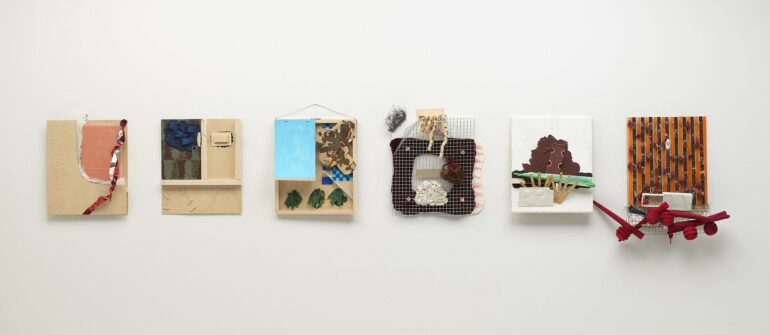
In 1975, a minor controversy shook the very foundations of the Whitney Museum of American Art in New York. At the center of the storm were pieces of string, fragile scraps of wood, and bits of paper that some critics at the time refused to consider art. Richard Tuttle, the creator of these works of absolute subtlety, had just unwittingly challenged the dogma of triumphant minimalism. Where his contemporaries were erecting monumental steel structures, Tuttle offered the imperceptible. This moment of rupture was not a provocation, but the affirmation of a sensibility that, for more than six decades, has refused to shout to be heard. To understand this radical subtlety, one must delve into the personal library and record collection of this artist who has transformed fragility into an architectural force.
The Negative Capacities and the Echo of Keats
Richard Tuttle’s work does not begin in the studio, but in the breath of words. An avid reader, he draws from poetry a working method rather than mere inspiration. His fascination with John Keats—and particularly with the concept of “negative capacity”—is the cornerstone of his approach. Keats defined this capacity as the human ability to dwell in uncertainty, mystery, and doubt, without desperately seeking to grasp facts and reason. In Tuttle’s sculptures, this translates into an absence of formal certainty. A work may be nothing more than a fold in a piece of fabric or a shadow cast on a white wall.
The artist often cites Keats’s “Ode on a Grecian Urn” as an aesthetic compass. This poem, which explores the tension between the stillness of art and the movement of life, finds a direct echo in his way of suspending humble materials in the space of the Pace Gallery. For him, poetry is not a narrative; it is a structure that allows the invisible to become tangible. It is not a matter of illustrating a text, but of constructing a visual syntax in which the void between two elements carries as much weight as a line drawn in graphite.
Agnes Martin and the Rigor of the Desert
While literature provides the intellectual framework, certain encounters have acted as spiritual catalysts. Among them, his friendship with Agnes Martin occupies a central place. Martin’s influence on Tuttle is not limited to the grid or geometric repetition; it lies in an ethic of perception. By observing Martin’s work, Tuttle came to understand that repetition is not monotony, but a form of monastic discipline that allows one to attain pure clarity.
This relationship also anchored his work in a specific geography: that of New Mexico. The vastness of the desert, that light which seems to devour objects, leaving only their essence, radicalized his approach to drawing. In Tuttle’s work, the line does not confine the form; it suggests it, much like the uncertain horizons of Mesa Portales. Agnes Martin’s teaching boiled down to one demand: fidelity to one’s own vision, far from the fads and clamour of the New York art scene. This independence of spirit allowed her to span the decades without ever allowing herself to be pigeonholed, remaining that eternal “artist for artists” whose influence is as discreet as it is omnipresent.
Bach or the Geometry of Sound
Music—and more specifically the work of Johann Sebastian Bach—constitutes the other pillar of her mental universe. Tuttle sees in Baroque music, and specifically in the Chaconne from Partita No. 2 in D minor for solo violin, a perfect analogy for her own artistic exploration. How, with a single instrument and a rigorous harmonic structure, can one achieve such emotional and spatial complexity?
For the artist, Bach’s line is a physical line. It occupies space, creates invisible volumes, and defines a duration. This temporal dimension is crucial to his work. Viewing a work by Tuttle takes time; it requires a slow, deliberate gaze, much like listening to a cello suite. There are no showy gestures, no grandiloquence. Everything hinges on the interval—on the exact moment when a note ends to give way to silence. It is this same precision that he applies when he mounts a piece of plywood on the wall at an unusual height: the placement is not arbitrary; it responds to an internal rhythm, a pulse that gives the object its necessity.
The Legacy of Betty Parsons and the Genesis of a Style
One cannot discuss Richard Tuttle’s career without mentioning the guiding figure of Betty Parsons. Her gallery served as the laboratory where the greatest names in Abstract Expressionism cut their teeth. Tuttle worked there, handling canvases by Pollock and Rothko, before exhibiting his own creations. This proximity to the giants of American art gave him an intimate understanding of materials and scale.
Yet, instead of following the path of gigantism, he chose that of humility. From his years at Parsons, he retained an absolute respect for raw materials. Whether it’s newspaper, wire, or synthetic foam, he treats each element with equal dignity. He does not seek to transform the material into something else, but rather to reveal its poetic potential. A crumpled sheet of paper is no longer waste; it becomes a topography, a miniature landscape that challenges our ability to truly see what surrounds us.
The Enduring Power of the Tiny Gesture
Today, Richard Tuttle’s work continues to defy expectations. In an era saturated with digital images and spectacular installations, his persistence with small-scale works and manual gestures seems almost anachronistic. Yet it is precisely this resistance that is his strength. His work reminds us that art is not necessarily a matter of production, but a matter of attention.
Drawing on the rigor of Bach, the uncertainty of Keats, and the clarity of Agnes Martin, Tuttle has built a bridge between disciplines. His influence extends far beyond sculpture, reaching into design, fashion, and architecture—fields where artists seek a form of truth stripped of all artifice. His objects, often described as fragile, actually possess a conceptual robustness capable of standing the test of time. They ask for nothing, except to be there, present, in the moment of encounter with the viewer. In this silent exchange, Richard Tuttle invites us to rediscover the power of the infinitesimal.