
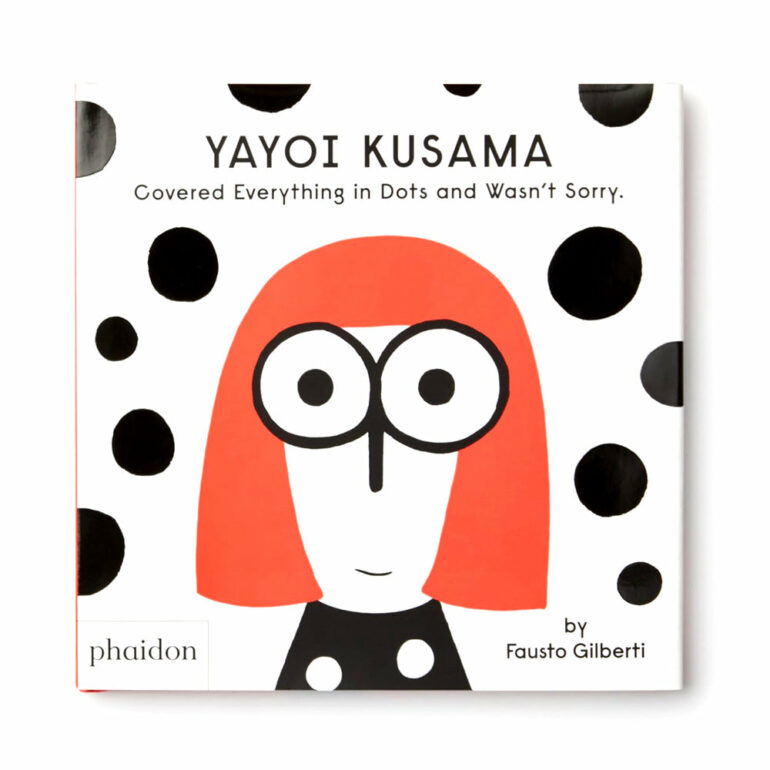
The Silence of Words Behind the Clatter of Polka Dots
The contemporary eye has grown accustomed to a certain saturation when it comes to Yayoi Kusama. There is that hypnotic repetition, that profusion of polka dots that invade walls, canvases, and luxury accessories, creating a visual language that is instantly recognizable across the globe. Yet this chromatic omnipresence and the explosive popularity of her immersive installations have ultimately overshadowed a fundamental dimension of her creative practice. Behind the glitter of mirrors and the obsession with infinite space lies a much more intimate body of work—one that is almost clandestine to the general public: a dense body of literary work, where ink replaces paint to explore the same psychological vertigo.
The Japanese artist has never limited herself to merely captivating the eye. While lines grow longer outside museums as people wait to catch a reflection in her mirror rooms, an essential part of her legacy lies in the solitude of the printed page. This foray into the world of letters is not merely a biographical curiosity or a peripheral activity; it forms the backbone of a way of thinking that seeks, by any means necessary, to ward off the anguish of disappearance. By examining his books and poetry, we discover a mental map that lends new meaning to his most famous motifs.
The Pen as a Scalpel: An Architecture of the Intimate
In Kusama’s universe, writing functions as a laboratory of obsession. While her visual artworks convey a form of self-dissolution into the infinite, her texts offer a brutal and unvarnished plunge into the reality of her psyche. Here we find prose that seeks not to seduce, but to bear witness to a constant struggle with hallucinations and perception. Her writings—often overlooked by traditional art critics in favor of her spectacular performances—reveal a narrative structure that mimics the repetition of her polka dots. Each sentence seems to be an additional dot placed on the page to anchor the mind in reality.
This literary output, which encompasses both the novel and poetry, serves as a necessary counterpoint to the sometimes playful dimension the public attributes to her installations. Where people see magic and technological wonder in her infinite spaces, her writings remind us of the source of these visions: a relentless struggle for mental survival. Words, for her, serve an organic function; they do not serve to describe the world, but to reconstruct it, fragment by fragment, to prevent it from collapsing. Literature here is the site of a radical laying bare, far removed from the polished aesthetic of her collaborations with haute couture houses.
A Poetics of Infinite Repetition
The transition from canvas to the page does not alter the nature of the obsession, but it does change its rhythm. Kusama’s poetry is imbued with the same spirit of proliferation as her paintings. One senses a quest for self-effacement, a desire to merge into a universal whole. This thematic “self-destruction,” which she has theorized throughout her career, finds a particularly powerful echo in the brevity of the poem. The words are arranged like cells, multiplying until meaning expands and converges with that sense of infinity she has so masterfully brought to life physically.

It is fascinating to observe how this literary aspect, though central to her practice, remained for a long time in the shadow of her monumental successes. The art market and social media have prioritized the image—immediate, shareable, spectacular—neglecting the slowness and complexity of the text. Yet, to understand the origins of her motifs, one must be willing to immerse oneself in her stories. It is there, in the depth of her books, that the dialogue between her native Japanese culture and her radical experiences takes shape. Literature serves as the breadcrumb trail that allows us to navigate the labyrinth of his mirrors without getting completely lost.
Beyond the motif: the text as a manifesto
To restore this artist’s literary world is also to refuse to reduce her to a visual brand. All too often, the artist is viewed through the distorting prism of her polka dots, as if her genius were limited to a graphic formula. Her writings prove the opposite: they demonstrate a keen awareness of the issues of her time and a desire to theorize her own inner turmoil. Her books are not notebooks, but works in their own right that possess their own aesthetic autonomy. They explore areas of shadow that the artificial light of her installations sometimes tends to erase.
The rediscovery of these forgotten texts allows us to envision a complete body of work, in which the hand that writes is inseparable from the hand that paints or assembles. From this perspective, literature is no longer a mere complement but the very source of Kusama’s imagery. It offers the essential keys to understanding the profound melancholy that permeates every polka dot and every reflection. By stepping back for a moment from our fascination with the image, we realize that the infinite is not merely something to be looked at: it is read between the lines of a body of work that has never ceased to seek its own salvation in the power of signs.
The fate of her writings ultimately mirrors that of her art: a constant tension between the desire for absolute visibility and the visceral need to fade into the background of her creation. While her installations continue to travel through the world’s major cities, her books patiently await those who wish to look beyond the surface of things. They constitute the most stable and enduring part of a body of work that has made repetition a universal language. It is perhaps there, in the silence of a library, that we come closest to the truth of an artist who has spent her life transforming her hallucinations into a world of paper and color.