
Make Texture a preferred source on Google to support us
Add Texture to GoogleThe Elegance of the Surf: The Rebirth of the Skin Diver at Christopher Ward
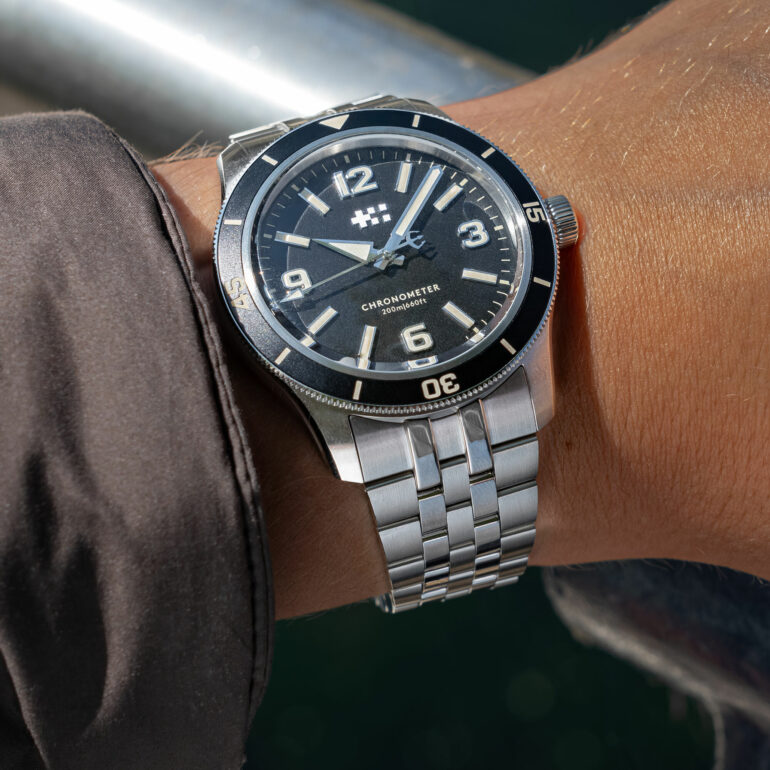
The Bay of Biscay is not a destination for lovers of picture-perfect postcards. It is a realm of storms, treacherous currents, and massive swells that crash against the coasts of the Basque Country and the Landes. It is in this rugged environment, where survival depends on the precision of one’s equipment, that Christopher Ward drew inspiration for its new collection: the C60 Trident Biscay. By moving away from the purely utilitarian codes of contemporary dive watches to embrace the “skin diver” aesthetic of the 1960s, the watchmaker marks a notable return to a style of watchmaking that is more tactile, more refined, and, let’s say it, more sensual.
This launch marks a strategic milestone. After the discontinuation of the C65 Aquitaine line, some feared that the brand would abandon the retro segment in favor of ultra-technical models or dials saturated with color. The Biscay proves otherwise. It offers this vision in three variations—Automatic, GMT, and Bronze—all sharing a common obsession with a slim profile, a luxury that has become rare in a world saturated with imposing cases.
The Science of Alloys and the Challenge of Patina
Within this collection, the bronze version immediately catches the eye. Rather than using the industry-standard CuSn6 alloy, which tends to oxidize unevenly and sometimes aggressively, Christopher Ward has opted for a marine-grade aluminum bronze (CuAl10Ni5Fe4). This material, used in heavy marine engineering, was chosen for its exceptional resistance to salt corrosion. Visually, this results in a much slower, more uniform patina that evolves into a noble hue rather than turning to verdigris within a few weeks.
The color scheme here is highly cohesive. The chocolate-colored dial, with its grainy texture, blends seamlessly with the golden highlights of the case, creating a warm, monochromatic ensemble. This is a watch that seeks to shine not through contrast, but through tonal harmony. The 39 mm case—the only size available for this bronze version—emphasizes this commitment to discretion and comfort.
The Architecture of Emptiness: The Light-Catcher Case
The true feat of the Biscay lies in its dimensions. In dive watchmaking, thickness is often the price paid for water resistance. Here, despite a water resistance of 200 meters and a screw-down caseback, the “Light-catcher” case manages to measure just 11 mm thick on both the Automatic and Bronze models. To achieve this sleek silhouette, the engineers drew inspiration from the curves of the Lumière collection, refining the sides so that the watch appears to visually sink into the wrist.
The GMT version, which requires the addition of a fourth hand, adds just one millimeter, bringing the thickness to 12 mm. In practice, a 42-mm watch with this profile offers a radically different feel: it slips under a shirt sleeve with the same ease as an elegant sports watch, while retaining the visual presence of a serious timepiece. The design of the bezel contributes to this perception. The teeth of the bezel crown have been redesigned with a more complex profile, offering a firmer grip and a crisper, almost musical click.
A Light from Another Era
The Biscay’s aesthetic rests on a delicate balance between modernity and nostalgia. The dials—whether cream, black, brown, or green—exhibit an organic depth thanks to their sandblasted texture. But it is the work on the luminescence that truly defines the soul of the piece. Christopher Ward has used a custom-pigmented Super-LumiNova Grade X1 BL. Its off-white hue evokes the aged radium of mid-20th-century timepieces, emitting a warm glow as soon as darkness falls.
On the GMT model, this attention to detail extends to the bidirectional bezel. Unlike ISO 6425 diving standards, which require unidirectional rotation to prevent overestimating dive time, the GMT function here is designed with the traveler in mind. Rotation in both directions allows for quick adjustment of time zones. A notable detail for purists: the numerals and markers on the bezel are also luminescent, a significant improvement over previous versions where only the triangle at 12 o’clock was treated.

Swiss precision for everyday use
Under the hood, the brand remains loyal to its trusted partners. The Automatic and Bronze versions are powered by the Sellita SW300-1 caliber, while the GMT model features the SW330-2. Both of these automatic movements are COSC-certified, guaranteeing chronometric accuracy of -4 to +6 seconds per day. With a 56-hour power reserve and a frequency of 4 Hz, these movements are examples of proven reliability, visible through a transparent case back that reveals a redesigned rotor.
The wearing experience is enhanced by updated fasteners. The recently introduced iLink steel bracelet is now the standard. Its tool-free adjustment system allows links to be removed with a simple press of hidden buttons, eliminating the need for a screwdriver or pin punch. For those who prefer leather, the Vintage Oak strap reinforces the timepiece’s heritage appeal, while the new, slimmer Hybrid strap—which tapers from 20 or 22 mm to 16 mm at the buckle—reduces bulk on the underside of the wrist.
A New Value Hierarchy
With a starting price of around £1,330 for the Automatic and rising to £1,635 for the GMT on a Consort bracelet, the C60 Trident Biscay positions itself squarely in the competitive fray. It directly challenges established benchmarks such as the Tudor Black Bay 58. While the Geneva-based brand retains the advantage of its METAS-certified in-house movements, Christopher Ward plays the card of a value proposition that’s hard to beat, offering an alternative that costs more than two-thirds less than its Swiss rival, without sacrificing chronometer certification or the quality of the finishes.
This collection does more than simply revive a style. It adapts today’s technical standards—extreme thinness, sophisticated marine alloys, quick-release strap systems—to a romantic vision of watchmaking. By choosing the name “Biscay,” the brand reminds us that its watches are ready for the Atlantic, even if their most frequent destination will likely be the comfort of an office or the terrace of a café overlooking the ocean.