
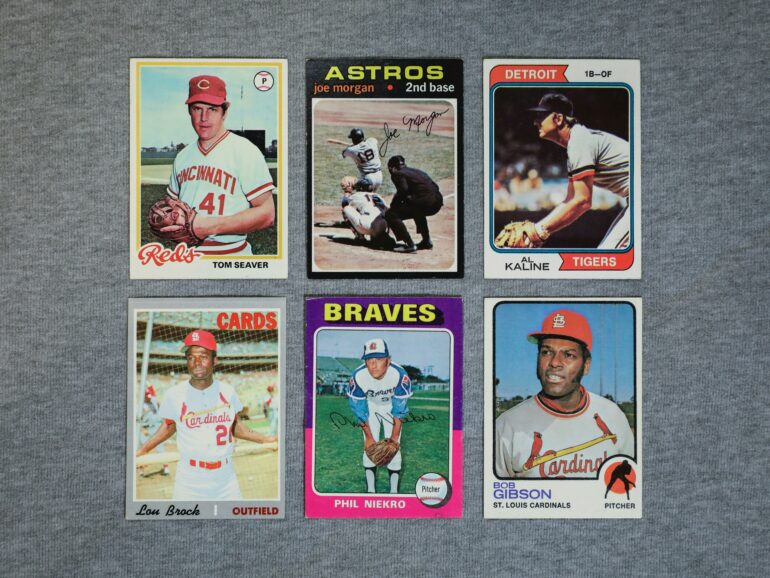
Bring up the topic in the midst of a circle of enthusiasts and watch the divide emerge instantly. The scene is always the same. On one side of the table, the purists assert with confidence that only the patina of time confers financial legitimacy on a piece of cardboard. On the other, feverish eyes are already focused on unwrapping a package fresh from the factory, hoping to unearth the newcomer that will drive up the bidding the next morning. This divide is far from a mere squabble among enthusiasts. It illustrates the duality of an alternative market that has become particularly sophisticated, where two diametrically opposed investment philosophies clash.
The sector has been shaped by this constant tension between preserving a historical legacy and speculating on emerging talent. Today’s investor no longer seeks merely to accumulate; he manages a complex portfolio. Building a solid collection requires a precise understanding of the mechanisms that govern athletes’ market value, the rarity of prints, and the condition of the pieces.
A Safe Haven: Time as the Sole Judge
The appeal of items predating the 1970s rests on a simple economic foundation: the absence of uncertainty. The athletic careers of players like Hank Aaron or Mickey Mantle are firmly enshrined in the history books. Their statistics will never change, injuries will not derail their trajectories, and no scandal will tarnish their legacy. A 1950s Topps card featuring one of these figures operates in the market with the same stability as a government bond or a masterpiece painting. It weather economic upheavals with a resilience that more recent assets struggle to match.
Yet this status as a safe-haven asset comes with formidable barriers to entry. Acquiring a historic piece requires a massive initial investment. The physical nature of the object becomes the crux of the matter. A print from the middle of the last century has survived countless handling, successive moves, and prolonged stays in poorly insulated cardboard boxes. Consequently, the condition of the piece dictates the pricing structure with unprecedented ruthlessness. Even the slightest damage to the corners or the tiniest misalignment causes the value to plummet.
This level of exactingness naturally drives buyers toward specialized dealers. The historical market is undermined by the circulation of elaborate forgeries and pieces that have been chemically or physically altered to deceive the buyer’s eye. Securing an investment in this field requires rigorous verification of authenticity—a process that often discourages novices.
The Lesson of the Years of Abundance
While previous decades hold a certain fascination, the period stretching from the late 1980s to the mid-1990s stands out as an economic anomaly—or even a cautionary tale. This interlude is bluntly referred to as the “junk wax” era. Faced with public enthusiasm, manufacturers flooded the market by printing their sets by the ton. The law of supply and demand took its course: overproduction destroyed scarcity, rendering the vast majority of these items virtually devoid of current financial value.
A few statistical anomalies nevertheless manage to emerge from this speculative black hole. A Fleer card of Michael Jordan or a portrait of Ken Griffey Jr. retain a special aura. Their value survives the flood of prints not because of the quality of the printing, but because of a perceived or constructed rarity tied to the athlete’s legendary status. These exceptions, however, prove the rule: volume is capital’s sworn enemy.
The Thrill of Contemporary Volatility
Looking back over the last two decades, we’ve witnessed a complete redefinition of the product. Manufacturers have incorporated the concept of artificial scarcity directly into the manufacturing process. Recent products are distinguished by complex physical attributes: printed serial numbers, autographs signed directly onto the surface of the card, or even the inclusion of an actual fragment of a jersey worn during a game. The flat piece of cardboard has become a three-dimensional artifact.
Paradoxically, this engineering of rarity makes authentication easier than it was for relics from the 1950s. Printing details, signature quotas, and color variations are documented with industrial precision by the brands themselves. The uncertainty no longer lies in the object’s provenance, but in the human journey it represents.
Investing in active players—and particularly in rookies—is akin to a venture capital strategy. Volatility is extreme. A single standout season on the basketball court is enough to multiply a rookie’s value by irrational factors overnight. This potential for meteoric profit comes with an equally immediate risk of loss if the young prodigy crumbles under pressure or suffers a serious injury. The difference in value between a recent edition of an American football star and his counterpart from fifty years ago perfectly illustrates the impact of modern mass production, which forces publishers to release multiple limited editions to maintain speculative pressure.
The Need for Certified Grading
Faced with this complexity, the issue of professional appraisal—or “grading”—is a point of contention. Going through a certification agency makes no economic sense for a base card produced in the millions. The cost of the appraisal would exceed the card’s value. On the other hand, for rare parallel versions or numbered autographs of up-and-coming players, evaluation by a trusted third party becomes a means of increasing value. By officially certifying the condition of the surface and the sharpness of the edges, the assigned grade eliminates doubt during future resales on the secondary market.
Diversification Strategy
The final approach depends on financial capacity and risk appetite. A limited budget seeking the thrill of discovery and betting on the emergence of future champions will find its place in the emerging ecosystem, where opening a sealed box is like a lottery with high potential returns. A more substantial capital investment will favor the calm yet reassuring presence of legends from the past, whose inclusion stabilizes the overall portfolio.
Current commercial infrastructures have adapted to this diverse audience. Major players in the sector, such as Giant Sports Cards, offer concierge-level services with free shipping on orders over $199, loyalty programs to maximize margins for repeat buyers, and aggressive marketing centered on the user experience, exemplified by their registered trademark Unbox Your Love Of The Game™. The amateur era is over. The market has matured, definitively establishing printed cards as an asset class in their own right.