
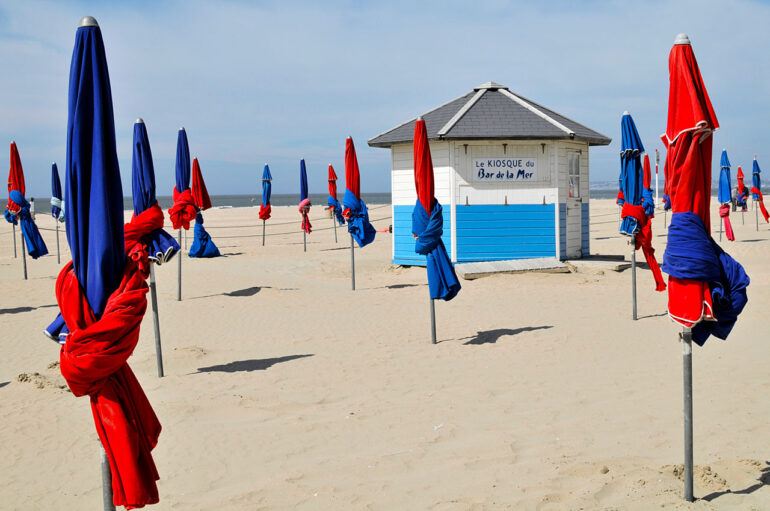
On the fine sand of the Côte Fleurie, a strange sea-green bungalow has stood on stilts since the spring of 2024. This lifeguard station, whose design seems straight out of a Santa Monica or Malibu beach, is not merely a lifeguard station. It is the latest manifestation of a mimicry that dares not speak its name—another piece added to the grand puzzle of a carefully cultivated transatlantic imagination. For decades, this Norman enclave has maintained a fascinating game of mirrors with America, to the point of being regularly referred to as the “French Hamptons.” Yet behind the beach huts engraved with the names of Hollywood legends and the shadow cast by the American Film Festival lies a sociological and architectural reality far more unique than a mere copy of Long Island.
The American Illusion and the Geography of Desire
Filmmaker Claude Lelouch summed up this feeling in 2019: staying here is like treating yourself to America without the hassle of traveling there. This proximity—just two hours from the capital, whether you travel by train or by road—has transformed this stretch of coastline into a hybrid territory. While the Hamptons are the natural extension of Manhattan, stretching eastward along Long Island, the Norman town has become the outpost of Paris—a spur of urbanity coming to rest at the mouth of the Touques River.
In his graphic work titled *Paris vs New York*, artist Vahram Muratyan had already highlighted this striking parallel. For city dwellers, the longing for the shore is not satisfied by simply gazing at the sea; it demands a transformation of the landscape. Manhattan has developed its backyard on the Atlantic peninsula; Paris has done the same on the shores of the English Channel. In both cases, the sand is not a boundary, but an extension of the metropolis—a conquered space where the codes of city life are transposed into a vacation setting. There we find the same power networks, the same media personalities, and the same captains of industry, seeking a form of social continuity in the salty sea air.
From haphazard urban development to the Morny Plan
However, the comparison with the Hamptons reaches its limits as soon as one examines the structure of the built environment. The Hamptons do not constitute a single urban entity, but rather a succession of villages and small towns—from Montauk to Sag Harbor, via East Hampton and Amagansett—where massive, isolated white mansions face the raw power of the Atlantic. Housing there is scattered, prioritizing the solitude of the property against the vastness of the landscape.
The Normandy model is radically different. Whereas the Hamptons grew in a more organic way, the French seaside town was born out of a political and visionary initiative in the 19th century. Its founder, the Duke of Morny, envisioned a comprehensive and modern urban plan as soon as the first villas began to rise from the ground amid the warren-like landscape. His idea was not to create a simple seaside resort, but a coherent triptych combining the town, the sea, and the racetracks. This integrated design gave rise to a veritable small city—dense and well-structured—that still retains a human scale and a vibrancy not found in the scattered residential areas of New York State.

Light as a Signature: Between Melancholy and Radiance
Beyond the architecture, it is the quality of the light that defines the profound identity of these two places. While the Hamptons are bathed in a white, horizontal, and often harsh light characteristic of the American East Coast, the Normandy coastline favors nuances and half-tones. One could sum up this aesthetic clash as a duel of paintbrushes: Hopper’s light versus Boudin’s.
Dimitri Beck, a keen observer of imagery and editor at Polka magazine, points out that this coast’s identity stems largely from its off-season visitors. People come here in search of the poetry of autumn skies and rain-drenched light. This unique atmosphere was also captured by fashion photographer Dominique Issermann on the local beach. Her photographs depict evanescent silhouettes and misty vibrations set against infinite vistas, far removed from the sometimes superficial, sun-drenched brilliance of American summers. It is this same melancholy, this very distinctive quality, that director Joachim Trier sought to capture in his latest feature film, *Sentimental Value*, which garnered attention at this year’s Oscars. The film draws on this Normandy mist to build its narrative, confirming that the connection between this city and the art of cinema extends far beyond the red carpets of September.
A Sanctuary of Intimacy
The issue of discretion is another major point of divergence. While the Hamptons are often the scene of a display of wealth and celebrity, the Normandy coast serves as a refuge for a more protected form of privacy. Public figures—whether comedians, actors, or corporate executives—seek a kind of sheltered normalcy there. Longtime residents draw a distinction between the summer hustle and bustle of the Hamptons and the year-round rhythm of this small town.
Since 1966 and the global success of the film *A Man and a Woman*, the town’s fate has been intertwined with that of cinematic glamour. But it is a glamour that has managed to remain discreet, rooted in daily rituals: the morning walk along the boardwalk, watching the horses in training, and photographing the changing tides, day after day. There is a repetitive and reassuring quality to this resort town which, despite its louvered barriers reminiscent of Hollywood, remains deeply attached to its European roots and its history of sand and mist. The Californian lifeguard station is, after all, just a nod, a touch of architectural humor in a city that knows full well that its soul lies not west of the Atlantic, but right here, in this shifting light that captivated the Impressionists long before the studio stars.