
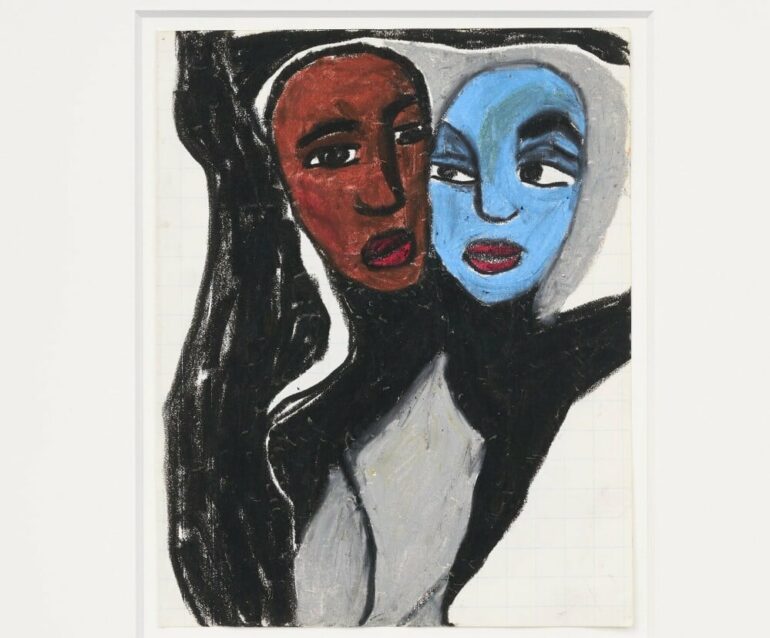
The Other Side of the Flesh
Our era demands absolute transparency and the immediate legibility of forms and faces. Filters smooth the skin, algorithms standardize silhouettes, and the contemporary gaze has grown accustomed to consuming flat anatomies, reduced to their strictest function as images. It is precisely against this tyranny of the contour that “Intimate Anatomies” stands. The curatorial project hosted by the Hauser & Wirth branch in St. Moritz takes the opposite stance: that of opacity, internal tension, and sensory turmoil.
Far from the archetypes of the muse or frozen beauty, the exhibition, scheduled for July 11 through August 29, 2026, tackles the very notion of the human portrait. The walls of the Graubünden gallery bring together three distinct artistic trajectories—Maria Lassnig, Carol Rama, and Cathy Josefowitz—to articulate a shared reflection. Here, the physical body is no longer that familiar territory we scrutinize from the outside. It transforms into an intimate geography, a receptacle for pressures, unfinished movements, and raw impulses. The aim is not to flatter the eye, but to impose a physicality that unsettles, that weighs heavily, and that stubbornly defies the art market’s reassuring classifications.
The Vertigo of Internal Sensation
Any attempt to understand the human figure in Maria Lassnig’s work requires setting aside the notion of likeness. Her approach is rooted in a visceral process in which painting serves as a seismograph for nervous and muscular sensations. The Austrian artist does not paint what she sees in a mirror; she translates onto the canvas the place where pain twists, where discomfort takes hold, where muscular tension distorts one’s perception of self.
Her canvases function as emotional X-rays. The distortions that mark her subjects are not the result of any gratuitous formal experiment. They are the direct consequence of a method that prioritizes proprioception over external observation. The reference to Maurice Merleau-Ponty’s phenomenology resonates strikingly here: the body is no longer treated as a passive object placed within a setting, but asserts itself as the absolute filter through which we experience the world. Lassnig’s works demand that the viewer feel the stretching, the compression, and the strangeness of their own skeleton. It is a dizzying balancing act, in which the self-portrait abandons vanity to embrace the abrupt truth of biology.
The Rough Architecture of Impulse
While Lassnig probes the inner workings of sensation, Carol Rama’s work operates on a decidedly more abrasive register. The works selected for this exhibition, spanning a period from the 1930s to the 1960s, attest to a fiercely unorthodox energy. On canvas or paper, Rama orchestrates visual collisions in which fragments of anatomy rub shoulders with explicit sexual references and materials radically foreign to the fine arts.
The gallery’s artist statement highlights this intrusion of the vernacular and the industrial: glue, aerosol sprays, and residues of everyday life come to taint the academic purity of the line. But to focus solely on the purely transgressive dimension of these compositions would be a mistake in analysis. Rama is not merely a purveyor of scandal. In her vocabulary, desire is not a subject for illustration; it becomes a tool for construction. Sexual drive, anxiety, and frenzy are treated as architectural forces capable of organizing matter. The body participates carnally in the creation of the work, asserting itself as an active, rebellious entity that refuses to be passively contemplated.
The Choreography of Lack
In contrast to this raw materiality, Cathy Josefowitz’s presence introduces a quieter, almost ghostly frequency. Drawing on an intensive practice in contemporary dance, her approach navigates the intersection of performance, sketching, and oil painting. Where others seek to immortalize a pose, Josefowitz strives to capture the fleeting nature of movement.
The archives of Artsy and Hauser & Wirth document this obsession with transience. In her work, the line does not delineate a form; it records the memory of a movement. The figures seem to be in constant negotiation with the background, on the verge of appearing or fading away forever. This embrace of fragility lends her canvases a melancholic and vibrant quality. The act of painting becomes a desperate attempt to hold onto a dynamic doomed to disappear. The two-dimensional surface does not confine the dancer; it offers the gesture an infinite space of resonance, a residual trace that survives the exhaustion of the muscles.
The Weight of the Institutional Framework
Bringing these three visions together under one roof requires a large-scale institutional infrastructure. Founded in Zurich in 1992, Hauser & Wirth established a presence in the Engadin resort town of St. Moritz in 2018. This geographical choice, rooted in one of the historic crossroads of Alpine luxury and international collecting, gives the exhibition a special resonance. The contrast between the highly controlled setting of the Swiss gallery and the organic rawness of the exhibited works creates a stimulating intellectual tension.
Above all, this grouping offers a cross-fertilizing historical legitimacy. Artistic practices long studied in isolation now shed light on one another. Lassnig’s gaze, Rama’s materiality, and Josefowitz’s movement combine to formulate a radical critique of figurative neutrality. Together, they demonstrate that representing a human being necessarily involves engaging in a power struggle with space, the social gaze, and memory.
An Irreducible Opacity
The dialogue established throughout the galleries offers no definitive conclusion regarding the nature of our incarnation. And therein lies its primary strength. By substituting the mystery of lived experience for the obviousness of appearance, the exhibition layout undermines our reflexes of visual assimilation.
In an age of overproduction of polished, consumable images, asserting the unease of the flesh becomes an act of aesthetic dissent. Anatomy, as dissected by these three artists, resists simplification. It remains that untamed territory, rife with contradictions, which continues to elude us just when we think we have grasped it.