
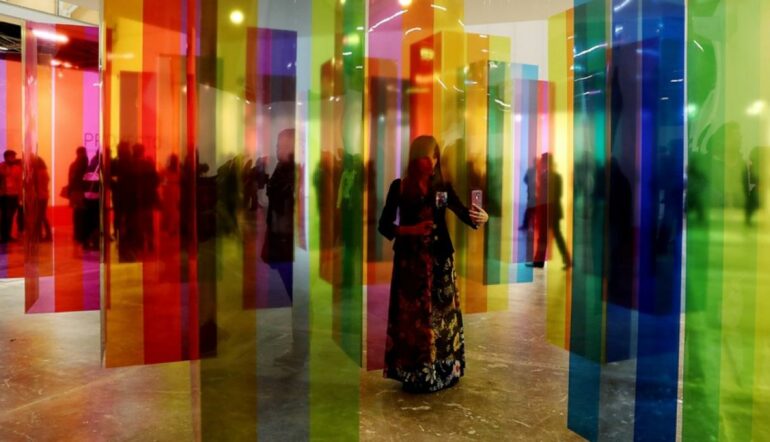
The Mirage and the Method: A Kinetic Immersion in the Heart of the Desert
In the arid expanse of Palm Desert, where the horizon seems to shimmer in the heat, another kind of vibration is about to capture the eye. It is no longer the desert’s natural phenomenon that blurs the view, but a meticulous orchestration of lines, colors, and perspectives. Heather James Fine Art offers an analytical exploration of one of the most stimulating chapters in modern abstraction: Venezuelan optical art. Titled “Completing the Illusion,” this exhibition sets out to dissect the mechanisms of a movement that has redefined our relationship with the flat surface.
The choice of venue is no accident. Placing these works—which are, by their very nature, unstable and shifting—within the static, mineral-like setting of Southern California creates an unexpected dialogue. Where the landscape invites distant contemplation, Op Art demands immediate, almost physical engagement. It is not simply a matter of looking, but of experiencing the fallibility of our senses in the face of compositions that defy inertia.
The Legacy of the Venezuelan Pioneers
To revisit the achievements of Venezuela’s forerunners is to examine a period of creative fervor in which art ceased to be a window onto the world and became a driving force of pure sensations. These artists did not merely seek to decorate space; they sought to fragment it. By describing their works as “pioneering,” the exhibition reminds us that these explorations of the retina and movement—conducted with surgical precision—paved the way for a dynamic perception of the artwork.
The Venezuelan movement distinguished itself through its ability to transform mathematical rigor into vibrant visual poetry. Through the use of repetitive patterns, simultaneous color contrasts, and complex geometric structures, these artists succeeded in creating a sense of depth and pulsation where there is nothing but paint or metal. The exhibition at Heather James Fine Art highlights this technical mastery, which, far from being a mere feat, served a broader ambition: to liberate art from its status as a static object.
The Viewer as Architect of the Image
The title chosen for this exhibition, “Completing the Illusion,” cuts straight to the heart of the matter. In optical art, the work remains incomplete until it is encountered by the human eye. It is the viewer’s brain that, in attempting to resolve the visual contradictions posed by the artist, ultimately creates the movement, depth, or light that do not actually exist on the medium. This interaction transforms the visitor into an indispensable collaborator.
This dynamic of the “completed illusion” suggests that art does not reside in the object itself, but in the space between the retina and consciousness. By shifting their gaze or moving their body in front of the pieces on display in Palm Desert, the public activates the works. Every tilt of the head, every step to the side alters the perception of patterns and colors, making the experience unique for each individual. It is this democratic and universal dimension of optical art that the exhibition seeks to reevaluate.

A Necessary Reexamination of Modernity
Why revisit these geometric experiments today? The reexamination proposed by Heather James Fine Art highlights the persistence of these questions in our contemporary visual culture. In an era saturated with digital images and simulations, the purity of the illusion produced by analog and physical means retains a singular power of impact. The precision of the Venezuelan pioneers reminds us that complexity can arise from an economy of means, provided that the structural logic is flawless.
The exhibition does more than simply present historical objects; it questions the validity of these visual systems over the long arc of art history. By isolating the components of this illusion, the curators help us better understand how these pioneers were able to anticipate our current relationship to the flow and instability of forms. The proposed itinerary invites a form of active meditation, where the rationality of the line meets the irrationality of sensation.
The Balance Between Rigor and Evanescence
One of the major themes of this exhibition lies in demonstrating the duality of Venezuelan Op Art: on the one hand, an absolute formal discipline, heir to Constructivism; on the other, a visual result that always seems on the verge of escaping or dissolving. This constant tension turns each work into a battlefield for perception. Rigid structures become fluid, flat surfaces plunge into imaginary abysses, and primary colors blend in the eye to create immaterial hues.
In the context of Palm Desert, this quest for the immaterial through the material takes on a special resonance. Within the gallery’s walls, the celebrated “pioneering feats” regain their original freshness. They remind us that art is, above all, a matter of perspective—an invitation to question what we believe we see in order to better grasp the reality of sensory experience. Once complete, the illusion does not deceive us: it reveals us to ourselves, as viewers who are aware of how our own visual machinery works.