
Make Texture a preferred source on Google to support us
Add Texture to GoogleThe Mark Left by a Race on Portuguese Asphalt
Portugal isn’t just a land of low-angled sunlight and coastlines carved by the Atlantic; for the motorsports world, it’s a mecca for fine-tuning. It is here, on the country’s winding roads and technical circuits, that a three-time Formula 1 world champion left his mark—not during a mere promotional visit, but through the intensive and meticulous use of a machine that has become inseparable from his name. This extended presence on Portuguese soil was by no means a matter of geographical chance. It stemmed from a need for discretion and technical precision, far from the hustle and bustle of the paddocks, where the asphalt meets the solitude necessary for perfecting a chassis.
This driver, whose record is etched into the history of the sport with three world championships, was not content to drive merely for glory. His time in Portugal was marked by an intimate relationship with the mechanics of the car. The car, which he drove with intense focus, served as much as a rolling laboratory as it did as his personal ride. Against the backdrop of the Algarve and the surroundings of Estoril, every kilometer traveled under the Portuguese sun contributed to the creation of a technical legend. We’re not talking here about a few laps around a track, but rather a total immersion in which man and machine eventually became a single kinetic entity.
The machine as an extension of instinct
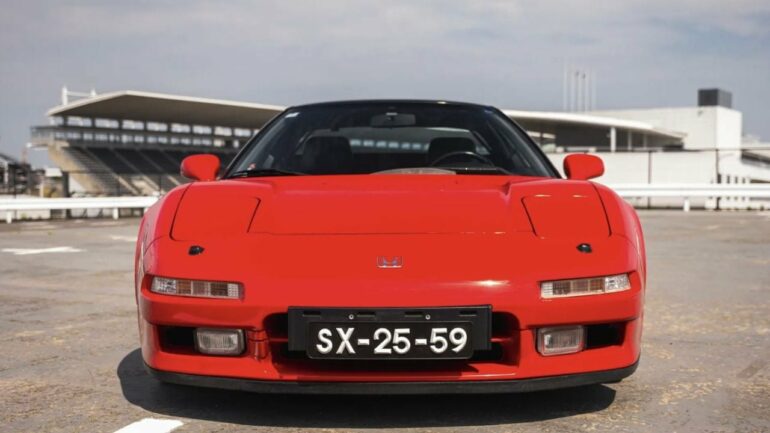
The car in question was not merely a work vehicle. It represented a turning point in automotive engineering—a project where the champion’s exacting standards met the ambitions of a manufacturer in pursuit of absolute perfection. As he drove along the Portuguese roads, the driver pushed the machine to its limits, validating every adjustment, every vibration, and every reaction of the front-end suspension. This phase of intensive driving outside the framework of official competition helped shape the car’s character. Portugal, with its temperature fluctuations and varied terrain, offered the ideal playground for this uninterrupted dialogue between the cockpit and the asphalt.
The three-time world champion brought a sensitivity that few of his peers possessed. For him, driving intensively in Portugal meant dissecting the suspension’s behavior, analyzing the engine’s response to acceleration, and ensuring that the car responded with surgical precision. This behind-the-scenes work, carried out far from the cameras, explains why this car retains a special aura to this day. It embodies the invisible adjustments made on a coastal road or coming out of a fast corner at the Autódromo do Estoril. Every component was scrutinized by an eye capable of detecting even the slightest millimeter of play.
A Portuguese Retreat Between Light and Shadow
The choice of Portugal as a base for these extended driving sessions also highlights a more personal aspect of the champion’s life. It was his refuge, a place where he could make the road his own. The car was the instrument of this newfound freedom. By racking up kilometers on national highways and secondary roads, he transformed a simple industrial object into a living piece of history. Local residents would sometimes catch a glimpse of this aerodynamic silhouette cutting through the air, perhaps unaware that, behind the wheel, a man was redefining the standards of on-road performance. This rigorous, daily use cemented the car’s place in the country’s cultural and automotive landscape.
This was no mere show-and-tell drive. Testimonies and facts agree on the systematic nature of his outings. The champion used the car for his personal travel, but with the rigor of a professional test driver. This duality of use—between private transportation and high-level testing—gives the car exceptional documentary value. It tells the story of an era when the boundaries between the life of an elite athlete and the technical development of a brand like Honda were porous, almost nonexistent. Portugal was the setting for this fusion, providing the space and serenity necessary for this ongoing exercise in style.

The Legacy of a Technical Feat
Today, the existence of this car, bearing the marks of a three-time world champion, raises questions that go beyond mere mechanics. What remains of a driver in a machine he drove so extensively? The wear on the seats, the patina on the steering wheel, and the still-responsive steering are all silent witnesses to those hours spent on Portuguese roads. The car is no longer just an assembly of steel and aluminum; it is the vessel of a unique expertise. It has outlived its first owner, yet it retains the physical memory of his driving lines and braking maneuvers.
This Portuguese period remains an essential chapter for understanding the drive that fueled the driver. The car, which remained in one place for a long time before joining other collections or appearing on platforms like Auto Trader, is tangible proof of a quest for meaning through movement. It serves as a reminder that performance is not born solely at the starting line, but in the tireless repetition of the action, in the analysis of every kilometer traveled between two villages in the Alentejo or along the coast of the Algarve. The champion’s time in Portugal was not a mere interlude; it was at the heart of his creative process.
The memory of these extensive test drives continues to captivate car enthusiasts and sports historians alike. It is not merely the prestige of the title that matters here, but the legacy left by a man who, at the pinnacle of his craft, chose Portugal to push a production car to its limits. This unbreakable bond between a region, a champion, and a machine remains one of the purest stories in contemporary motorsports history. A story of silence, speed, and precision that, decades later, seems not to have aged a bit on the sun-baked asphalt.