
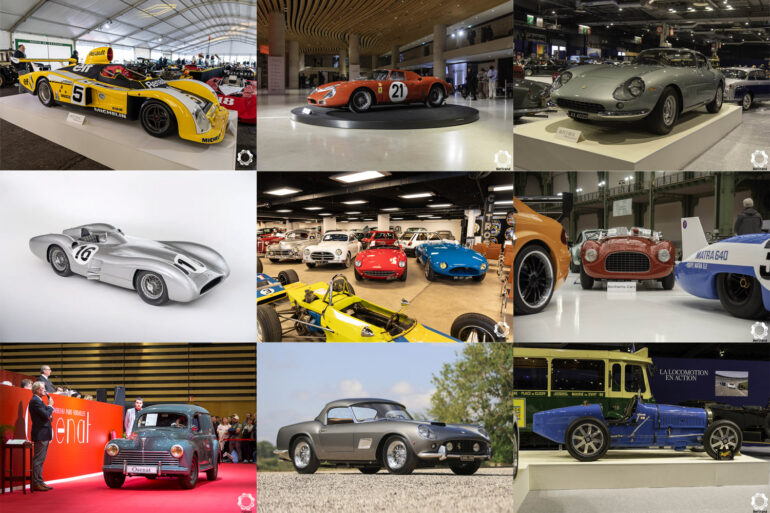
The scent of castor oil and weathered leather was long enough to justify signing a check. For decades, buying a classic car was driven purely by emotion: people bought a childhood memory, a silhouette they’d admired in their youth, or the thrill of imperfect mechanics. The market operated on instinct, often in a closed circle, among gentleman drivers and insiders who passed their treasures along away from prying eyes. Those days are gone. Hit hard by the search for safe-haven assets in a turbulent economic climate, the world of classic cars has undergone a fundamental transformation. Passion, while it hasn’t disappeared, now coexists with cold financial rationality. The classic car has moved beyond the realm of a mere Sunday pastime to become a tangible asset, scrutinized with the same rigor as a stock portfolio or a masterpiece painting.
The Tyranny of Documentation and Provenance
Today, lifting the hood is no longer enough. Even before listening to an engine idling, the modern buyer demands to dissect its history. The heritage aspect has taken center stage, transforming knowledgeable enthusiasts into uncompromising investors. In this new equation, the bodywork sometimes takes a back seat to the thickness of the invoice file. This shift stems from a visceral need for reassurance: the market demands proof.
Valuation criteria have been redefined around a strict three-part framework: authenticity, preservation, and liquidity. Absolute rarity is no longer a guarantee of a sound long-term investment if it comes with an unclear history. The market now prioritizes a vehicle’s overall consistency. A standardized restoration—one that’s too shiny or too perfect—raises suspicion. Collectors seek out original parts, paint weathered by decades, and the integrity of a factory-original configuration. A vehicle with a flawless, fully documented maintenance history dating back to when it was first registered will consistently outrank an identical model—one that may be more exclusive on paper but whose traceability disappears sometime in the 1960s.
This market logic sometimes upends established hierarchies. The exclusivity of a prestigious brand name is no longer everything. The concept of liquidity—the ability to resell the vehicle quickly and without a loss—reigns supreme. In practical terms, a convertible from the 1980s, known for its reliability and in high demand, will find a buyer much faster than a pre-war sedan—which is certainly extremely rare, but whose pool of potential buyers is shrinking year by year. The investor calculates their exit risk even before inserting the key into the ignition.
The End of Opacity
This market has become more professional in part because the tools have changed. Digitalization and the emergence of specialized players have shattered the opacity that once surrounded transactions. Platforms like Carjager have set new standards for transparency. Instant access to comparative databases, the standardization of independent technical inspections, and transparency regarding actual market valuations have empowered buyers. They now have an unprecedented level of information to support their decision-making, significantly reducing the element of bluff that once characterized private negotiations.
This new structure attracts radically different types of buyers. Alongside the purist who lives only to tune his carburetors on the weekends, we now find the wealth manager who views the automobile as a diversification tool. The latter will get behind the wheel only on rare occasions, viewing the purchase primarily as a store of value—contingent on meticulous maintenance and optimal storage.
Auction Fever
Despite this apparent rationalization, the sector retains an unavoidable element of volatility and irrationality, intimately linked to the very nature of the object itself. The barometer of this fever remains the auction floor. Major international auto shows and auctions organized by prestigious auction houses act as kingmakers. The entire ecosystem holds its breath during these highly publicized events.

The mechanics are formidable: all it takes is a single spectacular sale, fueled by a clash between two stubborn bidders, to redraw the price landscape of an entire segment. When a specific model shatters its estimate under the hammer, the shockwave spreads instantly. Owners of the same model reassess the value of their cars upward the next morning, effectively altering market expectations. This is where the method clashes with psychology: believing that a high price validates a risk-free investment is a common misjudgment. Fashion dictates its own cycles, and a model that is highly sought-after today may fall out of favor abruptly if generational preferences shift or if dozens of similar models suddenly flood the market on the back of a favorable market valuation.
The Price of Silence
Viewing a classic car as merely a financial product obscures a stubborn material reality: it is an asset that ages, wears out, and costs money when it isn’t being driven. Unlike a gold bar or a stock portfolio, a classic car imposes constant financial friction that erodes the theoretical return.
For such an investment to be profitable, meticulous accounting is essential. The associated costs are considerable and unavoidable. Storage must be secure and climate-controlled to prevent corrosion. Insurance requires customized policies based on regular appraisals. Added to this is the sometimes arduous search for spare parts that are no longer available, the periodic maintenance essential to keeping the engine running, and unexpected restoration costs that can quickly run into tens of thousands of euros. Ignoring these factors at the time of purchase is tantamount to turning a potential investment into a purely sentimental financial black hole.
The modern collector therefore walks a fine line. He must be methodical, anticipate shifts in trends, and resist the allure of short-term speculation. But ultimately, this asset class retains its absolute uniqueness. A classic car has a life of its own, a voice, a physical presence. It is driven, it is displayed, it demands attention. It is precisely this vibrant materiality that blurs the lines between the coldness of investment and the warmth of automotive heritage. Perhaps the perfect balance lies in embracing this duality: acquiring with the rigor of a banker, yet holding on to it for the privilege of owning a piece of automotive history.