
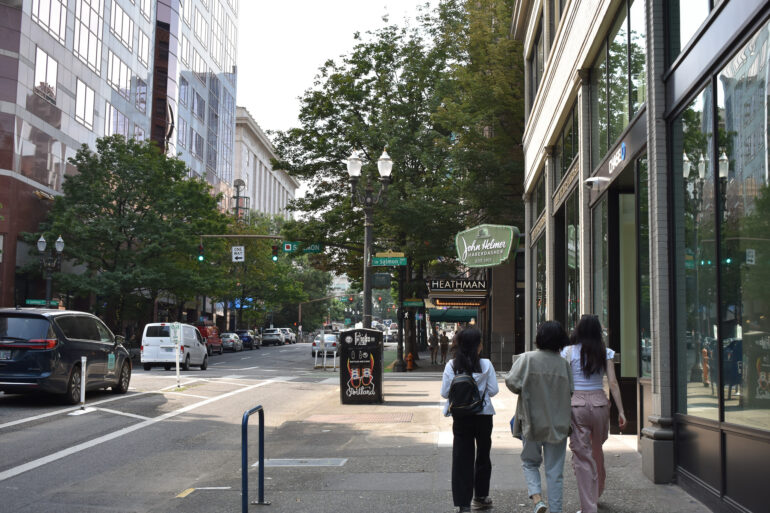
For nearly a decade, Portland seemed to have faded from the radar of urban excellence. The Oregon metropolis, which was once the sole U.S. representative in international quality-of-life rankings, had come to unwittingly embody the turmoil of an America in crisis. Between 2020 and 2021, the former “City of Roses” weathered a perfect storm: violent protests, a sharp rise in economic insecurity, a drug crisis exacerbated by controversial decriminalization policies, and—for the first time in generations—a population decline. But behind this bleak picture, a resurgence has taken hold. Far from the media spotlight, Portland has been orchestrating a profound transformation over the past two years, driven by a radical administrative reform passed in 2022 and strict corrective measures implemented starting in 2024. The downtown area, which many believed was doomed to the stagnation of deserted office districts, is once again becoming a testing ground for a new way of life—one that is more structured but still fiercely creative.
Transformation Through Pragmatism and Urban Design
Portland’s revival is no miracle, but rather the result of a commitment to professionalizing local governance. By putting an end to a laissez-faire attitude toward public drug use and investing heavily in emergency housing facilities, the city has regained the stability essential to its economic growth. This stabilization has unleashed an unprecedented wave of entrepreneurial energy. Where businesses were closing their doors, a new wave of galleries, innovative restaurants, and hybrid spaces is taking root. It is no longer just the “quirky” and kitschy city of the 2010s, but a city that is rediscovering sophistication and attention to detail. This shift is evident in the architecture itself, with the emergence of new buildings such as the Schnitzer School of Art + Art History + Art Design, designed by Lever Architecture, which now marks Park Avenue with its contemporary silhouette.
Rothko’s Legacy and the Museum Revival
Portland’s cultural history is now being written in glass and steel. The Portland Art Museum has just reached a historic milestone with the opening, in November 2025, of the Rothko Pavilion. This 2,044-square-meter expansion project does more than simply physically connect the institution’s two main buildings; it also pays tribute to Mark Rothko, a leading figure of Abstract Expressionism, who immigrated from Latvia in 1913 to take his first art classes right here in Portland. This new wing provides a showcase for recent acquisitions by major artists such as Jeffrey Gibson, Simone Leigh, and Ugo Rondinone. The experience continues in a sensory way at the Coquelico café, where the pastries draw direct inspiration from the master’s “Color-Field Paintings.” It is here that one comes to understand the city’s new ambition: to transform its past into a driver of international prestige.
Print as an Act of Cultural Resistance
While Portland has been the birthplace of influential publications like *Kinfolk* and *Berm*, it is now cementing its status as the capital of print with *Chess Club*. Don’t be misled by the name: here, we don’t play the Queen’s Gambit; we celebrate the book as an object and the independent magazine. The founders describe the space as a “playful gathering of visual cultures.” With a curated selection of over 400 titles, ranging from the highly graphic *Hi-Fructose* to the food-and-fashion blend of *Family Style*, this venue has become the centerpiece of the Portland Art Book Fair. Chess Club isn’t just about sales; its “How to Launch a Magazine” workshops are already preparing the next generation of creators. In September 2026, the space will leave Old City to relocate to the heart of downtown, doubling its floor space to better amplify the voice of print in a world saturated with digital media.

The Japanese Connection: From Omakase to High Fidelity
There is a mutual, almost mystical fascination between Portland and Tokyo, often attributed to the similar silhouettes of Mount Hood and Mount Fuji. This aesthetic kinship reaches its culinary peak at Nodoguro. Chef Ryan Roadhouse, trained in the art of kaiseki in Fukuoka Prefecture, offers an avant-garde take on omakase. His menus, which blend Pacific Northwest ingredients with the most rigorous Japanese techniques, are sometimes inspired by indie rock albums or the dreamlike worlds of Studio Ghibli. Recently relocated to downtown and honored with a James Beard Award, the restaurant heralds the upcoming opening of the James Beard Public Market, a major project dedicated to local gastronomy.
This Japanese influence also takes on an auditory form in the Pearl District. While “listening bars” are popping up everywhere from São Paulo to Abu Dhabi, Mono Space has chosen a more radical path: that of the listening gallery. Equipped with an Ojas high-fidelity system, designed by artisan Devon Turnbull, the venue treats music as a visual art form. The listening sessions there are curated events, exploring everything from Tim Maia’s Brazilian soul to J Dilla’s hip-hop productions and the golden age of the 1990s alternative scene. This cultural center, which opened in a former warehouse in June 2025, also houses a lending library dedicated to audio culture and a record shop to extend the experience at home.
Old Town’s New Vibes
When night falls, the eyes of the in-the-know turn to Old Town’s basements. Since February 2026, The Downbeat has been restoring the neighborhood’s nightlife to its former glory. Conceived by Cyrus Coleman—a designer at Nike and son of B.B. King’s drummer—in collaboration with Nigerian-British photographer Adewale Agboola, this club revives the atmosphere of legendary jazz clubs. Afrobeat, blues, and R&B resonate here in a setting that eschews easy nostalgia. Upstairs, an art gallery rounds out the experience, transforming the building into a true “creative gym” dedicated to supporting the city’s artists of color. This initiative embodies today’s Portland: a city that, after narrowly avoiding decline, has chosen to rebuild its identity on solid, inclusive foundations that are resolutely focused on creative excellence.