
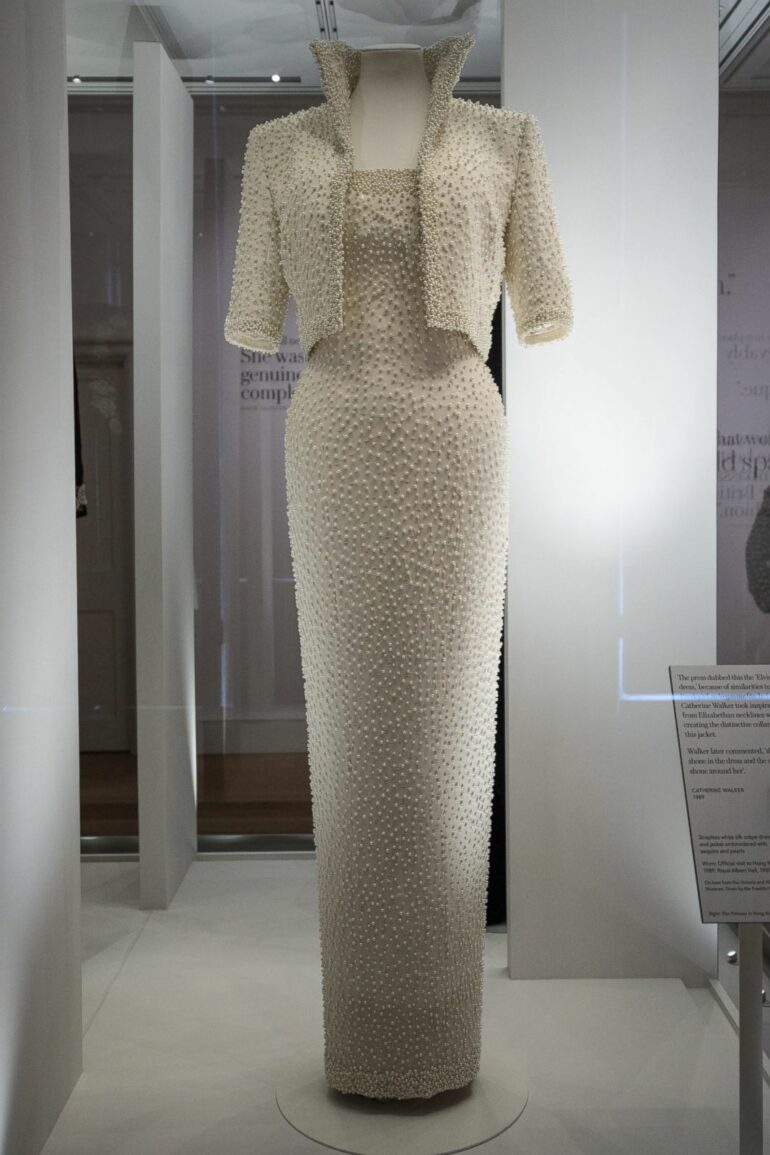
The weight of objects is never more palpable than when they outlive those who carried, handled, or cherished them. Seven hundred. The raw number is striking in its sheer magnitude. This is no longer a matter of a few scattered relics, but a massive inventory—a material map that traces the contours of a life scrutinized by the entire world. Through this colossal collection of garments, accessories, and personal effects, the exhibition titled Princess Diana: Love Life Legacy — A Life of Giving offers an immersion into what remains when the physical presence has faded: a textile trace, a glint of metal, the patina of an everyday object. This collection does more than simply document a wardrobe; it assembles the pieces of a complex puzzle where the private sphere meets the public stage.
The grammar of appearance and the armor of silk
In the context of this retrospective, clothing far transcends its primary function as adornment. Among the hundreds of items on display, garments take center stage, serving as silent witnesses to a form of nonverbal communication that mastered the art of sartorial diplomacy. Every fabric, every cut cataloged in this collection of seven hundred pieces reveals a facet of this “Life of Giving.” Here, one can discern the strategy behind the choice of a texture, the precision of a cut designed to achieve specific goals, and the evolution of a woman who learned to use her own image as a tool of influence.
The accumulation of these garments allows us to observe a stylistic transformation that follows, step by step, the princess’s journey. The accessories, which complement this collection, serve as punctuation marks. A belt buckle, a bag, a pair of gloves are no longer mere accessories but precision tools in the crafting of a silhouette that has become universal. The phenomenal quantity of objects gathered allows us to move beyond the cliché of the “one-of-a-kind piece” and enter the reality of a working wardrobe—an ensemble necessary for representative duties, where every detail was carefully weighed. It is in this profusion that we grasp the reality of his daily life: an uninterrupted succession of appearances in which nothing was left to chance.
The imprint of the gesture through personal objects
Beyond the glamour of official appearances, the exhibition ventures into a quieter realm: that of personal objects. It is undoubtedly here that the title “Love Life Legacy” takes on its full meaning. While clothing shapes the public image, personal belongings reveal the individual. These seven hundred possessions include fragments of intimacy—objects not meant to be seen by the public, but which accompanied moments of solitude, reflection, or correspondence. These pieces are the most revealing of the personality behind the royal title. They carry within them the memory of the hands that held them, the subtle wear from repeated use, and the touching ordinariness of domestic life.
The inclusion of these items creates a striking contrast with the splendor of the fashion accessories. We move from the glitz of gala events to the quiet of a desk or a nightstand. It is through this blending of genres that the exhibition succeeds in humanizing the historical figure. The personal objects serve as anchors to reality. They remind us that behind the display of luxury and protocol lay a life made up of simple rituals. The inventory thus becomes an implicit biography, where each object is a word, and the whole a complex sentence about the difficulty of reconciling a private life with an extraordinary destiny.
Philanthropy Embodied in the Objects
The subtitle “A Life of Giving” is not merely a catchphrase; it serves as the guiding thread for the selection made from among the 700 pieces. The notion of giving runs through the collection, suggesting that even in ownership, there was an intention directed toward others. Many of these objects served as vehicles for humanitarian efforts, worn during field visits or used in the context of her numerous charitable activities. Here, the object becomes an extension of an action. Clothing is no longer merely a matter of aesthetics; it becomes a uniform for a woman who redefined the contours of modern philanthropy.

This dimension transforms the very nature of the exhibition. We are no longer simply looking at expensive fabrics or rare accessories; we are observing the tools of a mission. The “Legacy” mentioned in the project is embodied in Diana’s ability to transform her image and her possessions into tools for raising awareness. The seven hundred objects are all evidence of a life lived under the gaze of others, but for the sake of others. Generosity is embodied in the decision to preserve these pieces, to pass them on, and now to exhibit them in order to perpetuate a certain vision of empathy.
The Archive as a Means of Survival
Gathering more than 700 personal items after so many years raises the question of preserving memory. Why keep one accessory rather than another? The answer lies in the evocative power of the objects themselves. “Princess Diana: Love, Life, Legacy” does not offer a nostalgic perspective, but rather an exploration of permanence. In a world of constant flux and ephemeral digital images, these seven hundred objects offer physical resistance. They are there, tangible, providing a direct window into history.
The journey through these garments and personal items compels a form of contemplation. One perceives overlapping eras, passing fashions, but also a certain consistency in self-expression. The collection functions as a mirror reflecting the aspirations of a decade, the codes of an institution, and the journey of a woman who knew how to navigate between these two worlds. Each piece is a remnant of a specific moment, a cell of memory that, when combined with the others, forms a living organism: that of a legend that refuses to fade away.
The exhibition does not seek to settle the debate about the princess’s life, but rather to enrich it through tangible evidence. Visitors leave this exhibition with the sense of having glimpsed a truth less polished than that portrayed in the magazines of the time. These objects, in their diversity and number, tell a story of commitment and presence. They bear witness to a life in which every accessory could become a message, and every garment a declaration of independence or solidarity. The number seven hundred will remain a symbol of a life lived with rare intensity, every fragment of which continues, even today, to resonate with the public.