
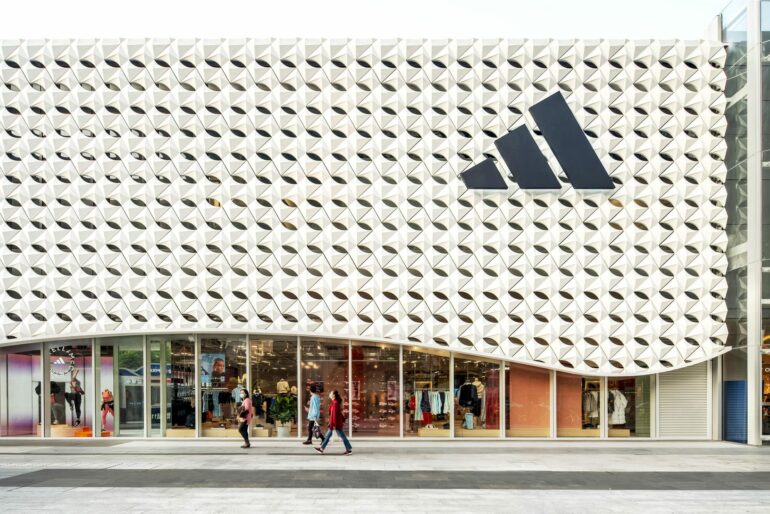
The Price of Glory: When the Field and the Stock Market Clash at Adidas
Sports have this stark duality: the jubilation in the stadium doesn’t always translate into euphoria on the stock market. For Bjørn Gulden, the current CEO of the three-stripe sportswear company, the second quarter of 2026 felt like a “fairy tale” unfolding on the field, but the wake-up call on the Frankfurt Stock Exchange turned out to be a cold shower. While the German group posted record revenues, driven by a global soccer craze, the financial markets reacted with rare severity, punishing the stock with a historic drop of more than 17%. This paradox highlights the constant tension between massive investment in brand image and the discipline of immediate profitability demanded by investors.
From a purely commercial standpoint, however, Adidas has never been stronger. Between April and June 2026, the company generated revenue of 6.74 billion euros, a 13% increase (and even 14% at constant exchange rates) compared to the previous fiscal year. Never before in the brand’s history had a quarter reached such heights. This momentum builds on an already strong start to the year, making 2026 a true demonstration of operational strength.
The “Backyard Legends” Strategy in the Face of Tough Numbers
At the heart of this commercial success lies the brand’s ubiquitous media presence during the World Cup. Bjørn Gulden made no secret of his enthusiasm, describing his role as an absolute privilege during such a competition. The cornerstone of this strategy? The “Backyard Legends” campaign, an initiative aimed at reconnecting with the very essence of the game—the kind played on the streets, far from the spotlight of official stadiums. For the CEO, the challenge was to restore an emotional connection to the brand—a successful endeavor, if digital engagement metrics are any indication: over 9 billion views and 400 million interactions, making this the largest campaign ever orchestrated by Adidas.
However, this visibility comes at a cost. To fund these activations and support its global presence, the group injected 924 million euros into its marketing budget—a 30% increase compared to last year (212 million euros in additional spending). This is precisely where the problem lies for financial analysts. Operating profit, although up 5% to 574 million euros, fell short of the consensus estimate of approximately 616 million. This difference, though minimal on a group-wide basis, was enough to dampen investor enthusiasm, dragging down other players in the sector in its wake, such as Puma, whose stock fell 3%.
Apparel Leads the Way, Footwear Under Scrutiny
A detailed analysis of the product segments reveals an interesting shift in consumer habits. Sports apparel emerged as the big winner of the quarter with meteoric growth of 34%, reaching 2.72 billion euros. This performance was driven by the Football and Originals divisions, as well as by a notable breakthrough in Running and Motorsport. In contrast, the footwear segment appears to be marking time, with virtually no growth (+1% at constant exchange rates) for a total of 3.49 billion euros.
This stagnation in the footwear segment is not due to a lack of consumer interest, but rather to a strategic choice by Bjørn Gulden: discipline. Faced with a European market saturated by aggressive discounts offered by retailers, Adidas chose to limit its shipments (sell-in) to preserve the value of its products. This tactic pays off for the brand’s image but inevitably weighs on quarterly volumes. The Adidas CEO even joked about this situation, noting that many retailers would likely have liked to have more inventory given the much stronger end-consumer demand (sell-out).
Innovation, however, remains the driving force behind the “Performance” segment, which surged by 39%. The success here is as much symbolic as it is technological. While World Cup-themed collections were flying off the shelves, athlete Sabastian Sawe made history at the London Marathon by breaking the legendary two-hour barrier. On his feet, the Adizero Adios Pro Evo 3 proved that the brand still dominates the race for technical excellence, solidifying its credibility against its direct competitors.
A Geography of Growth and a Shift in Distribution
On the global stage, the landscape is shifting. Latin America is emerging as the most dynamic region with a spectacular 35% increase in sales. Greater China confirms its return to favor with 19% growth, while North America is up 14%. Europe, a more mature market facing strong promotional pressure, brings up the rear with a 6% increase.
The distribution model, too, continues to evolve. The direct-to-consumer (DTC) channel soared by 24% to reach 2.91 billion euros. E-commerce, in particular, grew by 27%, validating the digital investments made in recent years. Wholesale remained stable with 6% growth, totaling 3.83 billion euros, demonstrating sound management of physical partnerships despite the shift toward digital.

In terms of profitability, Adidas managed to improve its gross margin by 0.8 percentage points, reaching 52.5%. This increase is the result of better management of selling prices—fewer sales, more full-price items—and a favorable channel mix. However, the overall operating margin edged down slightly, from 9.2% to 8.5%, a direct result of the massive marketing investment made for the World Cup.
Governance Transition and Cautious Outlook
Beyond the financial results, this quarter marks a turning point in the group’s senior leadership. After nearly three decades with the company, including nine years as chief financial officer, Harm Ohlmeyer is set to step down. The executive who oversaw the complex separations from TaylorMade and Reebok will be replaced by Birgit Kretschmer effective September 1. Kretschmer is no stranger to the company: after 25 years at Adidas, she is returning to the fold following her tenure as CFO at the retailer C&A.
This hybrid profile—combining brand culture with the cost discipline gained in the vertical retail sector—appears to be a signal to the markets intended to reassure them about the future management of margins. Bjørn Gulden welcomed her arrival, noting that the new CFO brings an intimate knowledge of the company coupled with enhanced budgetary discipline.
For the remainder of the fiscal year, Adidas is expressing measured confidence. The group has raised its revenue forecasts, now anticipating annual growth of between 9% and 10%. The operating profit target remains at approximately 2.3 billion euros, a figure that observers will be watching closely. The group also has a card up its sleeve: potential refunds of U.S. customs duties, estimated at between $250 million and $300 million, could boost future earnings, although they are not yet factored into the official forecasts.
Following this record-breaking first half, Adidas finds itself in a unique position: that of a brand that has regained its cultural aura and media clout, but which must still convince stakeholders that this success has not come at the expense of financial discipline. The share buyback—the first tranche of which, totaling 500 million euros, has just been completed—demonstrates this commitment to rewarding its shareholders after having unsettled them.