
The Parisian Look in the Face of Headwinds: The Winning Bet on Desirability
In an economic landscape where caution seems to have become the norm, the SMCP Group’s performance in the first half of 2026 offers a fascinating insight into the new dynamics of the fashion industry. While the French market—traditionally the cornerstone of its performance—is marking time, the giant of accessible luxury has managed to stay the course thanks to geographic agility and meticulous image management. The future of its brands is no longer determined solely in Paris, but within a global dynamic where Europe and the Americas are now driving growth. The published figures reflect a resilience that owes nothing to chance, but everything to rigorous financial discipline designed to safeguard the value of the brands.
The results for the first half of the year show revenue of 597 million euros—a performance that, although down slightly by 0.7% at current exchange rates, represents a 0.6% increase at constant exchange rates compared to the previous fiscal year. But beyond this apparent stability, it is the acceleration observed in the second quarter that stands out. With sales nearing 310 million euros in this period alone, growth strengthened to reach 1.8% at current exchange rates and 2% at constant exchange rates. This springtime resurgence suggests that the strategy to protect margins and the efforts to enhance the appeal of the collections are paying off, even in a consumer environment that the group’s management itself describes as cautious.
A Rapidly Changing Geography of Luxury
The most striking aspect of this earnings report is undoubtedly the stark contrast between the different regions of the world. France, the historic birthplace of Sandro and Maje, is going through a period of turbulence. With a 10.8% decline over the half-year, domestic sales totaled 184.8 million euros. Although this trend showed relative improvement in the second quarter (with the decline limited to 8.6% for 96 million euros), it highlights a certain degree of caution among local shoppers. However, this domestic slowdown is offset by robust performance in international markets, which are acting as key growth drivers.
Europe, excluding France, has now emerged as the group’s leading market. With revenue of 218 million euros for the half-year, the region posted robust growth of 6.9%. The second quarter was particularly strong, with an 8.9% increase, reaching 115.4 million euros. This performance demonstrates that the appetite for Parisian chic remains strong among our European neighbors, driven by effective sales execution. At the same time, North America is confirming its status as a key growth market. Sales there climbed to 97.7 million euros, representing a spectacular 11% increase at constant exchange rates for the half-year. This momentum continued between April and June with 7.2% growth (10.4% at constant exchange rates), bringing quarterly revenue to 50 million euros. This breakthrough across the Atlantic is crucial: it validates the relevance of the SMCP model in regions with high purchasing power, where exclusivity and French style remain major selling points.
Finally, the Asia-Pacific region, after a period of stagnation, is showing encouraging signs of recovery. While revenue for the half-year as a whole remained stable at 96.6 million euros (up slightly by 1.9% at constant exchange rates), the second quarter marked a turning point. With €43.9 million in revenue and 3% growth, the region confirms its gradual return to positive momentum. This Asian recovery, coupled with the Group’s solid performance in Western markets, allows the Group to look ahead to the rest of the year with renewed confidence.
Maje and Sandro: Two Pillars, Two Trajectories
At the heart of SMCP’s portfolio, the two flagship brands are performing differently. Maje has emerged as the driving force of the period. The brand founded by Judith Milgrom posted 3.7% growth over the half-year, reaching €232.6 million in revenue. Its momentum accelerated further in the second quarter with a 5.3% increase, driven by collections that seem to have perfectly captured the spirit of the times. This ability to maintain an upward trajectory in a complex market attests to the strength of its visual identity and customer loyalty.
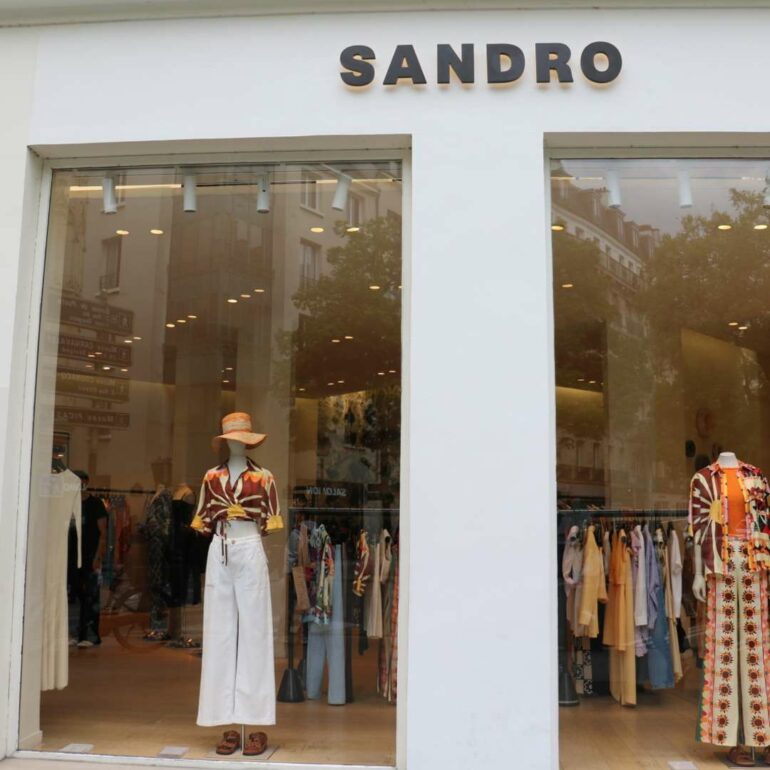
For its part, Sandro came close to the symbolic €300 million mark in the first half of the year. While the brand posted a slight decline of 0.9% at current exchange rates for the half-year, it returned to positive growth at constant exchange rates (+0.7%). Most importantly, the second quarter showed a significant recovery with growth of 2.2% (and even 2.6% at constant exchange rates). This return to form suggests that the strategic adjustments made are beginning to take effect, stabilizing revenue for the group’s largest brand by volume.

The picture is more complex, however, for the division comprising Claudie Pierlot and Fursac. These brands experienced a more pronounced decline of 13.2% over the first half of the year, with revenue of 64.7 million euros. The second quarter did not fully reverse the trend, with a decline of 11.2%. This situation highlights the ongoing challenge of maintaining consistency across a diversified brand portfolio, where smaller brands must redouble their efforts to hold their own against the group’s giants.
Profitability in Support of Brand Strategy
While overall revenue remains stable, it is in the area of profitability that the SMCP Group has achieved its most notable performance. Adjusted EBITDA surged to 119.2 million euros for the first half of 2026, compared to 112 million euros the previous year. Even more impressive, adjusted EBIT reached 53.2 million euros, a significant increase from the 42.6 million euros recorded in the first half of 2025. This growth automatically translates into an improved margin, which rose to 8.9% from 7.1% last year.
This improvement in financial indicators is no accident, but rather the result of a “disciplined execution of the margin protection strategy,” as Isabelle Guichot points out. The group’s CEO highlights a fierce determination to preserve the brands’ desirability. By refusing to resort to excessive promotions to artificially inflate sales volumes, the group prioritizes long-term value. This discipline not only helps to strengthen the financial structure but also reinforces the image of accessible luxury that sets its brands apart. The goal is clear: to transform every sale into an act of desire rather than a mere opportunistic transaction.
The improved financial structure gives the group the freedom to continue its strategic investments. Despite headwinds in France, management reaffirms its targets for the full 2026 fiscal year. This confidence is grounded in the operational strength demonstrated in recent months and in an organization capable of pivoting quickly in response to geographic opportunities. By strengthening its profitability while stabilizing its global operations, SMCP proves that the contemporary luxury model can not only survive but thrive by focusing on what matters most: the balance between Parisian creativity and iron-fisted management.
The path to the end of the year will therefore be marked by constructive vigilance. The group’s ability to maintain this momentum in the Americas and Europe, while supporting Asia’s resurgence, will be key to definitively validating its 2026 ambitions. In this balancing act, SMCP seems to have found the formula to turn consumer caution into an opportunity to reaffirm the strength of its brands.