
Make Texture a preferred source on Google to support us
Add Texture to GoogleTwenty-five cents. That was the paltry sum a twelve-year-old boy once paid for a modest green stone, which he sold for eight hundred dollars shortly thereafter. The anecdote might have been lost in the archives of a family of merchants, but Harry Winston turned it into something entirely different: the founding myth of his empire. In recounting this youthful coup of his own, the American jeweler was not merely seeking to boast of his precocious eye. He was laying—consciously or not—the foundations for an aesthetic obsession that would define his house’s identity. The stone in question was an emerald. Its shape would become a language.
Today, this strict geometry—characterized by a stepped octagon—has permeated the brand’s mental and physical space. It dictates the architecture of the display cases, shapes the woodwork in the reception rooms, and even dictates the design of the famous HW monogram. But it is on the body, in contact with the skin, that this visual grammar comes into its own. With the Ultimate Emerald Signature model, the manufacture delivers a show of strength in which watchmaking submits entirely to the dictatorship of the straight line.
The Tyranny of Transparency
Choosing the emerald cut is never an easy choice for a gem cutter. Unlike the brilliant cut, designed to amplify fire and dazzle the eye to the point of masking any inclusions, the stepped octagon cut demands absolute transparency. Its wide, open table acts as a merciless mirror: the slightest impurity or the tiniest variation in color is immediately apparent. This profile demands gems of impeccable purity.
This approach, in which the gemstone dictates the terms to the material that supports it, finds its most radical expression in the Classic Winston Emerald-Cut Diamond Ring. In this piece, the setting seems to yield. Surrounded by tapered baguettes, the central diamond appears to float, held in place by a setting of almost rugged discretion. The metal recedes into the background, refusing to steal the spotlight from the stone’s brilliance. This principle of the setting’s deliberate self-effacement in favor of pure geometry is precisely what governs the construction of the house’s latest masterpiece.
A ziggurat of gold and light
The Ultimate Emerald Signature watch does not resemble a traditional timepiece. By the manufacturer’s own admission, it is the most spectacular creation in its high-end jewelry watchmaking catalog. Viewed from the front, the piece stands like a miniature pyramid. Its case, forged from 18-karat white gold, rises through a succession of octagonal steps. This architectural base is brilliantly illuminated by a pavé setting alternating between brilliant-cut and baguette-cut diamonds, structuring the volumes through a play of contrasting lines.
At the summit of this miniature structure sits an emerald-cut diamond, the focal point of the entire design. But the rigidity of the octagon is immediately broken by a moving band. Twenty-four marquise-cut diamonds encircle the base of the case, forming a halo mounted on a movable system. This kinetic mechanism captures light at every angle of the wrist’s inclination, casting a shadow that brings the white gold structure to life.
Time as a Raw Material
One must handle the object to understand its primary function, which is almost relegated to the status of an intimate secret. The apex of the pyramid pivots on its own axis in mechanical silence. Hidden beneath this shell of diamonds lies the dial, itself adorned with 98 meticulously set gemstones.

This concealment of the dial reverses the usual relationship with the watch. Displaying the time becomes a secondary act, a secret shared only with the piece’s owner. In this world, the true measure of time is not read on hands. It is calculated in the workshops. It takes the artisan gem-setters one hundred hours of uninterrupted manual labor to set all the stones on a single case. Here, time is consumed—literally burned away—by the demands of the craftsmanship.
The idea of a secret watch embodying the codes of the octagon is not a recent flash of inspiration. The first iteration of this line emerged from the workshops in 2014, in a pristine version covered exclusively in diamonds. Far from running its course, the concept has evolved into a playground for chromatic experimentation. The brand has successively adorned the watch’s architecture with blue sapphires, electric-cyan Paraíba tourmalines, and pink sapphires, before recently unveiling a green variation, logically closing the color wheel with the hue of the stone that gives the model its name.
A Geometric Shockwave
The influence of the octagon extends beyond the realm of extreme complexity. The strength of this motif lies in its adaptability, capable of withstanding drastic changes in scale. The secret Emerald Signature line draws on the principle of the concealed dial and tiered architecture, but softens it with a pivoting mother-of-pearl background that plays on gentler perspectives.
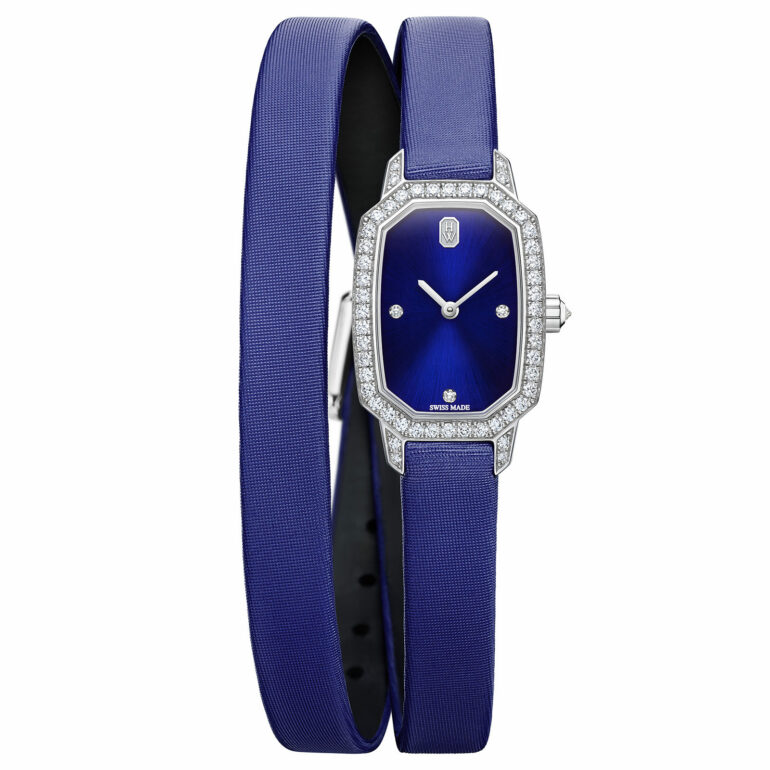
In a different vein, the Precious Emerald wristwatch distills the house’s identity into a compact design. Here, the octagon takes on a more compact form, encircled by a flowing bracelet set with marquise-cut diamonds. It captures the spirit of the famous Winston Cluster technique, where the asymmetrical arrangement of the stones creates the illusion of a plant-like form. Finally, moving from high jewelry to timepieces designed to withstand daylight, the simple Emerald collection reinterprets this iconic shape on 18-karat rose or white gold cases, proving that the aesthetic framework endures even when stripped of its most imposing diamonds.
Embracing such a recurring form requires a certain confidence. Where the luxury industry often succumbs to the temptation of perpetual variation to justify novelty, the persistence of the emerald cut acts as an anchor. The Ultimate Emerald Signature, with its tiered architecture and dazzling brilliance, perfectly illustrates this defining break from convention in American high jewelry: a self-assured ostentation that exists only because it is constrained by the strictest discipline of geometry.