
The Grand Compromise: Latakia and the Invention of the Post-Assad Syrian Riviera
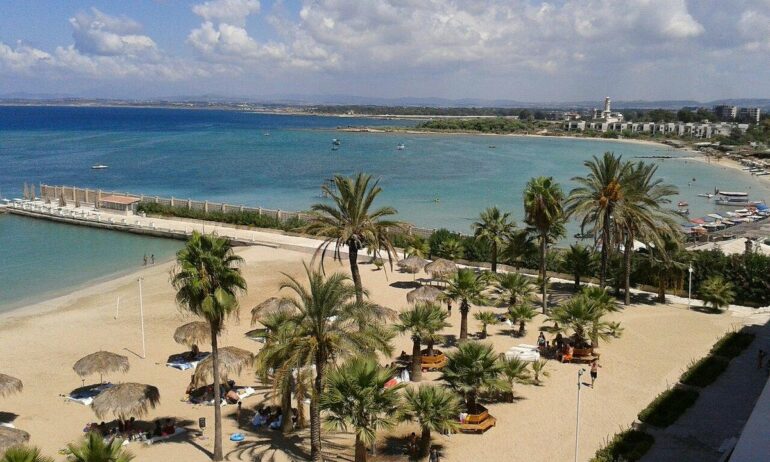
On the road leading southeast from Aleppo, the landscape is a litany of scars. The shattered concrete of bombed-out buildings and the silence of deserted villages form a barren backdrop, punctuated only by the presence of armed young men at checkpoints. Then, almost without transition, the atmosphere softens. The gray of the dust gives way to the green of the hills, and the horizon opens up to the Mediterranean. Military patrols give way to roadside stalls piled high with inflatable buoys and brightly colored air mattresses. We arrive in Latakia, Syria’s main port and a historic stronghold of the Assad era, now a testing ground for a sense of normalcy in the midst of reconstruction.
The city is an open-air paradox. While the streets still bear the scars of rubble, the waterfront buzzes with new life. Women in summer dresses and sleeveless tops stroll with their children, turning their backs on the ruins to gaze out to sea. Latakia is a city undergoing a transformation. Signs of the past are still there: a luxurious mansion, now occupied by soldiers of the transitional government, still displays the Falcon of Quraysh—the emblem of the previous era—on its gate. In the pockets of passersby, banknotes still bear the likeness of the leader who fled to Russia at the end of 2024. But the spirit of the city already seems to be elsewhere.
Between Pragmatism and Bikinis: The Rules of the Social Game
Since January 2025, Syria has been led by Ahmed al-Sharaa, the former leader of the rebel group Hayat Tahrir al-Sham, who rose with lightning speed from the insurgency to the highest echelons of government. His government is now trying to project an image of institutional discipline and pragmatism, far removed from radical stereotypes. For Syrians and international observers alike, the stakes are high: can this new government accommodate the diversity of an exhausted and distrustful country? On the ground, the mood isn’t one of fear, but of swimming. Near the water, residents gather around plastic tables, smoke shisha, pass around rounds of drinks, and seem to be issuing a challenge to the rest of the country: to catch up with them on the path to individual freedom.
This coexistence is based on a typically Syrian compromise. In June 2025, the Ministry of Tourism issued specific rules: burkinis or modest attire are required on public beaches. However, Western-style swimwear, including bikinis, is permitted in hotel resorts and private beach clubs. In Latakia, the contrast is striking, sometimes just a few meters apart. On the public beach, families arrive with their coolers, bags of bread, and bottles of tea. The women, often veiled and dressed in loose-fitting clothing, stay grouped together under the umbrellas while the men swim in long shorts.
“It’s beautiful,” says a local woman between puffs on her shisha. She looks out at the beach littered with trash bags, where children weave their way between the lounge chairs. “It’s mostly Arabs who come here—no Europeans yet. We hope tourism will continue to grow, especially with foreign visitors.” This is the down-to-earth, conservative side of Latakia—friendly and full of good-natured charm. But just a few steps away, on the aptly named Côte d’Azur Road, the atmosphere changes radically.
The luxury push and the bet on the “untapped market”
At the Hola Beach Club, which has just opened its doors, the sound of Arabic club hits and the buzz of a pool party welcomed more than 300 guests on the very first day. The venue is stylish without being stuffy. Manaf Kaddour, the owner, describes his establishment as an “affordable luxury” beach club. It features a spa, designer boutiques, a beauty salon, a gym, and a rooftop nightclub. “Since Syria’s liberation, many local and international investors have been planning to enter the tourism market,” explains Kaddour. For him, speed is the key to success. What surprises him most? The total lack of obstruction from the new government regarding his highly “Westernized” projects.
Admittedly, the old bureaucracy hasn’t completely disappeared, and the banking system is still awaiting reforms, but Kaddour says he no longer has to worry about bribes or political interference in his business. For him, Latakia is a “virgin market.” Admission to these private havens of peace costs about 9 euros for adults and 4 euros for children—a significant sum, but one that doesn’t stop visitors from flocking in from Damascus, Aleppo, or Idlib. Abdul Wahed Daboul, general manager of the Afamia Hotel Resort, shares this optimism. With a portrait of Al-Sharaa prominently displayed on his desk, he asserts that “Latakia is completely different from the rest of Syria. Here, people are free and open-minded. They come to enjoy the beach, have a drink, and not worry about a thing.”
A New Sense of Security: The Tourist Police in Action
Yet, a carefree attitude cannot be simply decreed. Security is at the heart of ongoing negotiations. A new force, the tourist police, has been created. Its officers, dressed in deep blue uniforms, patrol the beaches and historic sites. Their exact role is still being defined: they are not a vice squad, but are tasked with ensuring the safety of people and property. The head of this force in Latakia, Osama Marandi, commands 225 officers, including 50 women. “Welcome to the new Syria,” he says with calculated warmth.
Among them is Rama Ghanem, a former teacher who chose to join the police force to help her hometown develop. “The old Syria was beautiful, but today it’s changing for the better. Before, there were no rules; now there are. This is our Syria, the people’s Syria,” she asserts. The laws are now clearer, even if they may seem restrictive to some. In addition to the ban on alcohol on public beaches, restrictions limit access to certain areas for groups of men traveling alone, in order to foster a family-friendly atmosphere and prevent harassment. “We have no problem with bikinis,” the police chief clarifies, before Rama Ghanem adds: “They are allowed, and we welcome them—as does the government—but not in public spaces.”

A Cultural Mosaic That Has Withstood the Test of Time
In the heart of the city, Latakia reveals its hidden historical treasures as you wander through its narrow streets. Ilyas Karkhour, caretaker of the Armenian Church of the Virgin Mary, guides the few visitors through this 820-year-old stone sanctuary. The city center is a mosaic: churches stand side by side with mosques, shopkeepers switch between Arabic and Armenian, and Alawite, Sunni, and Christian communities live side by side. It is this diversity that, according to Caroline Chrakiam, a local resident we met on Blue Beach, constitutes the very essence of Syria. “For now, we’re waiting to see,” she adds cautiously, however.
Waiting and observing have become survival instincts for the coastal residents. While hope and a certain sense of freedom are palpable, certainty is still lacking. For some who have returned from the United Arab Emirates, the beach remains a place they visit with a touch of apprehension, as memories of curfews and the anxiety of the war years are still too fresh. “There’s still a bit of fear,” says Kanz, another resident of Latakia. “It will take time for us to fully trust these new leaders, and for them to fully accept who we are.”
As night falls, the Christian neighborhood on America Street comes alive. At the Abu Ghassan Pub, conversations grow loud as soccer matches play on the screens. Suddenly, everything goes dark: a power outage. No one bats an eye. Karim Morcos, a regular, shrugs. He notes that these outages are now less frequent and shorter than before. On the way out of the pub, you notice a red cap on a shelf bearing a slogan—an ironic nod—that reads: “Make Syria Great Again.” A joke, no doubt, but one that resonates like a silent prayer in this city that refuses to give in.
Practical Information and Economic Context
Syria’s recovery took a decisive turn during Donald Trump’s visit to the Gulf in 2025, leading to the lifting of U.S. sanctions. This development paved the way for foreign capital. Last year, the country signed tourism investment contracts worth 1.3 billion euros. These funds are earmarked for the construction of hotel complexes, the renovation of historic districts, and the improvement of road infrastructure. Latakia hopes to attract investment from the Gulf to transform its coastline into an international summer destination.
Travelers should note a few logistical details: credit cards are generally not accepted, so it is essential to bring U.S. dollars or Syrian pounds in cash. Tourist visas can be obtained upon arrival (approximately 130 euros for European passport holders). Aleppo International Airport is the nearest point of entry, located about a two-and-a-half-hour drive from Latakia. In addition to its beaches, the region is home to major archaeological sites such as Ugarit, the birthplace of the alphabet dating back to 6,000 B.C., as well as the medieval fortress of Qalaat Sahyun, a UNESCO World Heritage Site.