
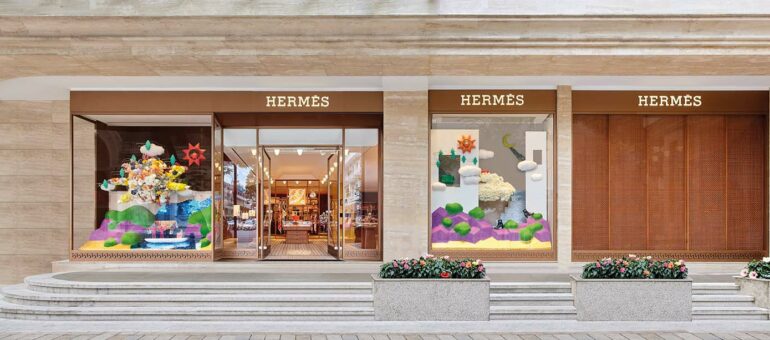
On June 16, a new address was added to London’s prestigious luxury scene: 166 New Bond Street. Far from being merely a social event, this opening epitomizes the organic growth strategy and physical presence that the Faubourg Saint-Honoré-based house continues to prioritize. In a macroeconomic climate where uncertainty seems to be the only constant, Hermès has just unveiled its results for the first half of 2026, demonstrating remarkable resilience despite the turbulence in the financial markets.
With total revenue of 8.16 billion euros, the company led by Axel Dumas posted a 6.1% increase at constant exchange rates. Looking at the raw figures, growth at real rates appears more modest (+1.6%), due to adverse currency effects that reduced revenue by more than 360 million euros over the first six months of the year. However, it is the company’s internal momentum that is drawing attention: after a sluggish start to the year, the second quarter showed significant signs of acceleration, with sales climbing 6.7% on a like-for-like basis to reach 4.09 billion euros.
The Contrasting Geography of Desire
Hermès’ resilience is not uniform across the globe. The true driver of this half-year’s performance lies across the Atlantic. The Americas displayed remarkable vitality with a 15.3% jump at constant exchange rates. This performance is built on a solid foundation, balanced across the company’s various segments, proving that the “saddler’s dream” retains its full appeal among American customers.
In Europe, outside our national borders, the 8.8% growth attests to the effectiveness of recent investments, such as the reopening of the Berlin store. France, for its part, benefited from a second quarter boosted by the return of tourist traffic, closing the half-year with a 1.8% increase. The situation in Japan is more complex: while sales there surged by 11% at constant exchange rates thanks to a marked acceleration between April and June, currency depreciation pushed the result into negative territory (-2.1%) once converted to euros.
The Asia-Pacific region, closely watched with concern by all industry observers, maintained 2.4% growth excluding Japan. Greater China and South Korea continue to drive the region, offsetting the persistent weakness in the Middle East. The Middle East remains the only geographic region in decline (-4.2% at constant exchange rates), although the latest signs point to a gradual recovery. These fluctuations illustrate the group’s ability to navigate through turbulent periods without ever losing its overall course.
The Focus: Excellence in Leather and Craftsmanship
At the heart of the Hermès machine, the Leather Goods and Saddlery division reaffirms its status as an unshakable pillar. With growth of 9.8% at constant exchange rates, this division continues to benefit from demand that structurally outstrips supply. New releases continue to enjoy unwavering success, as exemplified by the Cliquetis, Double Longe, and Kelly Hobo models, which enrich an already legendary collection. To keep pace with this momentum, the House has opened its twenty-fifth leather goods workshop in Loupes, in the Gironde region, reaffirming its decentralized production model, which is deeply rooted in France.
The company’s other sectors are not to be outdone. Silk and Textiles are performing strongly (+9.7%), while the home and jewelry segments are up 5.4%. However, certain segments are stagnating: Apparel and Accessories, as well as the Beauty division, posted declines of 2.5% and 6.1%, respectively, at current exchange rates, although ready-to-wear remained positive (+2%) when currency effects are excluded. The watch division, after years of euphoric growth, is entering a stabilization phase at constant exchange rates, bearing the full brunt of currency conversion with a 4.2% decline on a reported basis.

A Financial Structure Built to Last
Despite these headwinds, the company’s profitability remains at levels that command respect. Recurring operating income came in at 3.35 billion euros, representing an operating margin of 41%. While this is a slight decline from the previous year’s 41.4%, this level of performance remains exceptional within the industry. Net income, meanwhile, stabilized at 2.24 billion euros. If we adjust this figure to exclude the one-time tax levy imposed on large French companies, it would rise to 2.5 billion euros, or nearly 31% of revenue.
The strength of its financial position allows Hermès to continue its ambitious investment policy while rewarding its shareholders with €1.9 billion in dividends. Net cash reached a staggering €12.93 billion at the end of June. This financial strength is accompanied by a growing commitment to its people: the company hired more than 600 new employees during the first half of the year, bringing its global workforce to more than 27,000 people, of whom more than 16,000 work in France.
The Stock Market and the Reality on the Ground
The financial market, always quick to react impulsively, initially shunned these results. At the opening bell, the stock fell by more than 4%, reflecting a certain caution regarding future margins and revenues deemed, at times, to fall short of the expectations of the most demanding analysts. This nervousness echoes an already turbulent first quarter, marked by geopolitical impacts in the Middle East and more uncertain tourism trends.
However, the correction was short-lived, with the stock rebounding by more than 2% the very next day. Analysts at Bernstein notably highlighted an improvement in the second quarter compared to the first, while urging a nuanced interpretation of these figures. For Axel Dumas, this performance validates, above all, the house’s unique artisanal model. By focusing on maintaining its fundamental balance and customer loyalty, the group is sustaining ambitious medium-term growth prospects without succumbing to the allure of short-term gains.
Hermès continues to forge its own path with a quiet confidence. Despite a global economic climate that is clouding in some areas, the house seems to be navigating a parallel dimension, where the value of the long term and the precision of craftsmanship outweigh the volatility of market indices. This half-year, though challenging from a monetary standpoint, once again confirms that the “rare and desirable” strategy remains one of the most effective bulwarks against economic cycles.