
The Tiara of Exile: When the Crown Becomes Armor
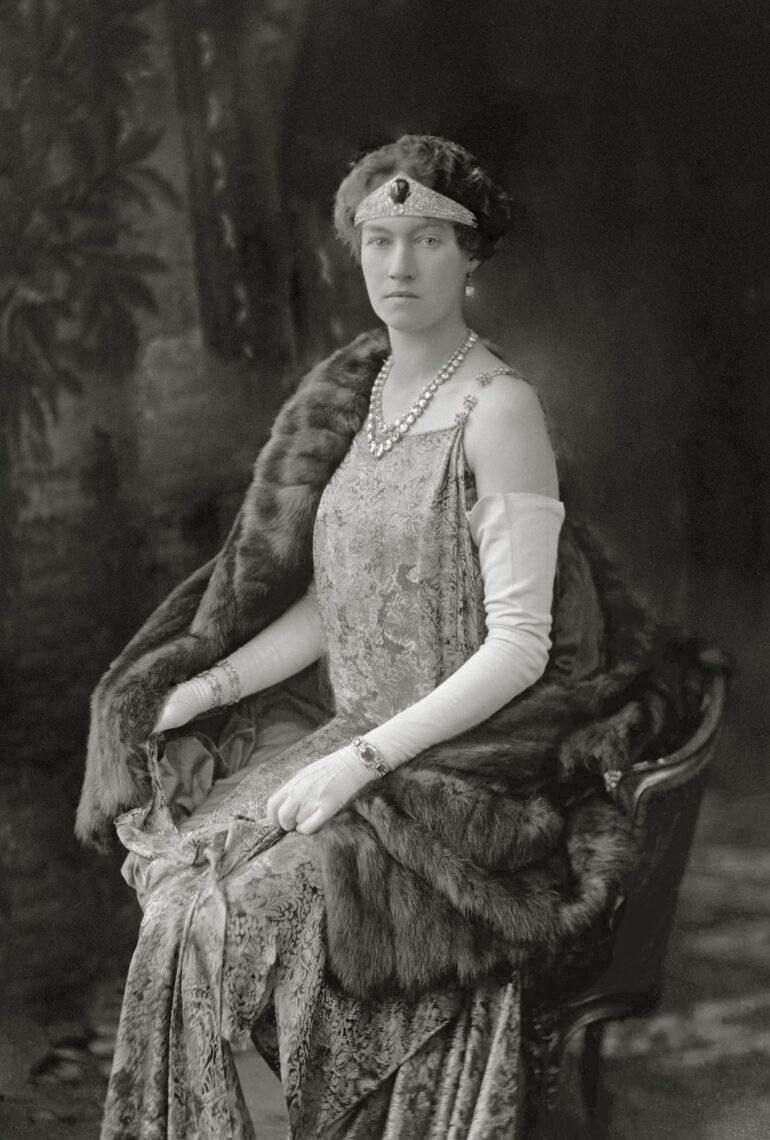
There are objects whose symbolic significance far exceeds the value of the gemstones from which they are made. In the shadows of the corridors of power and the recesses of history, certain ornaments cease to be mere adornments and become symbols of a cause. Such is the case with the tiara of Grand Duchess Charlotte of Luxembourg. If we pause for a moment to consider its frontal profile—that bold point rising toward the sky—our minds take an unexpected turn. What we seem to see is no longer merely a piece of princely jewelry, but the emblem of a figure from contemporary mythology: Diana Prince, alias Wonder Woman. This collision between the historical reality of a European sovereign and the aesthetic of an Amazon warrior is not merely a visual coincidence. It implicitly tells an epic tale of resistance and survival at the heart of the darkest hours of the 20th century.
The Outbreak of War in 1940 and the Decision to Leave
Charlotte of Luxembourg’s fate took a dramatic turn when Hitler’s troops crossed her country’s borders. The invasion was not merely a territorial aggression; it was a shockwave that threatened to erase the very sovereignty of the Grand Duchy. Faced with the advance of the German army, the Grand Duchess found herself confronted with a dilemma that would define her reign. Stay, at the risk of becoming a puppet in the hands of the occupier, or leave to embody the country’s legitimacy from abroad. She chose exile. The Nazi tide sweeping across Europe left little room for half-measures. For Charlotte, leaving her homeland was heart-wrenching, but it was also a political act of the highest order. It was against this backdrop of haste and danger that the journey began, as she took with her the symbols of her office, including that precious tiara that would never leave her side.
The escape is no peaceful, leisurely journey. It is a series of urgent decisions, blocked roads, and borders crossed under pressure. As she travels through France and then Portugal, the sovereign carries with her the weight of her people. She is no longer merely a woman fleeing war; she is the state on the move. In her luggage, the tiara represents far more than a family heirloom. It is the anchor of constitutional continuity. While the Nazi regime sought to erase Luxembourg’s identity, Charlotte’s presence outside the country’s borders upheld the nation’s legal existence. Through its physical presence, the jewel attested to the permanence of the crown in the face of the barbarism taking root in the heart of Europe.
The Atlantic and the American Refuge
The Grand Duchess’s journey ultimately took her across the Atlantic. The United States became the stage for a new form of resistance. By settling on American soil, Charlotte of Luxembourg did more than simply seek safety; she embarked on a crucial diplomatic mission. In a country still wavering over the extent of its involvement in the global conflict, the sovereign became a leading figure, a voice bearing witness to the distress and courage of small, oppressed nations. The United States then discovered a woman of absolute dignity, holding high the colors of her country even as it was being wiped off the map by Hitler’s occupying forces.
During her time in the United States, every public appearance was a peaceful declaration of war. The tiara, carefully preserved, played a major psychological role here. It commanded respect and reminded her American counterparts that Charlotte was no ordinary refugee, but a head of state whose legitimacy remained intact. The comparison with Diana Prince takes on its full meaning here. Like the fictional heroine who leaves her island to fight evil in the world of men, the Grand Duchess had to cross the ocean to carry the torch of justice. The tiara is no longer merely a ballroom accessory; it is the visor of a battle helmet—an instrument of soft power ahead of its time.
An Aesthetic of Power: From the Court to Pop Culture
The visual impact of this jewel is striking. Its massive structure, geometric lines, and central point—which evokes an inverted chevron—create an impression of strength and determination. There is a ruggedness to this beauty, a verticality that stands in stark contrast to the rounder or more floral designs of the same era. It is precisely this “warrior’s crown” look that creates a mental bridge to Diana Prince’s headpiece. In the collective imagination, Wonder Woman’s tiara is a protective tool, capable of deflecting projectiles and symbolizing invincibility. Charlotte’s tiara, though forged from the finest metal and adorned with sparkling gemstones, shares this symbolic function as a shield.
It is fascinating to see how a historical object, created in the workshops of the greatest jewelers to meet the codes of aristocratic etiquette, can resonate with comic book icons. This “strange” resemblance mentioned by observers is no coincidence. It highlights a universal truth about the representation of female authority. In times of major crisis, the ornament sheds its purely aesthetic function to once again become an attribute of sovereignty. By wearing this tiara in the face of the challenges of her time, Charlotte of Luxembourg transformed a luxury item into a historic artifact of resistance. Long before the silver screen, she embodied the figure of the woman who, in the face of invasion and oppression, refuses to yield.
Her stay in the United States left a lasting mark on the Grand Duchess’s image. There, she found an echo of her own struggle for freedom. By visiting American institutions and meeting with the decision-makers of the time, she linked the fate of her small country to that of the great American democracy. The tiara was a silent witness to these exchanges, these official dinners, and these speeches in which the future of Europe was at stake. Throughout those years of exile, it remained the tangible link between Luxembourg’s glorious past and its uncertain future. With every glint in the diamonds, the hope of a return was expressed.
The Enduring Power of a Symbol of Sovereignty
Beyond a mere stylistic anecdote, the story of this jewel is one of triumph over erasure. Hitler sought to eliminate nations and their symbols; Charlotte used hers to assert her presence even more strongly. The tiara emerged unscathed from the conflict, just as the Grand Duchess’s resolve did. Today, it remains a central part of the heritage of the Grand Ducal Court of Luxembourg, reminding current generations that luxury can sometimes be the garb of courage. It is not merely a treasure to be admired in a display case or at a gala ceremony; it is a piece of European history that has traveled, endured, and survived the attempt to annihilate an entire continent.
The next time we see that distinctive tip glistening beneath the chandeliers of a palace or in an archival photograph, we cannot help but think of that Atlantic crossing and of that sovereign who, in the face of the invader, managed to hold her head high. The comparison with Diana Prince, far from being trivial, underscores the timelessness of the figure of the protector. Whether fictional or flesh and blood, the woman in the tiara remains the one who, in the midst of turmoil, refuses to give up. It is not the physical resemblance to a comic book heroine that matters most, but rather the reality of a life dedicated to preserving a national identity in the face of the most devastating threat humanity has ever known.