
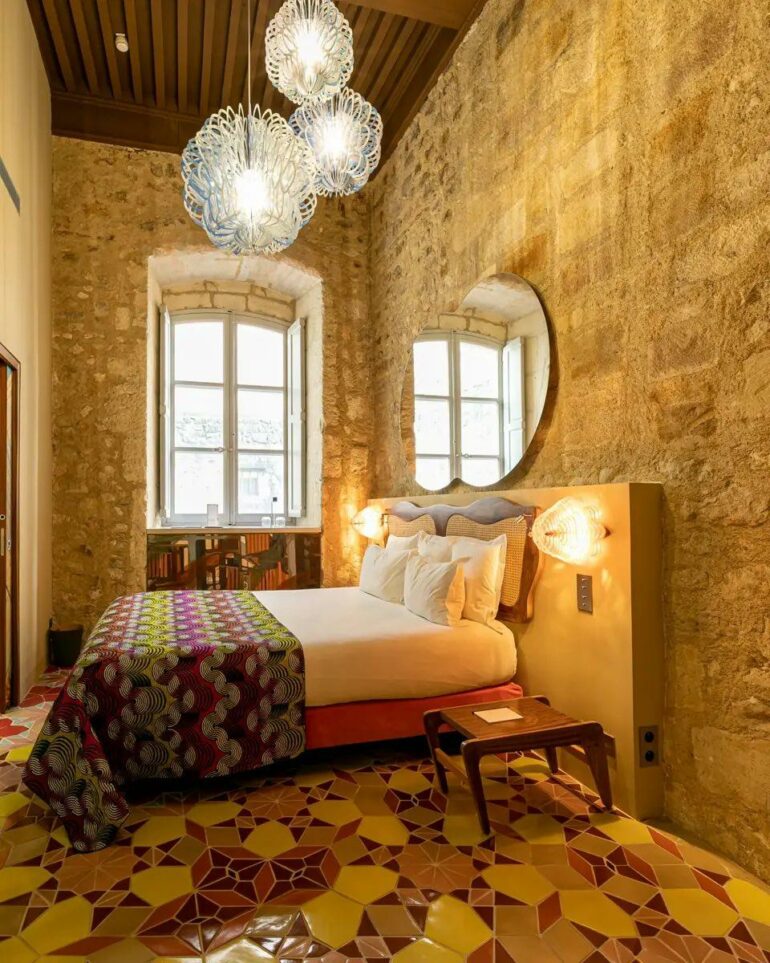
A Strategic Return to Mainland China
After withdrawing from the Chinese market during the global health crisis, the Berlin-based brand Design Hotels made a highly publicized return last year. The company has already added four new properties to its portfolio for 2025. The first step was taken with The Arcadia Place, an idyllic mountain retreat nestled near Lugu Lake in Sichuan Province. This re-entry was masterfully orchestrated by the brand’s CEO, Stijn Oyen. With over 25 years of experience in the hospitality industry, notably at Starwood and Marriott International (Design Hotels’ parent company since 2011), this Belgian executive knows the ins and outs of the industry like the back of his hand. In a recent conversation, he shared his insights on the abundance of spectacular hotel projects in China, the growing appetite for immersive experiences, and the future flagship destinations in the Asia-Pacific region.
A glowing report card and growth driven by Asia
Despite a complex international landscape, particularly in the Middle East, Design Hotels is emerging from a historic 2025. The brand has never recorded such strong performance. Notably, the Asia-Pacific region has been the true driving force behind this momentum, accounting for nearly 30% of the company’s overall growth in recent months.
An “à la carte” business model designed for hoteliers
Unlike traditional franchises, the brand’s approach is based on flexibility. Fixed costs for member hotels are deliberately kept at a very affordable level. The difference lies in the ancillary services. Much like a customer choosing a meal at a fine restaurant, the hotelier has access to a wide range of services: content creation, brand strategy, artistic direction, digital tools, and distribution channel optimization. The goal is to work hand in hand to build an annual action plan fully tailored to the venue’s history, its local roots, and its ambitions.
Word of mouth as the main driver of recruitment
The expansion of the portfolio does not follow a strategy of aggressive market expansion or regional quotas. In fact, nearly 80% of the new hotels joining the venture come from within the network itself. It is often current owners or their close circles who recommend new properties. Recently, a superb project in Bali came to fruition solely because the owners were childhood friends of long-standing Italian members of the network. Although the brand receives a mountain of unsolicited applications every year, the selection process remains extremely rigorous, and only a tiny minority are accepted.
The perfect balance between independence and the support of a global giant
Belonging to a titan like Marriott might have raised concerns among hoteliers who joined Design Hotels precisely for its rebellious and independent spirit. It did, in fact, take some time for both sides to find their footing. Today, harmony is complete. The offices remain based in Berlin, and the company retains complete freedom over its curation and corporate culture. Marriott values this uniqueness while making its immense resources available. Members have clearly understood this, as evidenced by the latest internal survey from 2025, which proved to be the most positive ever conducted since the group’s inception.
Major achievements: from geographic expansion to the return of paper
The reconquest of the mainland Chinese market is undoubtedly one of the brand’s most significant recent achievements. But other initiatives have also been successful, such as the development of the in-house creative agency. It now manages global campaigns and the design of immersive websites for the properties. On another front, the brand took a bold gamble by relaunching its print publications: the famous hotel lifestyle book and a magazine transformed into a biannual journal. In an era saturated by digital media, these tangible and elegant items have regained immeasurable value in the eyes of travelers.

The Chinese market: an essential hub of creativity
It seemed unthinkable for the brand to remain absent from China. During scouting trips with its teams, management was literally blown away by the avant-garde nature and quality of local hotel concepts. The independent hotel sector there is experiencing a true creative boom. Yet the re-entry strategy was carried out without haste: there was no obligation to sign a specific number of properties within a set timeframe. The approach prioritizes, above all, partnering with exceptional projects.
A hybrid clientele: between a quest for local authenticity and international tourism
The profile of travelers varies significantly depending on the hotels’ locations. In unspoiled areas like Lugu Lake, there is a unique mix of international guests and Chinese tourists escaping coastal cities to reconnect with authenticity. Furthermore, the recent easing of visa policies for many European countries has clearly boosted interest among foreign travelers, although it is still a bit too early to establish precise statistics, as the brand’s return to this market dates back only a year.
Organic growth as the sole compass for the Middle Kingdom
The stated ambition is to regain, or even surpass, the brand’s pre-pandemic footprint in China. However, this will not be achieved by imposing arbitrary quotas. Growth will come naturally as establishments aligned with the group’s philosophy join the community. The enthusiastic feedback from the first Chinese members is creating a virtuous cycle, attracting in its wake a multitude of projects, each more fascinating than the last.
Asia-Pacific in the Crosshairs: India, Japan, and Vietnam
While China is the focus of attention, other Asian territories promise significant breakthroughs. India is an obvious priority, as evidenced by the recent signing of a hotel in the heart of a vineyard near Pune, a sector generating increasing interest. The presence in Japan is also set to intensify, as is the case in Vietnam, a market that is generating immense enthusiasm among the teams. The Asian continent is teeming with visionary creators, offering an exceptional playground for redefining the hospitality industry of tomorrow.