
The Engineering of the Invisible: The Architects Behind the Scenes Who Are Redefining Hospitality
Whether in the cozy intimacy of a Munich bar or under the subdued lighting of a table in Bangkok, guests often perceive only the end result: an emotion, a sense of comfort, a feeling of natural ease. Yet behind the seamless flow of service or the warmth of an atmosphere lies a rigorous, almost scientific discipline. Far from the hype surrounding star chefs, a new generation of consultants and designers is dedicated to refining the details that go unnoticed but dictate a venue’s success. From visual acoustics to the psychology of work attire, take a journey into the heart of this precision engineering that transforms a simple establishment into an institution.
Munich: Martin Imschweiler and the Quest for an Organic Soul
To understand Martin Imschweiler’s vision, one must step behind the bar at Schumann’s, the Munich institution where he presided for twelve years. It was there, interacting with a discerning clientele amid the controlled chaos of Bavarian nights, that he learned a great venue is never defined solely by its menu or its furnishings. In 2021, he founded Imschweilers with a clear ambition: to reconcile aesthetics and operations—two worlds that, in his view, too often ignore one another.
His consulting firm’s approach is based on an almost archaeological observation of the built environment. Verena Glup, creative director, emphasizes this priority placed on the existing structure. Before sketching any concept, the team analyzes shadows, natural light, the neighborhood’s history, and the architectural framework. This was the case during the renovation of the Parkhotel Mondschein in Bolzano. Rather than imposing a cosmopolitan style, Imschweiler chose to make the hotel an ambassador for South Tyrol’s culinary traditions, creating a space that feels as though it has always been within these walls. For him, success lies in what he calls “the essence of a place”: a combination of invisible functional details that, when taken together, create absolute coherence.
This rigor applies equally to the creation of a modular bar for the Swiss furniture manufacturer Lehni as it does to the upcoming Iza Noodle Bar, set to open soon in Munich. The guiding principle remains the same: steer clear of fleeting trends in favor of enduring principles. Staff who recognize you, lighting that flatters your complexion, a visual identity that isn’t overbearing—these are the elements that, according to Imschweiler, make people want to come back. His advice to restaurant owners is unequivocal: staff training must be an ongoing process, ideally refreshed every six months, because even the most beautiful concept will fall apart if the human element falters.
Bangkok: Lundi, or the Psychological Mastery of Photons
In Bangkok, Kunlatida Suwintrakorn approaches hospitality from a radically different angle: that of physics and spatial psychology. Founder of the Lundi agency, this architect trained in France has made lighting her exclusive specialty. According to her, a gourmet meal, no matter how perfect, can be completely ruined by poorly calibrated lighting. Light that’s too harsh makes the guest feel exposed and pale; poorly managed darkness sows doubt about the cleanliness or quality of the food.
Lundi’s work goes far beyond simply selecting designer lighting fixtures. It involves complex engineering that takes the Color Rendering Index (CRI) into account. Kunlatida Suwintrakorn enforces a strict standard: to ensure that dishes retain their appetizing appearance and natural colors, the CRI must remain above 90. It is this technical precision that allows the food to “come alive” in the diner’s eyes.
The example of the Nusara restaurant perfectly illustrates this symbiosis between space and light. There, the firm analyzed the variations in light on the Wat Pho temple—visible from the dining room—to adjust the interior lighting in real time. The idea is to create a seamless transition from day to night using smart control systems. For Lundi, automation isn’t a gimmick but an operational necessity: it frees staff from having to manage light switches and ensures a consistent ambiance, regardless of the demands of service. By avoiding fixed spotlights in favor of adjustable track systems, the firm also allows the space to evolve without requiring costly wiring work every time the table layout is changed.

London: Service Works and Clothing as a Precision Tool
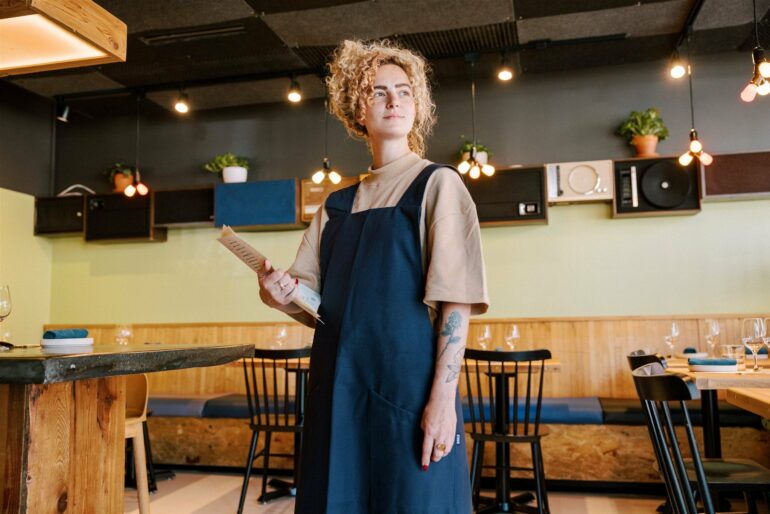
Just as light shapes space, clothing shapes attitude. In London, Tom Chudley made a unique career shift, leaving the kitchen to enter the world of fashion—yet never forgetting the demands of the trade. With Service Works, launched in 2020, he offers a fresh take on workwear that refuses to choose between style and functionality.
His initial observation was simple: traditional uniforms are often uncomfortable, not very breathable, and wear out prematurely. By using durable organic cotton, Service Works creates pieces that can withstand the rigors of repeated industrial wash cycles while remaining comfortable to wear in the stifling heat of a kitchen. The design is never arbitrary: the checkered chef’s pants, for example, feature a classic pattern whose primary function is to conceal stains, while the seersucker jackets evoke the historic elegance of maître d’s while offering a contemporary lightness.
The brand’s success with establishments like St. John and Wildflowers proves that uniforms are no longer seen as an imposed constraint, but rather as an extension of the restaurant’s identity. Chudley advocates a participatory approach: those who wear the garments every day are best positioned to assess their fit and durability. Staff who feel comfortable in their uniforms perform better and are more at ease. By blurring the line between technical apparel and functional ready-to-wear, Service Works reminds us that elegance in the dining room begins with respect for the comfort of those who serve.
Toward a Hospitality of Consistency
What these experts—from Munich to Bangkok to London—teach us is that the luxury of tomorrow will no longer lie in ostentation, but in the absence of friction. A successful venue is a system where every element—the cut of an apron, the angle of a light beam, the resonance of a material—works together to tell a unique story.
The lesson is universal: to endure, an establishment must stop chasing fleeting Instagram trends and focus instead on timeless principles. Total coherence between the menu, the acoustics, the service, and the visual identity creates a sense of security and belonging for the guest. It is in this delicate balance—this alchemy of the invisible—that the soul of a place is forged, one that lingers in our memories long after we’ve left the table. True hospitality begins where the effort of design fades away, giving way to pure experience.