
Make Texture a preferred source on Google to support us
Add Texture to GoogleThere is a fraction of a second—between the fading of day and the arrival of night—when light loses its sharpness and gives way to a diffuse glow. Photographers and filmmakers call it the golden hour; poets see it as a moment of transition, an artistic blur where anything seems possible. It is precisely this suspended atmosphere that Laurent Ferrier chose to capture during the recent Geneva Watch Days. With the Classic Moon Dusk, the latest addition to the highly exclusive Atelier Series, the Geneva-based watchmaker moves away from stark contrasts to explore the nuances of cast shadows and fading light.
While previous iterations of the collection, finished in blue or silver, embraced an almost academic celestial clarity, the Dusk version ventures into more sensory territory. Here, the watch does more than simply tell the time; it attempts to recreate its thermal texture. This shift toward warmer tones marks a notable evolution for the brand, which has chosen to anchor its astronomical complications in an earthly setting: that of a horizon ablaze before fading into darkness.
The geometry of the pebble and the resurgence of yellow gold
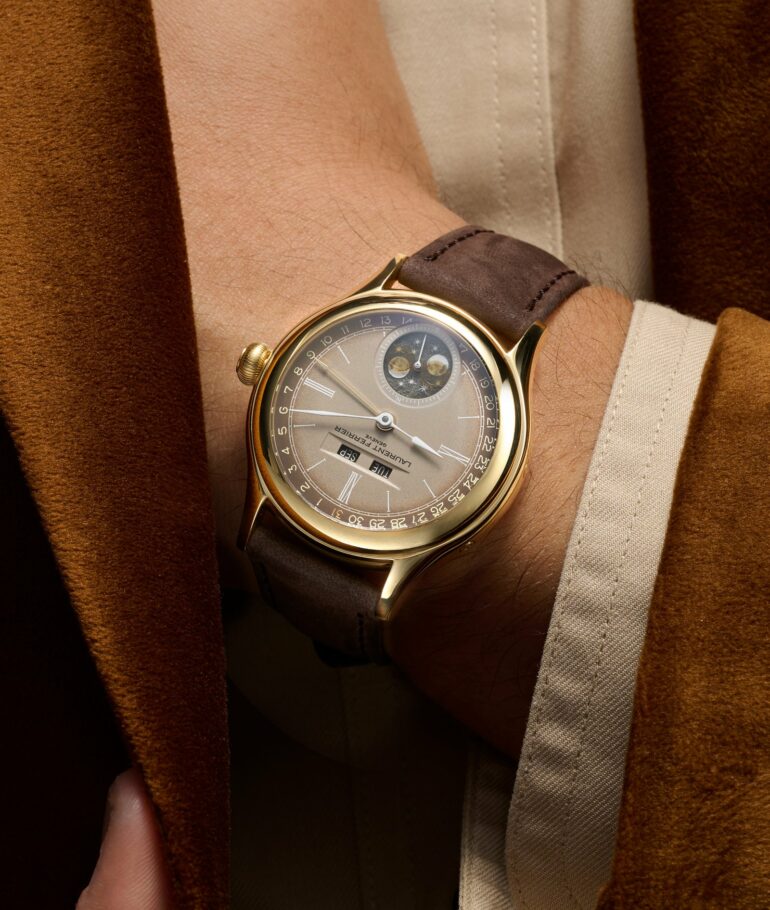
The first striking feature of this edition is the choice of material. For the first time in this series, the case is crafted from 18-karat yellow gold. This metal, long overshadowed by the coolness of steel or the softness of rose gold, regains its prestige here by serving as the physical embodiment of the sunset metaphor. The hue of yellow gold, particularly vibrant in low-angle light, highlights the distinctive silhouette of the brand’s creations: the “pebble” case.
Measuring 40 mm in diameter and 12.9 mm thick, this case eschews sharp angles. Inspired by 19th-century pocket watches, the design emphasizes organic curves and a smooth texture that seems to have been polished by the passage of time. The “ball”-shaped crown—a discreet yet inseparable signature of the Laurent Ferrier aesthetic—perfectly complements this ergonomic design. The choice of yellow gold is not merely aesthetic; it also reflects a philosophy of rarity and value, placing the timepiece within a classic watchmaking tradition while making a bold visual statement on the wrist.
The balance of proportions is crucial here. Despite the complexity of the movement it houses, the case retains a remarkable visual delicacy. This ability to conceal the technical complexity behind apparent simplicity is the hallmark of niche haute horlogerie, where luxury lies not in ostentation, but in the precision of the lines and the fluidity of the curves.
The Smoked Dial: A Gradient of Earth and Light
Beneath the domed sapphire crystal, the Classic Moon Dusk’s dial unfolds a highly subtle chromatic composition. The center, in a sandblasted taupe tone, gradually darkens toward the periphery, reaching chocolate-brown shades—almost licorice-like. This “smoked” finish, far from being a mere decorative artifice, evokes the onset of darkness. The slightly grainy or speckled texture prevents the dial from appearing too flat, capturing light irregularly to add depth to the display.
The annual calendar information is arranged with a precision that borders on minimalism. Two horizontal windows located just below the 12 o’clock hour marker indicate the day of the week and the month. The date, meanwhile, is displayed by a slender central hand whose gold tip hovers over a peripheral scale. With its brilliance and delicacy, this hand resembles the last ray of sunlight piercing the horizon—a touch of bright light in the midst of a dial that leans toward darkness.
Also featured are the yellow gold “Sagaie” hands, which glide over the teardrop-shaped hour markers, creating a cohesive whole where every element seems to have been shaped by the pursuit of soothing visual harmony. The choice of a mocha-colored nubuck strap extends this sensory experience, offering a soft, matte texture that contrasts with the mirror-polished finish of the case.
The Artistry of Openwork for the Moon Phases
The major innovation of this Atelier Series, however, lies in the presentation of its signature complication: the moon phase. Located at 6 o’clock, the moon phase disc does more than simply display the moon. It employs an extremely complex enameling technique rarely seen in men’s watches: plique-à-jour.
Unlike traditional enamel, where the material is applied to a metal base, plique-à-jour involves applying the enamel into the cells of a metal frame that has no bottom. The result is a transparency similar to that of a stained-glass window. For the Classic Moon Dusk, Laurent Ferrier opted for an anise-yellow enamel. This translucent disc covers the two moons (representing the northern and southern hemispheres, marked by the letters N and S) engraved on a golden-hued obsidian disc. When light passes through the enamel, it reveals the celestial body with a depth and organic luminosity impossible to achieve with simple tinted glass.
This technique requires absolute mastery of firing and polishing, as the absence of a base makes the material extremely fragile. This choice demonstrates the brand’s commitment to fusing the most demanding artistic crafts with precision mechanics. The moon thus appears to float in a misty halo, perfectly in tune with the piece’s twilight theme.

A Precision Movement: The LF126.02 Caliber
At the heart of this timepiece is the hand-wound in-house Caliber LF126.02. Visible through a transparent case back, this movement is a delight for connoisseurs of traditional finishes. The bridges, adorned with impeccable Côtes de Genève, feature hand-polished recessed angles, reflecting a level of craftsmanship that only very limited production allows.
Technically, this movement offers a generous power reserve of 80 hours. Most importantly, it features a full annual calendar. This complication is one of the most prized by collectors for its everyday practicality: it automatically accounts for months with 30 and 31 days. The only manual adjustment required is once a year, at the end of February. The seconds display is superimposed on the moon phase disc at 6 o’clock, while a power reserve indicator is cleverly positioned on the movement side so as not to disrupt the dial’s serenity.
The balance wheel beats at 21,600 vibrations per hour, ensuring stable accuracy, while the date and moon phases are set via correctors integrated into the case middle, thus preserving the purity of the roller-style case’s lines.
Exclusivity and Market Positioning
Like all timepieces in the Atelier Series, the Classic Moon Dusk will be produced in an extremely limited run of just 20 numbered pieces. This rarity, combined with the use of yellow gold and artisanal techniques such as plique-à-jour, justifies a price tag of approximately 93,000 CHF (approximately 98,000 euros, depending on taxes). This represents a significant increase compared to previous models made of steel or even rose gold, which can be attributed to the greater complexity of the dial and the volatility of precious metal prices.
However, in the world of collectible fine watchmaking, this difference of 5,000 to 6,000 euros is not the deciding factor. The buyer of such a piece seeks above all a signature style, an aesthetic experience, and the assurance of owning an object that few others will see on their wrist. The Classic Moon Dusk is designed for those who prefer the whisper of a poetic complication to the clamour of more contemporary designs. By capturing the fleeting moment when day gives way to night, Laurent Ferrier has created a mature masterpiece, where technical prowess takes a back seat to contemplation.