
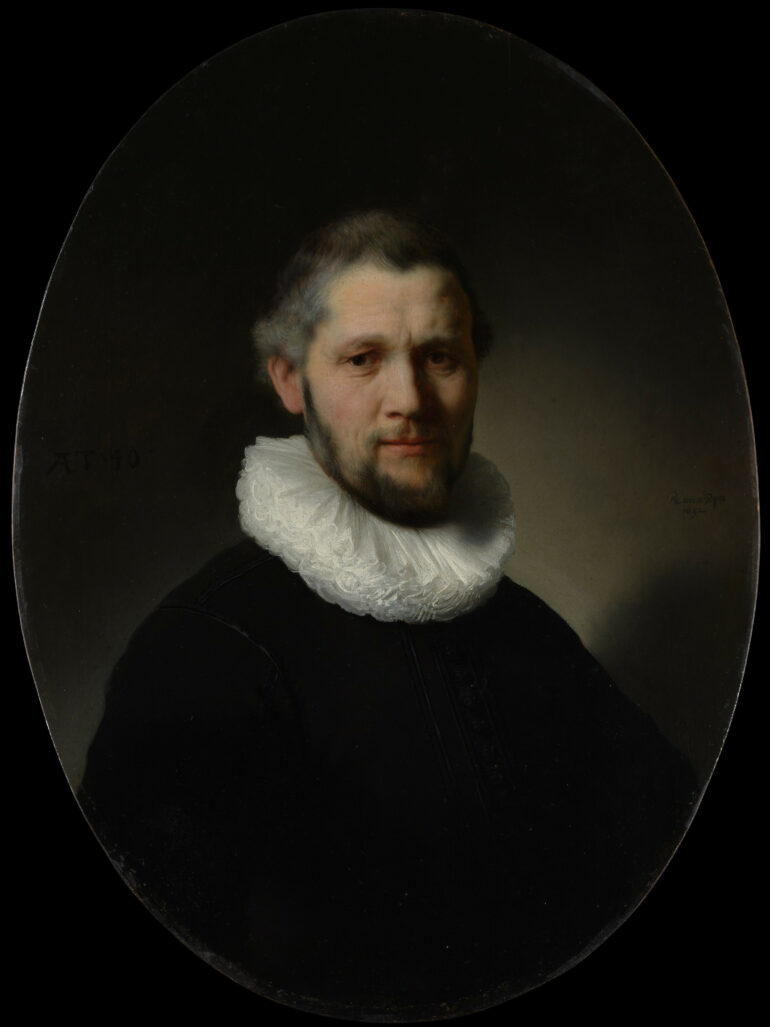
The moment of suspense in a masterpiece
The art world is full of silences that speak volumes. Currently, in the hushed corridors of British expert circles and government ministries, a work by Rembrandt is the subject of almost religious attention. It is not only its artistic quality that is stirring up the inner circles, but its administrative fate. The portrait of Catrina Hooghsaet, a masterful canvas by the Dutch master, has just been met with a radical decision: a temporary ban on leaving British territory, more commonly known as an “export bar.” This mechanism, a sort of cultural veto, halts the painting’s journey to distant collections and temporarily freezes a transaction involving staggering sums.
When a work of this significance is sold, it often leaves the public sphere to disappear into the shadows of vaults or private galleries. But in this case, the British government has decided to intervene. This forced pause is not a mere bureaucratic formality; it is a showdown between free-market forces and the preservation of national heritage. The painting now finds itself in a gilded waiting room, while authorities determine whether a national institution or a local patron can match the sale price to keep the work on British soil.
A staggering figure: $97 million
The transaction amount, which totals $97 million, immediately places this portrait in the stratosphere of the Old Masters market. This figure is not merely a measure of Rembrandt’s artistic value; it acts as a nearly insurmountable barrier for most public museums. Raising such a sum within a set timeframe is a logistical and financial feat. For curators, this amount represents both a tribute to the work’s visual power and a titanic obstacle to keeping it in the public domain.
This record valuation underscores the persistent scarcity of Rembrandt works of this caliber on the private market. Every time such a piece appears, it sends shockwaves through the market that redefine benchmark prices. At $97 million, the portrait of Catrina Hooghsaet is not merely an object of admiration; it becomes a premier financial asset, scrutinized by investors as much as by art historians. This tension between price and historical value lies at the heart of the current controversy.
Behind the Scenes of a Low-Key Sale
Christie’s orchestrated this complex sale. Unlike spectacular public auctions, this transaction took place behind the scenes as a “private sale.” This approach, favored by high-profile collectors, avoids immediate media exposure while ensuring surgical precision in negotiations. The role of the intermediary is crucial here: it involves navigating between the demands of an often international buyer and the legal constraints of a country protective of its cultural treasures.
However, despite the secrecy surrounding these negotiations, whispers are circulating. In the art salons of London and New York, people are wondering about the seller’s identity. Who would part with such a Rembrandt? Speculation is rife, fueling gossip in both high society and the art world. This air of mystery is an integral part of the high-end art market, where anonymity is a currency as valuable as the dollar. The seller, hidden behind the screen of contractual confidentiality, remains for now a mysterious figure, whose motives and identity are the subject of all manner of conjecture.
Catrina Hooghsaet as seen by Rembrandt
Beyond the millions and the legal proceedings lies the presence of Catrina Hooghsaet. In 1657, when he painted this portrait, Rembrandt captured far more than just a face. He captured the soul of a woman from Amsterdam’s bourgeoisie, known for her independent spirit. The master plays with light—that famous chiaroscuro that seems to emanate from the very flesh of the model. The detail of the lace, the depth of her gaze, the texture of the fabrics: everything comes together to make this canvas a masterpiece from the artist’s mature period.
It is precisely this exceptional aesthetic quality that prompted the imposition of the export bar. The committee of experts tasked with advising the British government determined that the painting had such a close connection to art history and the national collections that its permanent removal would constitute an irreparable loss. The portrait is no longer merely an image; it has become a fragment of British history through its prolonged presence on British soil, and its sale serves as a wake-up call for cultural authorities.
How the export ban works: a battle for cultural heritage
The export bar system is a uniquely British feature that fascinates the global market. It is not a confiscation, but a reprieve. The government gives domestic institutions a few months to try to raise the necessary funds. If a museum manages to raise the full $97 million, the seller is obligated to transfer the work to it. If no one steps forward, the export license is granted, and the Rembrandt can leave the country to join its new owner, likely across the Atlantic or in Asia.
This mechanism highlights the fragility of cultural policies in the face of the power of private capital. Every time such a decision is made, it triggers a race against time. Fundraising campaigns become veritable national sagas, appealing to the generosity of major donors and relying on public funds. For the portrait of Catrina Hooghsaet, the stakes are high: the amount is so large that it could well be one of the most daunting challenges ever faced by institutions in the United Kingdom.
An Uncertain Outcome in a Globalized Market
The painting’s future currently hangs in the balance, awaiting a financial decision. The art market is closely watching this period of uncertainty. On one hand, the foreign buyer is waiting to take possession of the artwork; on the other, defenders of British cultural heritage are searching for a miracle solution. This situation illustrates the new reality of historical masterpieces: they are citizens of the world, yet their territorial roots are fiercely defended by nation-states.
The fate of this Rembrandt will be decided in the coming months. Whatever the outcome, the portrait of Catrina Hooghsaet will have once again proven that art, when it reaches such heights of perfection and value, ceases to be a mere matter of taste and becomes a major geopolitical and economic issue. The painting waits, motionless, in the spotlight of a news story that extends far beyond the confines of the canvas itself.