
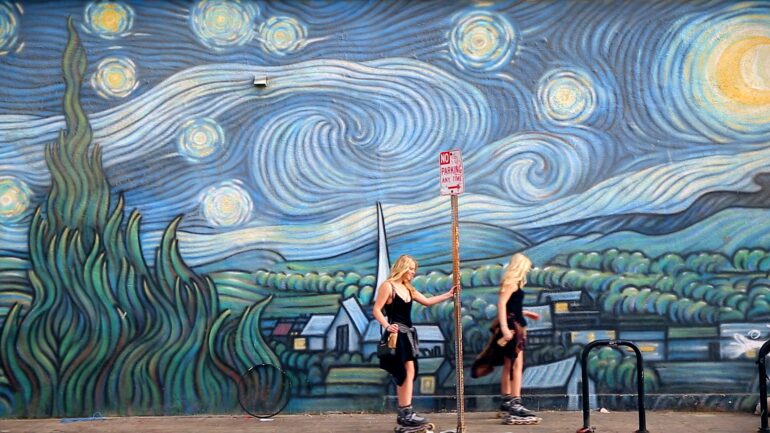
For anyone who grew up in the vertical corridors of London, the concentric districts of Paris, or the meticulously planned layout of Tokyo, arriving in Los Angeles invariably induces a sense of horizontal vertigo. The visitor’s first instinct is a desperate quest: to find the center. We look for an epicenter, a rallying point, a market square where the city’s pulse beats stronger than anywhere else. We eventually come to understand—often after a day of wandering through this patchwork of intertwined cultures—that this center does not exist. And it is precisely in this absence of a core, in this embraced fragmentation, that the strength of a city that no longer apologizes for being what it is lies today.
The End of the Inferiority Complex
Not so long ago, in the 1990s and at the dawn of the new millennium, Los Angeles suffered from a chronic lack of confidence. Despite its global influence through the entertainment industry, the city seemed incapable of defining its own cultural narrative. New York remained the must-visit destination for contemporary art, while European metropolises set the standards for gastronomy, fashion, and design. Los Angeles was a dream factory, but it struggled to be taken seriously as a capital of the art of living. That era of doubt is now a thing of the past.
The paradigm shift is complete. The city has matured, become denser in some areas, and, above all, learned to celebrate its nuances. The art scene is the most striking testament to this. In the Arts District, institutions like Night Gallery have developed programs of rare ambition, attracting the attention of the most discerning collectors. Further west, the trans-Pacific dialogue has intensified. The work of Nonaka-Hill and Gallery Castle, which highlights postwar Japanese artists, demonstrates that Los Angeles has become a pivotal platform between Asia and the West—a crossroads where new aesthetic hierarchies are taking shape.
A Cuisine of Legitimacy
This maturity is just as evident on the plate. The days when Los Angeles cuisine was reduced to kale salads and detox juices are long gone. Restaurants like n/naka and Osteria Mozza have settled the debate: Los Angeles now holds its own among the world’s great culinary capitals. This recognition wasn’t achieved by mimicking the styles of other places, but by harnessing the unique richness of its local terroir and its diverse communities.
The city offers a rare luxury: the ability to traverse several worlds in a single day. You can immerse yourself in the nighttime steam of Koreatown’s spas, savor the delicacy of a Taiwanese pastry, sit down at a Chinese seafood restaurant, or stop at a Mexican street vendor’s stand to discover what many consider the very essence of local cuisine. This diversity isn’t just window dressing; it’s the common thread that connects the art scene, nightlife, and creative communities. It’s a city to be experienced through improvisation, a constant flow where contrasts don’t clash but coexist with disconcerting ease.
Urban Rhythms and Rituals
To get to know Los Angeles, you have to embrace its rhythm—that slow, sometimes meandering “flow.” The ideal day often begins where nature reclaims its place: Griffith Park. It’s the recommended starting point, before the afternoon heat sets in and makes the air still. After a walk in the hills, the must-do morning stop is at Go Get Em Tiger on Hillhurst Avenue, for a coffee to fuel your exploration of the surrounding neighborhoods. Each neighborhood, from Los Feliz to Larchmont Village, tells a different story—an alternative take on what it means to live here.
The city’s very architecture invites this exploration from within. In the Arts District, an evening can stretch out on the patio at Bestia, where industrial energy blends with laid-back sophistication. It’s this ability to transform once-neglected areas into hubs of creativity that makes Los Angeles a permanent laboratory for architects and designers.
The Cult of the Object and the Long Term
In this forward-looking city, certain places serve as anchors in time. In Atwater Village, the Tam O’Shanter preserves an almost timeless atmosphere. Since 1922, its dark wooden benches have welcomed those seeking a slice of history in a constantly changing metropolis. In contrast to this classicism, yet with an equally radical standard, Found Oyster offers a modern take on the oyster bar, where natural wines pair with ingredients of absolute freshness.
This pursuit of excellence is reflected in the city’s almost museum-like relationship with design and objects. JF Chen’s cavernous warehouse on Highland Avenue houses antiques whose quality rivals that of the greatest institutions, while lovers of fine stationery and minimalist aesthetics gather at Hightide. These spots are not just stores; they are repositories of good taste that bear witness to the richness of the local creative communities.
Los Angeles no longer needs to be defended or even explained. It offers itself to those who embrace its excess, its contradictions, and its unexpected generosity. From the shores of Santa Monica to the hills of Highland Park, the city unfolds like a promise of freedom for anyone willing to let go of traditional reference points and instead let themselves be carried along by its perpetual motion.