
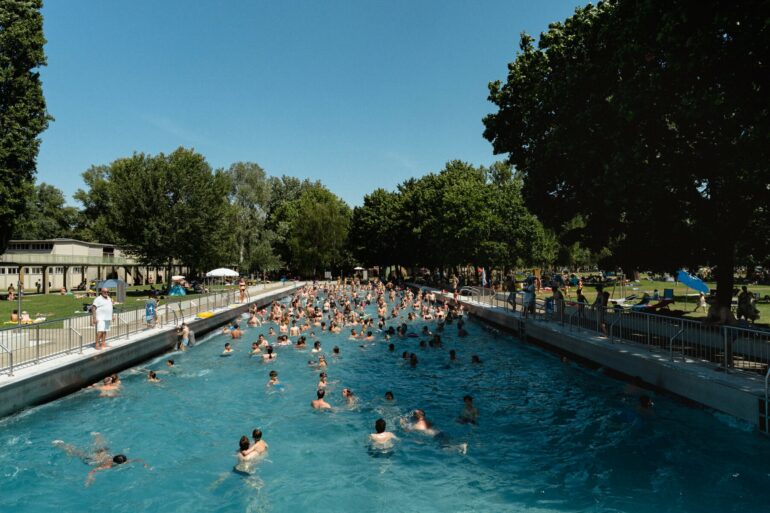
The Call of the Danube: A Deep Dive into Viennese Aquatic Sociology
In Vienna, the arrival of warmer weather isn’t just marked by the opening of the terraces in the First District, but by a silent, rhythmic migration toward the Danube’s branches. For those settling into the Austrian capital, the true rite of passage into citizenship doesn’t take place in the concert halls of the Musikverein, but in the early morning, on the banks of the Untere Alte Donau. There, in the low light of dawn, the ritual of swimming becomes a key to understanding the city, revealing a society that has turned its river into an open-air living room, a gym, and a political laboratory.
The journey often begins at the Donaustadtbrücke station. As you step out of the subway car after a twenty-minute ride, you leave the urban concrete behind for a landscape of reeds and winding paths lined with wooden cabins. It is here, at the Badeareal an der Promenade, that you’ll encounter the long-time regulars. The scene is like a well-rehearsed dance: swimmers of a certain age, with their unflappable breaststroke, share the water with local figures, such as the gray-haired septuagenarian whose mastery of stand-up paddleboarding commands respect. On the wooden docks jutting out over the calm water, the student crowd takes over, transforming the sun-warmed planks into a stage for flirting and cramming for exams—where people polish their tans just as much as they do their social media profiles.
The Architecture of Leisure: From Modernism to Imperialism
If swimming in Vienna is an art, it has its temples. The most iconic of these is undoubtedly the Strandbad Gänsehäufel, affectionately nicknamed the “Lido of Goose Island.” This complex is not just a place to relax; it’s an architectural manifesto. Rebuilt in the late 1940s by the architectural trio of Max Fellerer, Carl Appel, and Eugen Wörle, it embodies modernist aesthetics applied to popular leisure. Along two kilometers of meticulously maintained beaches, people of all ages mingle between the volleyball courts and the tree-top adventure park. People come here for the day, enjoy schnitzel sandwiches, and marvel at the municipality’s almost obsessive vigilance—twice a month, they clear away algae and underwater vegetation to ensure the water remains crystal clear.
For a more intimate experience—almost aristocratic in its rigor—head to the Bundesbad Alte Donau. Formerly a military swimming school, this site is now a listed historic landmark and belongs to the Republic of Austria. Monica Titton, who teaches fashion history and theory at the University of Applied Arts in Vienna, considers it her ultimate refuge. The architecture blends elegantly and discreetly into the landscape. Here, the restaurant’s white wire-frame chairs and the immaculate terrace evoke an era when swimming was as much a discipline as it was a pleasure. The water seems livelier and fresher here, and, according to regulars, the maintenance is impeccable.
The tablecloth and the rowboat: the art of living by the water
The closer you get to the Alte Donau station, the more vibrant and lively the atmosphere becomes. Here, the picnic culture reigns supreme. Coolers are overflowing with fresh cherries, and those who’ve forgotten their provisions find themselves at the restaurant Das Bootshaus. The restaurant is a local institution run by the Querfeld family, a Viennese culinary dynasty that also owns the famous Café Landtmann and Café Museum, whose original design was created by Adolf Loos. The connection to the water isn’t just about the view: the family’s sons are elite rowers, trained at the nearby rowing club. Here, we order a Hugo spritz and fried calamari, watching the ballet of platform boats equipped with palm-shaped umbrellas or the more traditional pedal boats venturing out onto the canal.
This culture of water recreation extends right up to the doors of international institutions. At the Kaiserwasser, in the shadow of the towers of the Vienna International Centre, UN officials slip away between meetings for a refreshing swim. It is this immediate proximity to the water that defines the everyday luxury of the Viennese. For those seeking a complete escape, the train takes them to Bad Vöslau, a spa town whose aesthetic seems straight out of a Wes Anderson film, and which has been attracting spa-goers since the 1820s.
From Wild Rebellion to Urban Resilience
In contrast to this structured setting, the Donauinsel embodies the city’s wild and untamed side. This artificial island, created in the 1980s to protect Vienna from flooding, has become a sanctuary of freedom. Here, there are no rental lounge chairs or umbrellas: you dive right in from the riverbanks, making your way through the reeds. With its 1.8 million trees, the island is the green lung and beating heart of Vienna’s nightlife, hosting impromptu parties under the canopy of the forest. Further north, toward Floridsdorf, on the Neue Donau, naturists find a private space to practice the “culture of the free body” so dear to Central Europe.
Even imperial history plays a part in this passion for water. At the Schönbrunner Bad, located on the heights above the imperial palace, you can swim where Emperor Franz Joseph had his own pool installed. Sipping coffee on the lawn, in the very spot where the court once spent its summers, lends the morning swim an almost solemn air—provided you arrive before noon, when the sun and the crowds transform the place into a more conventional swimming pool.
Yet this abundance is not enough for some committed citizens who are advocating for an even greater integration of swimming into the very heart of the city. Groups such as the Schwimmverein Donaukanal (Danube Canal Swimming Association) champion a political vision for urban water. Ana Mumladze Detering, co-founder of the movement, advocates for wastewater management and flood prevention systems to be reimagined as multi-purpose spaces capable of bringing vitality and refreshment right in the heart of the city. According to her, while Vienna already excels at managing its waterways, the climate emergency makes it imperative to make swimming a common and accessible part of daily life. Through the Swimmable Cities platform, these activists are shaping the future of a resilient metropolis where the river is no longer just a backdrop, but a bulwark against the heat and a catalyst for social connection. Until these projects come to fruition, the people of Vienna continue to tend to their aquatic garden, balancing respect for imperial traditions with a taste for resolutely contemporary freedom.